
Discover the 50-year legacy of the Fiat 147 and the revolution of the alcohol engine


Half a century has passed since Brazilian streets saw one of the most emblematic automobiles in our industrial history, a vehicle that would forever change the way the country views mobility. The Italian automaker’s compact divided the public right away: some drivers questioned its initial robustness compared to competitors at the time, while another segment celebrated its perfect agility for urban traffic and fuel economy. Leaving passions aside, the undeniable fact is that this model inaugurated the manufacturer’s operations in the national territory, bringing unprecedented engineering solutions that forced the entire sector to modernize quickly so as not to be left behind.
Technical innovations presented during the official debut in Minas Gerais
The official presentation took place in 1976, with the historical hillsides of the city of Ouro Preto as a backdrop, a poetic contrast between the colonial past and the future of engineering. To surprise the market, the vehicle arrived equipped with an engine installed in a transverse position, a true rarity at the time that allowed for a smaller engine compartment and much more legroom for passengers. Furthermore, the project adopted radial tires as standard and a windshield made of laminated glass, implementations that were not mere luxuries, but direct advances in occupant safety. Still in that debut year, during the popular São Paulo Motor Show, the company gave a glimpse of the future by displaying an experimental prototype that already ran on fuel extracted from sugar cane.
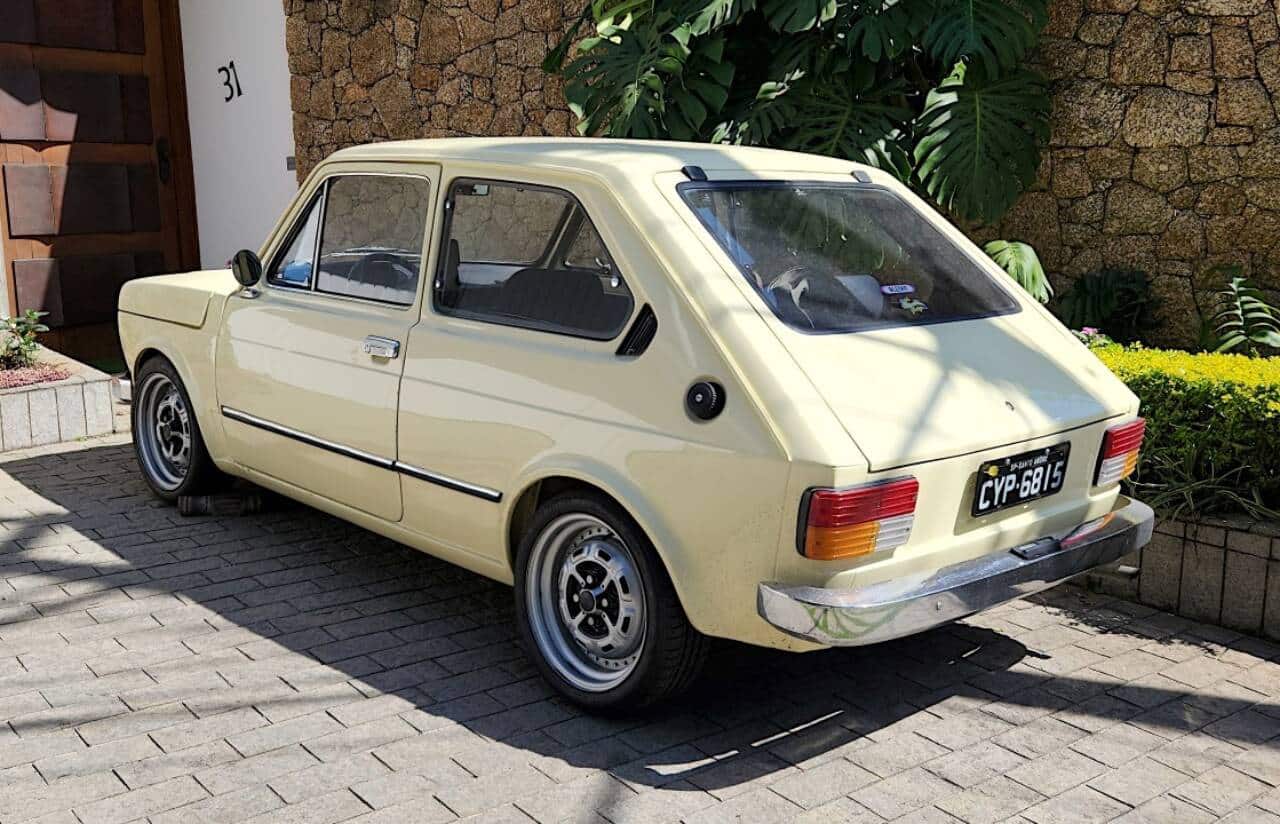
The emergence of the famous Cachacinha and the transformation of the energy matrix
The real watershed in the model’s trajectory occurred in 1979, a time when the world was still suffering from the severe oil shocks that drastically increased the price of gasoline and threatened the global economy. In response to this crisis scenario and driven by the Proálcool government program, the compact became the first car on the planet manufactured on a large scale to run exclusively on ethanol. Affectionately nicknamed Cachacinha by consumers, due to the sweet and characteristic smell that came from the exhaust, the car had a 1.3 engine capable of delivering 62 horsepower, proving that it was possible to combine performance with a clean, locally produced energy matrix.
This technological audacity not only solved an urgent economic problem of that decade, but planted the structural seed for the absolute dominance of flexible engines that we see in dealerships across the country today. The relevance of this initial bet is so profound that ethanol continues to be the protagonist of decarbonization strategies in Brazil, serving as a fundamental basis for modern hybrid systems that combine electric batteries with traditional vegetable fuel, showing that the 1979 vision was decades ahead of its time.
Structural modifications carried out to support Brazilian roads
The basis of the project was born in Europe under the name Fiat 127, a sales success on the old continent, however, bringing the car directly here without adaptations would be a fatal mistake due to the precarious conditions of our asphalt and dirt roads. Engineers had to severely reinforce the suspension, change vital mechanical components and make visual adjustments to ensure the durability demanded by local drivers, who were used to carrying a lot of weight. Measuring exactly 3.63 meters from tip to tip, the debut version arrived in stores boasting a powerful 1,050 gasoline engine, producing 50 horsepower. Two years later, in 1978, the catalog grew with the introduction of a 1.3 gasoline variant, which increased performance to 61 horsepower and brought more breath to overtaking.
Creating a complete line of derivatives from a single platform
Another fundamental milestone of this project was the capacity for diversification, something practically unheard of for the national industry until that moment, which used to create exclusive platforms for each type of body. The compact served as a kind of blank canvas for the automaker to develop an entire family of utility vehicles and passenger cars, serving different profiles of workers, young people and large families with an optimized production cost.
- Variants with a sporty appeal, commercially called Rallye and TR, focused on attracting a young audience with side stripes, auxiliary headlights and exclusive details on the dashboard.
- Deep aesthetic updates to the front and rear that culminated in the launch of the sophisticated Spazio line, offering a more premium finish.
- A light pickup truck aimed at heavy work in cities, which later inherited the famous and lasting Fiorino baptism.
- The closed van for transporting cargo and urban deliveries, a hugely successful concept that survives to this day on the brand’s more modern platforms.
- The spacious Panorama station wagon, designed with a raised roof at the rear to accommodate larger family luggage during holiday trips.
- The Oggi sedan, which offered a generous trunk and straight lines to compete directly in the compact three-box vehicle category.
The closure of the assembly line and the passing of the baton in the eighties
The pioneer’s life cycle bravely extended until 1987, accumulating hundreds of thousands of units sold and definitively consolidating the Italian brand in the hearts and garages of Brazilians. Its departure from the assembly lines was gradual and planned, serving to prepare the dealerships’ ground for the arrival of its natural replacement, the Fiat Uno, which had debuted with enormous critical and public success in 1984. The transition marked the end of a romantic era of national automotive engineering, but left an undeniable legacy of innovation, space efficiency and energy courage that forever changed the way the country produces and supplies its vehicle fleet.





