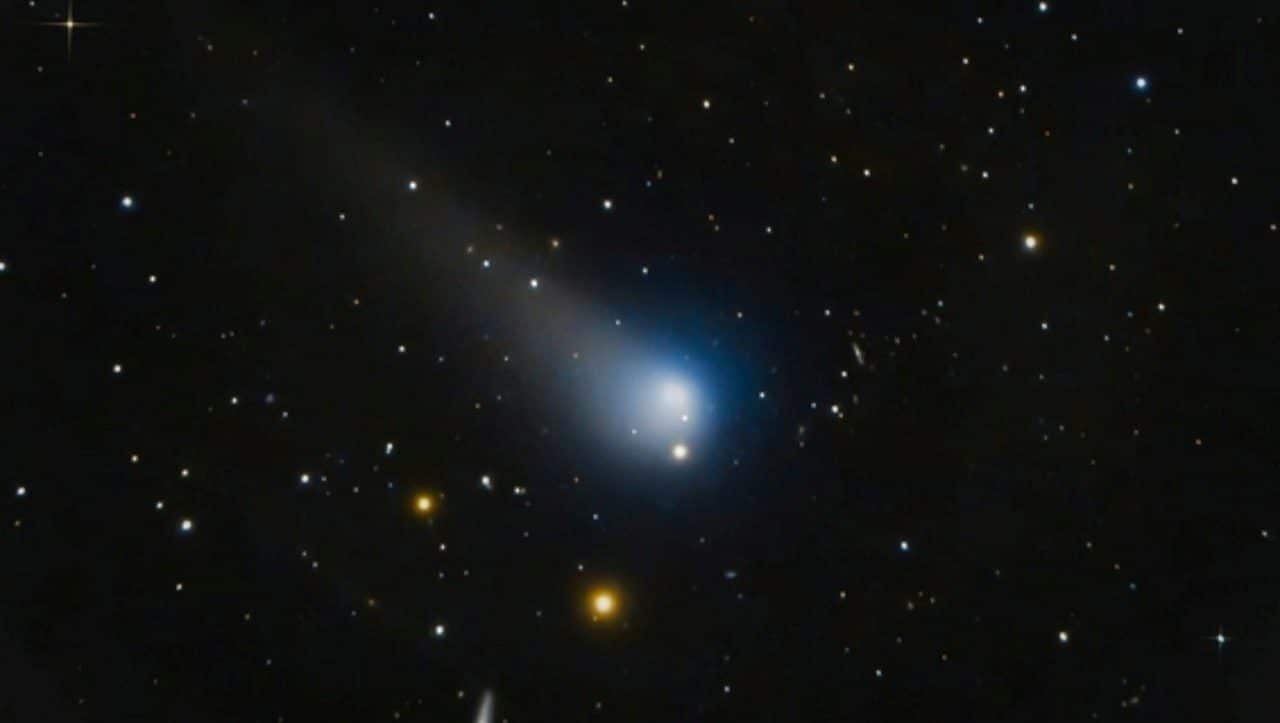
Astronomy lovers have a special reason to wake up early this April 2026, thanks to the approach of comet C/2025 R3 (PanSTARRS). Since the 8th, this celestial body composed of dust and ice appears on the horizon just before dawn, creating a very short viewing window. Anyone who wants to follow the passage of this ancient space traveler needs to race against time, as the Sun’s brightness will soon completely overshadow the phenomenon in the morning sky.
Distant origin turns C/2025 R3 into a scientific relic
Initially identified in September 2025 by researchers at the Hawaiian observatory Pan-STARRS, this celestial body belongs to the long-period category. In practice, this indicates that its trajectory originates in the most remote confines of our system, specifically in the Oort Cloud, an icy region that extends almost a light-year away from the Sun. As its orbit takes thousands of years to complete, witnessing its passage is a privilege of a single generation. Experts treat the object as a true time capsule, as it carries intact building blocks from the time when planets were still forming, something much rarer than the frequent visits of short-period comets.
Science usually classifies these stars as large clumps of ice, rock and cosmic dirt wandering through the vacuum. When this frozen mass approaches solar heat, the sublimation process occurs, transforming the ice immediately into gas and generating the famous luminous tail, as well as a bright cloud called a coma. Studying the structure of PanSTARRS helps astronomers map the chemistry of the early universe, justifying all the effort needed to track such a distant and complex target during the early hours of the morning.
Increase in luminosity bumps into obstacle on the horizon
At this moment, the star registers an apparent magnitude close to +6, a level that requires an environment completely free of urban lights to be noticed with the naked eye. On the astronomical scale, smaller numbers indicate greater light intensity. The good news is that the object should reach its maximum brightness, estimated at magnitude +3, during perihelion — its closest approach to the Sun —, scheduled for April 19 and 20, 2026. With this intensity, comparable to the faintest stars visible in small cities, the use of binoculars will guarantee a much richer visual experience, although direct observation will also become viable.
The big problem with this phase of greater intensity is the unfavorable geometric position that the star assumes in the firmament. As it advances towards our star, the comet loses altitude on the eastern horizon, plunging precisely into the area where the dawn light begins to emerge. In this way, the object’s peak brightness occurs simultaneously with daylight, creating a scenario where solar glare threatens to erase the view of the ice tail. To be successful, the observer will need to find the exact minute of balance between the final darkness of the night and the minimum height of the star in the sky.
Tools and strategies to capture the star’s passage
Ensuring good viewing requires avoiding the light pollution of large cities and seeking rural areas with the east completely free of buildings or mountains. The most suitable equipment for beginners is a pair of binoculars in the 10×50 standard, capable of capturing diffuse light and revealing the characteristic mist shape of the phenomenon. Experienced photographers can rely on cameras set up in manual mode on firm tripods, using long-range lenses, while owners of computerized telescopes will have the advantage of tracking the nucleus with millimeter precision.
Monitoring daily movement requires the support of astronomy software or digital celestial charts, as the apparent trajectory changes every morning. The useful interval for looking up lasts a few minutes, ending drastically as soon as the first rays of sunlight touch the atmosphere. Focusing the search between April 19 and 20 guarantees the chance of seeing the nucleus in its most active phase, as long as the weather cooperates and the horizon is clear.
Step by step so you don’t miss the morning show
- Organization of the time: As the event takes place exclusively in the late hours of the morning, set your alarm well in advance to arrive at the location without rushing.
- Terrain mapping: Prioritize high or open locations where the east direction is not interfered with by public lighting or physical obstacles.
- Optical support: Have your 10×50 binoculars cleaned and adjusted as they are the best value for finding the bright spot before using a telescope.
- Digital Navigation: Keep a stargazing app open in night mode to cross-reference the target’s position with neighboring constellations.
- Visual training: Stay in absolute darkness for about 20 minutes to dilate your pupils, avoiding checking messages on your cell phone during this process.
- Thermal protection: The calm of the early morning drops temperatures quickly, requiring the use of thick coats and gloves to maintain comfort while waiting.
- Continuous focus: Don’t expect to see a line crossing the sky; look for a static, opaque cloud, scanning the same region repeatedly until you identify the contrast.
The visit of C/2025 R3 reinforces the monumental scale of the cosmos and the smallness of our time window in the face of astronomical events of this magnitude. Facing the tiredness and cold of the early hours of the day gives as a prize the sight of a primordial fragment that traveled billions of kilometers just to cross our neighborhood. Taking advantage of these days in April 2026 is the only way to record in memory the passage of this ancient rock, before it returns to the deep darkness of space and disappears forever from our era.