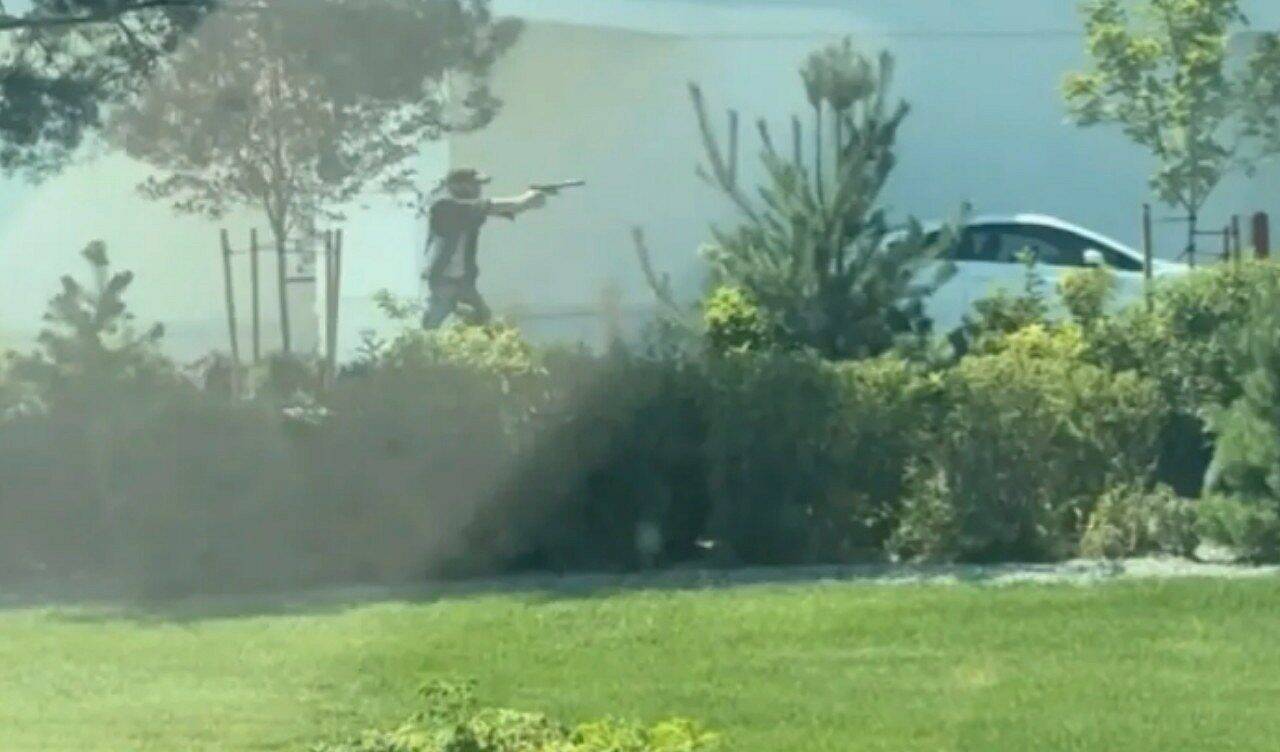
A 35-year-old medical professional, Jordan Salinas gained public recognition for his bravery when confronting 24-year-old Chad Williams, responsible for an armed attack on August 1, 2026. The confrontation took place in the car service area of an In-N-Out unit, located in the state of Idaho. The citizen’s ability to respond was not the result of chance, but the result of a long period of tactical preparation, motivated by a previous trauma involving armed violence.
That morning, the caregiver, who dedicates his days to his wheelchair-bound brother, enjoyed a horse ride alongside his partner. The route included a stop for a meal at a snack bar in the city of Twin Falls. As soon as they approached the commercial establishment, they both noticed a completely unusual movement in the environment.
Dozens of customers left the building in a hurry through the emergency doors. At first, the health professional thought it was a fire starting in the culinary facilities, until characteristic gunshots ripped through the air.
Moved by an immediate reflex, the man advanced in the direction from which the detonations were coming. He would later explain this attitude as an involuntary and trained movement, devoid of conscious hesitation.
Application of military doctrine and use of specialized weaponry during confrontation
To counter the threat, he used an FN Five-Seven model semi-automatic pistol, a high-speed weapon often associated with tactical forces, which was equipped with a silencer. During the approach, the citizen applied a strategic concept known as the OODA Cycle, originally developed by the United States Air Force for decision-making in combat.
- Observe: Immediate collection of information about the environment, the flow of people and the exact position of the attacker.
- Guide: Quick analysis of the scenario based on prior training, identifying the best physical coverage options available.
- Decide: Choose the safest tactic to neutralize the threat without putting innocent lives at risk.
- Act: Executing the advance and firing at the exact moment the shooter became a clear target.
The vehicle was disembarked with the equipment already in hand, ignoring the pleas of his girlfriend who was trying to call him back. Exactly at that moment, a new sequence of shots echoed through the parking lot.
Security camera records captured the man’s cautious advance toward the diner’s main structure. He used In-N-Out’s decorative vegetation and signage totems as physical shields against potential projectiles.
Protected by this makeshift barrier, the caregiver identified Williams positioned near the drive-thru lane. The attacker had just rested a rifle on his shoulder and began a sequence of shots at cars parked in line.
Exchange of fire forces the aggressor to retreat and avoids a greater number of victims
When viewing the scene, visual confirmation was immediate. The health professional later reported that he was absolutely sure that he was responsible for the massacre as soon as he saw the long gun pointed at the cars.
Holding the pistol firmly with both hands, he pulled the trigger. This marked the first occasion in his entire life that he needed to direct his equipment’s aim at a human being.
The criminal’s reaction upon noticing armed resistance was instantaneous. According to the civilian shooter’s report, the attacker showed surprise and discomfort as soon as he realized he was receiving fire in return.
The tactical response came not only from the citizen, but also from a public security agent who was off duty at the scene. Jack Johnson, sheriff in charge of Twin Falls County, confirmed that the criminal found himself trapped by two distinct defense fronts.
Pressured by the armed reaction, the individual left the cafeteria area and fled towards the courtyard of a nearby visitor center. Police authorities testified that, moments later, the man took his own life with a gunshot.
History of violence in a shopping center motivated the caregiver’s tactical preparation
The official report on the tragedy at In-N-Out recorded three deaths and seven injuries. However, investigators on the case were adamant that the body count would have been substantially worse without the coordinated intervention of the civilian and plainclothes police officer.
The head of the local police department classified the pair as fundamental players in preserving order. The sheriff highlighted that their courage broke the criminal’s focus, ensuring the survival of dozens of customers who were in the line of fire.
With the massive arrival of vehicles and tactical teams at the perimeter, the health professional chose to retreat and store his weapons. He understood that the scene now belonged to state agents.
A feeling of accomplishment took over his thoughts as he observed the isolation of the area. He knew that his intervention had achieved the main objective of ceasing active aggression.
The roots of this preparedness date back to 2021, when he survived a similar attack at the Boise Towne Square mall, an event that resulted in two deaths. On that occasion, he noticed a pattern of behavior in criminals, who always look for victims without the ability to defend themselves.
The daily responsibility of caring for a family member with reduced mobility set off a definitive alert in her mind. The certainty that he and his brother would be easy targets in a panic situation was the catalyst for the years of rigorous training that culminated in this month’s decisive action.