
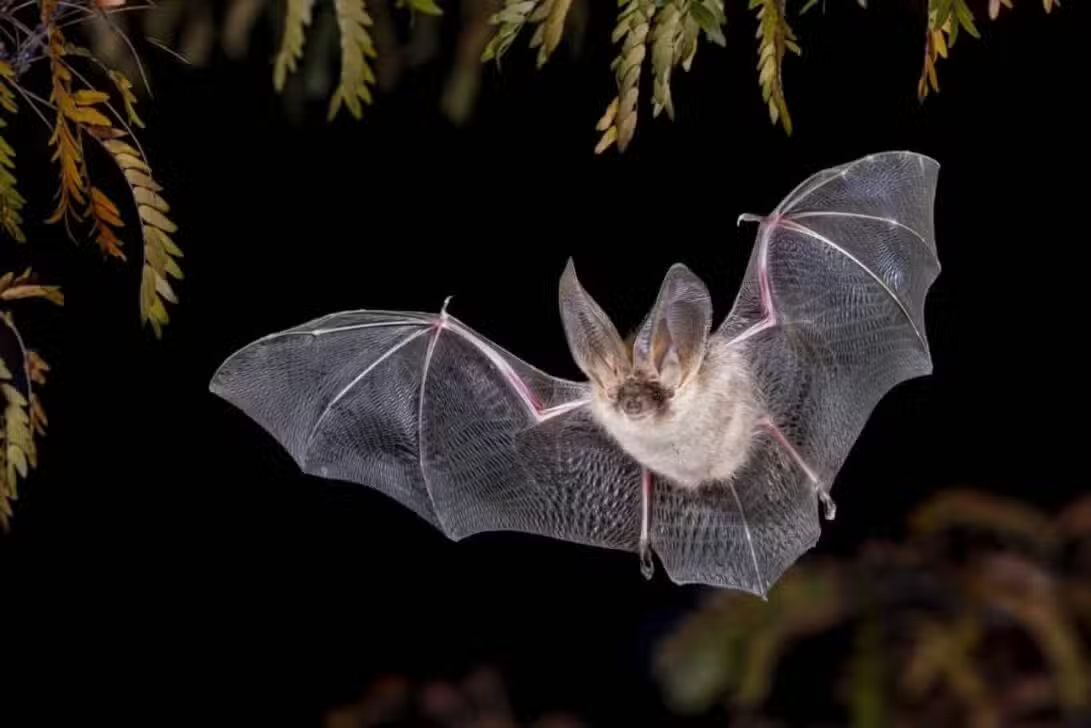
Researchers have discovered a unique dual immune system in evening bats, the largest family of bats in the world. This trait, which involves two separate sets of genes to produce antibody building blocks, may explain these animals’ unusual tolerance to viruses, which are harmless to them but cause serious disease in other species, including humans. The discovery was detailed in a study published in the journal Science Advances.
Unraveling the bat immunological enigma
Bats have long represented a mystery to science because they harbor viruses that trigger severe illnesses in other living beings, while rarely showing any symptoms. This remarkable resistance has driven the search for explanations about its robust defense capacity against pathogens. Recent research offers a significant clue to understanding how these mammals manage to avoid infections that would be lethal to most.
Antibodies are “Y” shaped proteins that play a crucial role in the immune system. They are responsible for identifying and neutralizing external invaders, such as viruses and bacteria, as well as other threats, such as toxins. Each antibody is made up of two “heavy chains” and two “light chains” that help to recognize and bind to specific characteristics of infectious agents, telling the body how it should react to combat them.
Unprecedented defense system found in mammals
The team of researchers examined 26 species of bats and identified two complete heavy chain loci, located on different chromosomes. This finding is surprising because in humans and most other mammals, the genes that build antibody heavy chains are organized in a single region of the genome. The study confirmed that both sets of genes are functional and actively used by bat immune cells to form antibodies.
Hannah Frank, associate professor of ecology and evolutionary biology at Tulane University and co-author of the study, expressed surprise at the discovery. She stated that the only other class of vertebrates where something similar has been observed are fish, which makes the finding in bats an unprecedented evolutionary peculiarity among mammals. Initially, scientists considered that it could be an error in the assembly of bat genomes, but the consistency of the data confirmed the authenticity of the double system.
How the two antibody chains act in protection
Through genetic analyses, the team distinguished the functions of each of the two loci. One of them contains a larger and more diverse collection of genetic segments, which can generate a broad, pre-existing repertoire of antibodies. The other locus, although with fewer building blocks, demonstrated greater dependence on a process called somatic hypermutation, where antibody-producing cells make small genetic changes after contact with a pathogen.
These genetic changes allow antibodies to become more “customizable” to address specific threats to the immune system. Frank compared the bats’ defense system to the different layers of protection seen in the movie “Mulan,” where an initial alarm (innate system) warns of the threat, and a more targeted attack (adaptive system) responds to the specific enemy. Michael Letko, a molecular virologist at Washington State University who was not involved in the study, explained that this extra gene diversity could result in faster, more effective responses from the start of an infection.
Implications of the research for human health
A deeper understanding of bat immunity could open new perspectives for the study of viral infections and the evolution of immunity in general. Daniel Becker, associate professor of biology at the University of Oklahoma, suggested that the duplication seen in evening bats is intriguing and indicates the need for more immunological studies on this globally distributed family of animals.
Researchers hope this knowledge will help predict which types of bats are most likely to affect human health and how to mitigate those risks. Furthermore, Letko pointed out that bats have a remarkably low incidence of tumors and cancer, raising the question of whether their unique immune systems could hold clues for developing new therapies for these diseases in humans.
This study suggests that the bat immune system can generate a “trainable and customizable cache of cells” from each locus, providing a level of personalization that helps combat a broader range of threats than other mammals can. Although the exact mechanism of advantage still needs further study on bats’ exposure to viruses, the discovery is considered a crucial step in unraveling the mystery of their coexistence with pathogens.
- Higher body temperatures, which create an environment less conducive to viral replication at certain stages of infection.
- A greater number of virus-containing packages in stem cells, which may indicate a viral encapsulation or control mechanism.
Hannah Frank emphasized the importance of learning from the evolution of these animals, which have lived with viruses for millions of years, and highlighted the need not to “vilify” them for their ability to survive.