
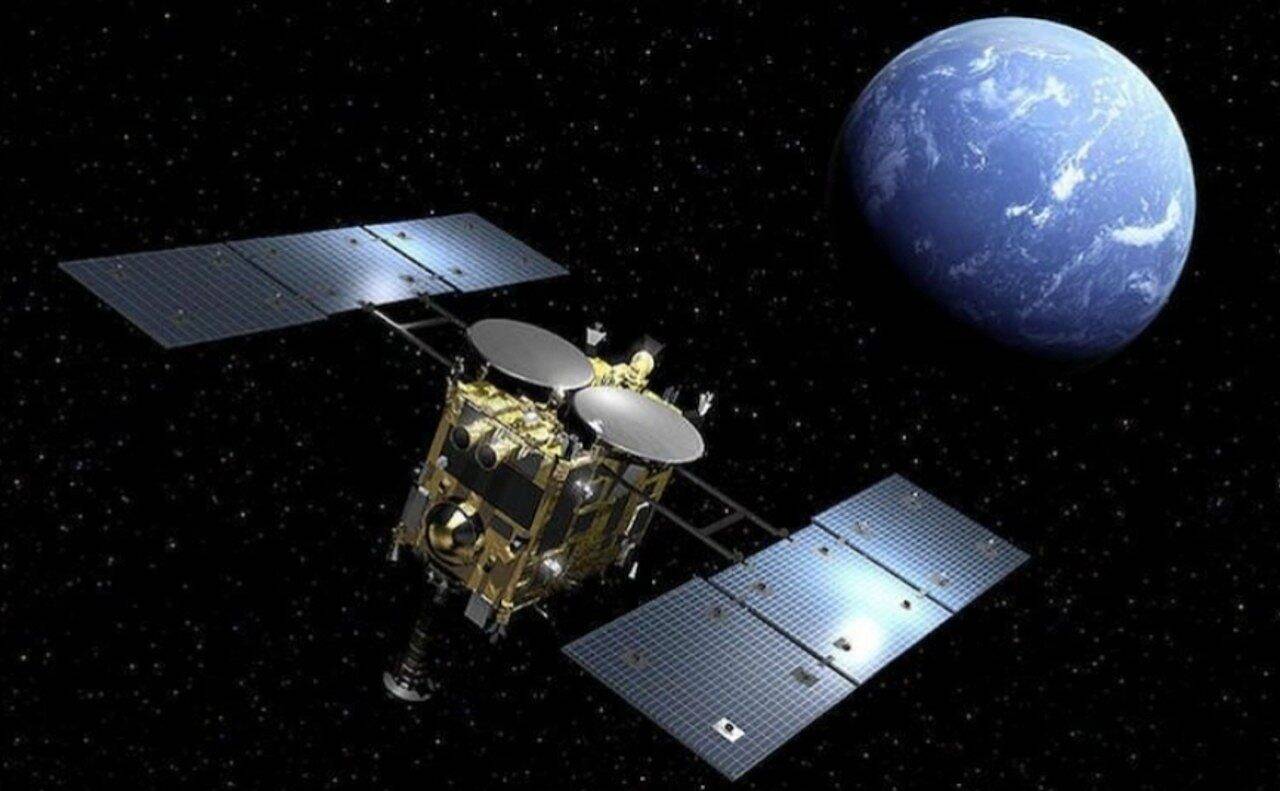
The Hayabusa2 probe, part of a Japanese mission, achieved a feat considered unprecedented on a global scale. On July 5, the spacecraft performed the world’s first LiDAR laser altimeter measurement while flying over the asteroid Trifune. Distances of approximately 20 kilometers and 25 kilometers were recorded, seconds before and after the closest approach, respectively, a success recently announced in a statement.
The spacecraft operated at a relative speed of around 5 kilometers per second in relation to the asteroid, equivalent to approximately 18,000 kilometers per hour. During the approach, Hayabusa2 passed just 744 meters from the center of Trifune, managing to hit the celestial body twice with its laser, as had been calculated for the mission.
Researchers from the Chiba Institute of Technology’s Planetary Exploration Center, involved in developing the instruments, compared the feat to “yabusame” – archery on horseback. They explained that, just as the archer controls the horse to fire the arrow at the exact moment, precise control was required to hit the small asteroid with a laser from a spacecraft at very high speed, demonstrating remarkable accuracy.
This ability to obtain laser telemetry data at multiple times is crucial for accurately determining the positions and velocities of celestial bodies. The advance also paves the way for the observation of stars that are not illuminated by sunlight, known as celestial bodies in shadow. In the future, it is hoped that even more advanced laser irradiation devices will be able to provide detailed information about the size, shape and movement of asteroids.





