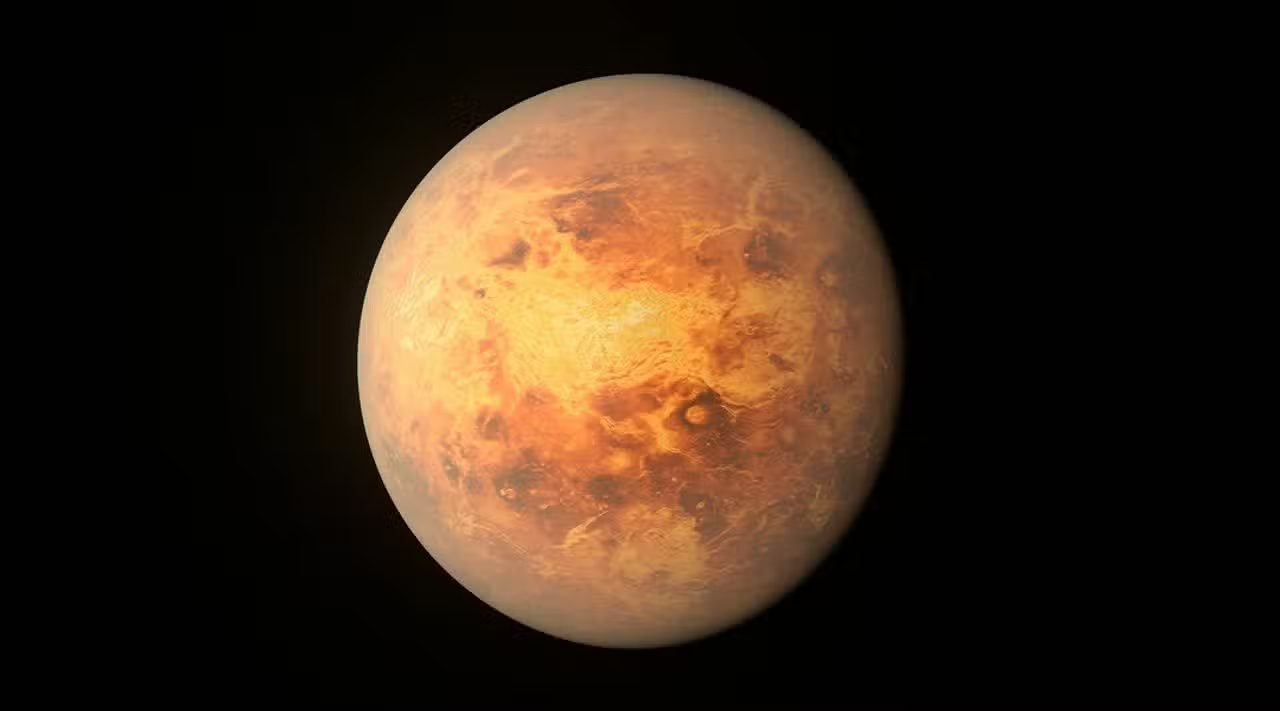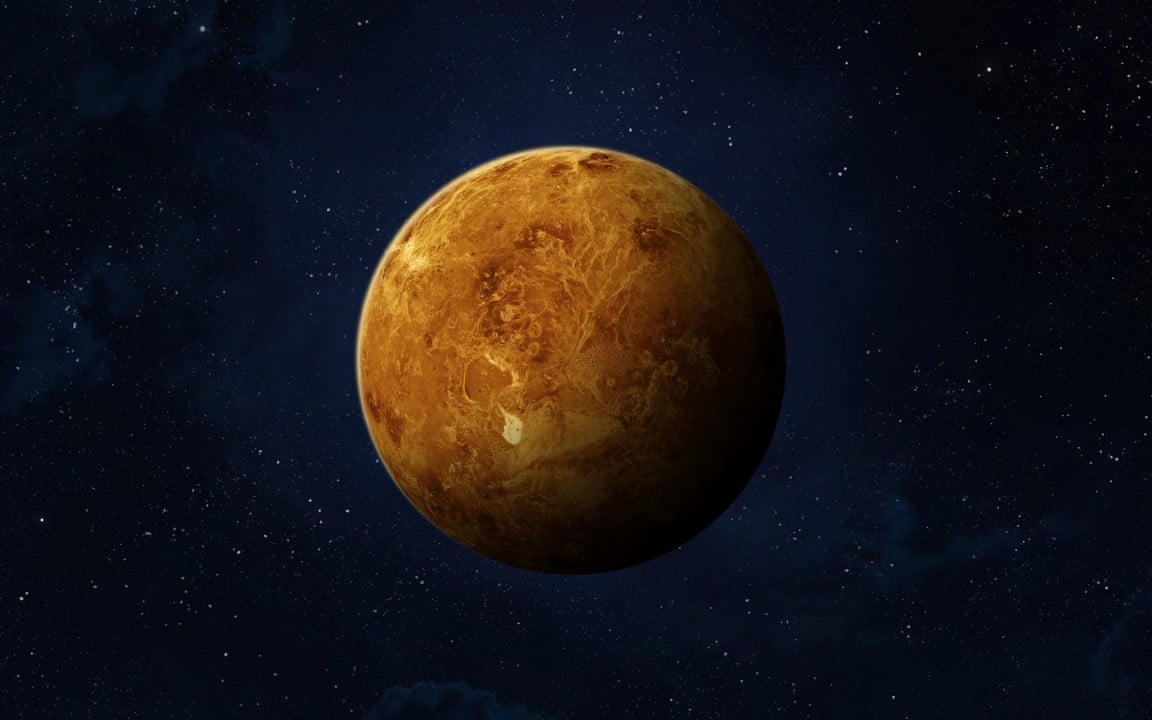
A team of astronomers has identified evidence of unusual and impressive rings that encompass the entire planet Venus, located in its atmosphere, after reexamining observations made more than a decade ago, according to a study published on January 15, 2026.
In 2010, researchers using the William Herschel Telescope, located in the Canary Islands, were observing at night, waiting for the sun to set to focus on dust disks around young stars.
While waiting, the team recorded images of the planet Venus, totaling 36 minutes of observation. As Venus was not the main objective, this data was saved and remained forgotten for more than ten years.
This initial negligence proved to be relevant, as a recent new analysis, conducted by scientists in the Netherlands, revealed the presence of rings that cover the entire planet within the Venusian atmosphere.
The ExPo instrument, attached to the telescope, was fundamental; it measures and filters polarized light, allowing the team to study details of Venus’ atmosphere. Light, when dispersed in dust and gases in the atmosphere, becomes linearly polarized, which offers astronomers valuable information about the planet’s climate.
This particularity of polarized light may have been the key to a serendipitous discovery.
“We report observations of faint (10−6), concentric, planet-wide rings in the polarized stream of sunlight reflected by Venus,” the team wrote in their scientific paper.
The rings appear to be slightly off-center in relation to the subsolar point, being visible in different filters of the visible spectrum, but they do not stand out in observations that measure the total flux of light.
Scientists, however, remain cautious about not confirming the detection of an unprecedented atmospheric phenomenon on Venus, due to the limited number of observations available.
After the planet was accidentally recorded, the ExPo instrument was dismantled, making these the only observations of this possible phenomenon. After the discovery, the team spent years trying to rule out the existence of the rings.
“As these rings had never been observed, our initial suspicion was that it was an instrumental effect, mainly because they appear almost concentric around the most luminous region of Venus’ disk”, the team detailed in the article, mentioning that they investigated possible terrestrial explanations, but without success.
“We were unable to identify any instrument effects that would produce rings in images taken with the Hα, continuous Hα, and Na filters, but not others,” they added.
“We also were unable to find a plausible mechanism by which filter-generated polarization, including narrowband filters, would create the large-scale, spatially cohesive ring pattern that was observed, centered near the subsolar point in Venus’ disk.”
If this discovery is confirmed, it will not be the first time that planetary-scale waves have been recorded on Venus, which adds credibility to the observation. In 2015, the Japan Aerospace Exploration Agency’s (JAXA) Akatsuki probe detected a wave measuring approximately 9,650 kilometers, which extended almost from pole to pole.
Likewise, large gravitational waves were previously identified by instruments on the Pioneer Venus probe, albeit in a preliminary way. At that time, the hypothesis of gravitational waves on a planetary scale that would modify the density of gas in the atmosphere also emerged, but could not be verified. The current team believes that the phenomenon observed now may be similar.
“Our numerical simulations indicate that both the flow and the degree of linear polarization through the disk are influenced mainly by the characteristics of the cloud layer, but that a variation of 5% to 10% in the density of carbon dioxide above the clouds will cause a change in polarization within the sensitivity of ExPo, without altering the brightness of Venus in a detectable way”, explained Gourav Mahapatra, atmospheric physicist at the University of Delft, in the Netherlands, and lead author of the study, in his doctoral thesis.
“Such density waves can be caused by intense irradiation from the subsolar area. Their movement across the planet appears to follow the flow established from the subsolar region to the antisolar region.”
If the existence of these rings and waves is confirmed, researchers believe they could offer an explanation for Venus’ super-rotating atmosphere. While the planet Venus completes a rotation in 243 Earth days, its atmosphere does so in just four days, a phenomenon not yet fully understood. More studies are needed to validate this detection and better understand this intriguing atmospheric phenomenon.