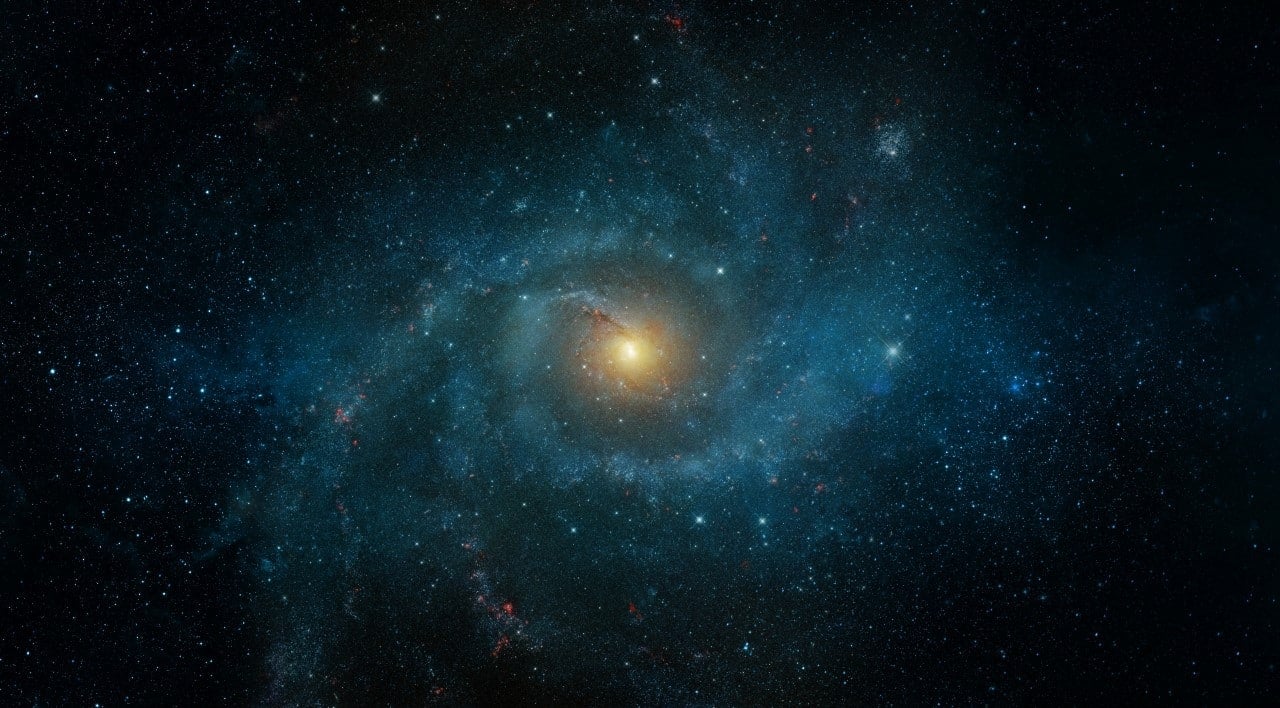
A recent photographic record released by the astrophysics teams of the North American space agency exposes unprecedented details of NGC 5128, popularly known in astronomical catalogs as Centaurus A. Located at a distance of approximately 12 million light years from our planet, the system hosts a chaotic and fascinating scenario where the accelerated birth of stars, dense clusters of interstellar dust and the extreme gravitational force of a supermassive black hole coexist in constant friction.
Positioned in the constellation Centauri, this structure is the fifth brightest galaxy in the night sky visible from Earth and has extreme operating dynamics. Experts classify it in the “starburst” category, a technical term that defines stellar systems that produce new stars at breakneck speed, far surpassing the calm, gradual pattern found in conventional space formations spread across the cosmos.
The detail achieved by this high-resolution visual capture gives researchers a crucial tool for analyzing one of the cosmic neighbors most monitored by modern science. The information extracted from this material allows us to investigate fundamental fronts of observational astrophysics:
- The chronological evolution of galactic structures over the millennia.
- The gravitational and thermal impact of dark cores on adjacent space.
- The structural consequences of colossal collisions in the architecture of the universe.
Marks of an ancient collision shape the system’s peculiar shape
Since its official discovery in 1826 by Scottish astronomer James Dunlop, the shape of this celestial body has intrigued the scientific community because it completely deviates from the classic spiral pattern that defines our Milky Way. A thick and dense band of dark debris crosses the system’s equator, creating an opaque visual barrier that blocks the emission of visible light and hides the violent processes occurring in the formation’s core.
Advanced research indicates that this unusual and distorted morphology was born from a violent collision that occurred in the remote past between two galaxies of different sizes and compositions. The direct impact and merger of these bodies generated a massive accumulation of gaseous material and solid particles, establishing the perfect chemical and physical conditions to trigger the current outbreak of star birth dominating the region.
Hidden at the center of this thick cloud of debris operates a supermassive black hole with a mass estimated at a staggering 55 million times that of our Sun. This highly active gravitational engine expels beams of radiation and subatomic particles that travel thousands of light years, drastically altering the composition of space far beyond the visible edges of the main system.
The exact combination between the ancient clash of two galaxies, the accelerated manufacturing of stars and the uninterrupted fury of an active nucleus makes this place a true astronomical testing ground. Scientists use this extreme and dynamic environment to understand the invisible forces and chain reactions that continue to sculpt the geometry of the cosmos since the Big Bang.
Observation technologies break the cosmic dust barrier
The photographic material processed and published by the space agency’s teams illustrates a celestial body at the height of its structural and chemical metamorphosis. Mapping the internal dynamics of such a close neighbor provides astrophysicists with the practical template needed to decipher identical phenomena occurring in the dark, unexplored reaches of the observable universe.
To be able to see beyond the curtain of debris that divides the galaxy, orbital equipment captures different spectrums of light that human eyes cannot naturally process. The combined use of infrared sensors, X-rays and radio waves makes it possible to pierce the darkness of the central band, revealing with mathematical precision the exact nurseries where newborn stars begin to shine.
Several ground-based telescopes and orbital complexes keep their lenses pointed at this specific target due to the inexhaustible wealth of data that its chaotic core offers daily. Each new spectral scan performed by the agencies delivers additional and crucial pieces to piece together the complex puzzle that links the consumption of dark matter to the evolution of giant stellar systems.
Uninterrupted monitoring funded by large space programs guarantees a constant flow of very high-resolution images to research laboratories around the world. These visual records function in practice as a time machine, allowing academics to read the violent past of the cosmos and accurately predict the fate of other similar galactic formations.
Core feeding dynamics dictate the pace of stellar creation
The system’s gravitational center functions as a cosmic sinkhole of unimaginable proportions that relentlessly attracts any matter that crosses its event horizon. During the fall towards the dark abyss, the gases reach speeds close to that of light and superheat, ejecting highly energized jets of plasma before being completely swallowed by the singularity.
The columns of radiation fired by the black hole’s magnetic poles represent the most impressive and studied visual signature of the entire astronomical ensemble. They tear through intergalactic space for distances that exceed the diameter of the host galaxy, proving conclusively that a single point of extreme gravity can dominate and alter an entire region of the universe.
The colossal energy released by these constant eruptions heats and violently pushes the vast reserves of cold gas floating in the vicinity of the core. This thermal agitation acts as a natural regulator of the system: at the same time as it spreads heavy elements throughout empty space, it defines the exact speed at which the material condenses to form new suns.
Mapping the unpredictable behavior of these plasma jets provides the ultimate key to solving one of the greatest mysteries in modern astrophysics. Detailed analysis of this energetic feedback mechanism explains how supermassive black holes grow in perfect synchronization with the galaxies that host them, dictating the eternal cycle of life and death in deep space.