
Deep-sea explorers find new species with tadpole-shaped tentacles off the coast of California


Although the California coast is one of the best known and recorded in the world, researchers continue to identify previously unseen forms of marine life just a few kilometers from the surface. On August 3, 2026, a new discovery was revealed, highlighting the still unexplored biodiversity.
This year, a team of scientists from the Monterey Bay Aquarium Research Institute (MBARI) revealed the discovery of a new species of gelatinous sea creature during an expedition to the Channel Islands. The ten-day mission, which departed from Monterey Bay towards the islands, had the main objective of unveiling the universe of marine organisms that inhabit ocean depths, such as jellyfish and other invertebrates.
To carry out the research, specialized equipment was used, such as a remotely operated vehicle (ROV) and a camera with high sensitivity to light, designed to locate animals living on or near the bottom of the ocean.
Chief scientist Steven Haddock said that the team had been waiting four years for a new vessel for this expedition, which allowed them to reach depths of up to 3,700 meters (more than 12,000 feet). In these environments, it was possible to observe marine beings that look like extraterrestrials, including jellyfish, bioluminescent sea cucumbers and several varieties of siphonophores, which are deep-sea predators.
“We were able to see some old friends and some new friends down there that we hadn’t seen in a while,” Haddock said.
The team collected dozens of specimens, focusing on gelatinous marine organisms, to record the variations that these animals show when moving from colder waters to warmer regions to the south.
“There is a lot of interesting diversity that still needs to be organized,” Haddock said.
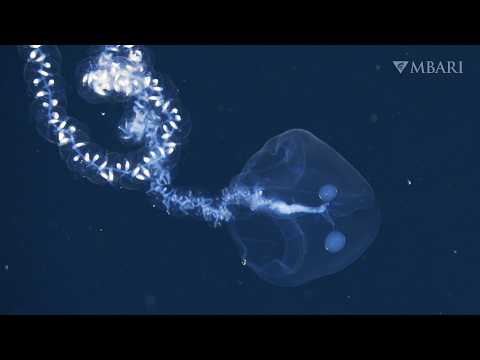
An unexpected discovery was a new species of Erenna siphonophore, a translucent animal related to jellyfish. This organism was located approximately 6,500 feet (about 1,980 meters) below the ocean surface. The different species of siphonophores appear as elongated and transparent structures, similar to worms or snakes, with bioluminescent tentacles that emit light.
“They have tentacles that hang down with small branches, almost like fingers, and move them with a luminous point at the end”, described Haddock about the Erenna siphonophores.
The function of these light attractants is linked to the scarcity of prey at depth, compared to the ocean surface. The twinkling lights at the tips of the tentacles serve to attract victims from a distance, allowing the siphonophores to capture them when they approach.
Initially, the team believed that it was an already known type of Erenna siphonophore, but a more detailed analysis of the tentacles revealed a distinctive feature. Haddock stated that the tentacles “looked exactly like a tadpole”.
“It had a big, round head and two points where the eyes would be, and then this long, wavy tail,” he said.
This peculiar appearance suggests that the creature is “adapted to attract a different type of fish” compared to other documented versions of the species, as Haddock explained.
Haddock noted that the variety of bioluminescent baits also demonstrates how different species of siphonophores can thrive in the same region of the deep ocean.
“Why wouldn’t one species become the dominant one? Well, I believe that the tentacles, the diversity of the tentacles, allows them to attack different types of prey,” Haddock explained. “Each has its own little niche in the ecosystem in which it specializes.”
The scientist mentioned that they are waiting for more documentation processes to be completed before releasing photographs of the new species.
Haddock highlighted the importance of these deep-sea creatures for the underwater ecosystem, highlighting that many of them migrate to shallower waters at night.
“This process connects deep-sea ecosystems to shallow ecosystems,” he said. “So a lot of things that people are familiar with, like tunas or swordfish, feed on species that are actually deep-sea.”
Although these translucent, luminous animals may seem strange, they may be more abundant than common land animals, including humans.



