
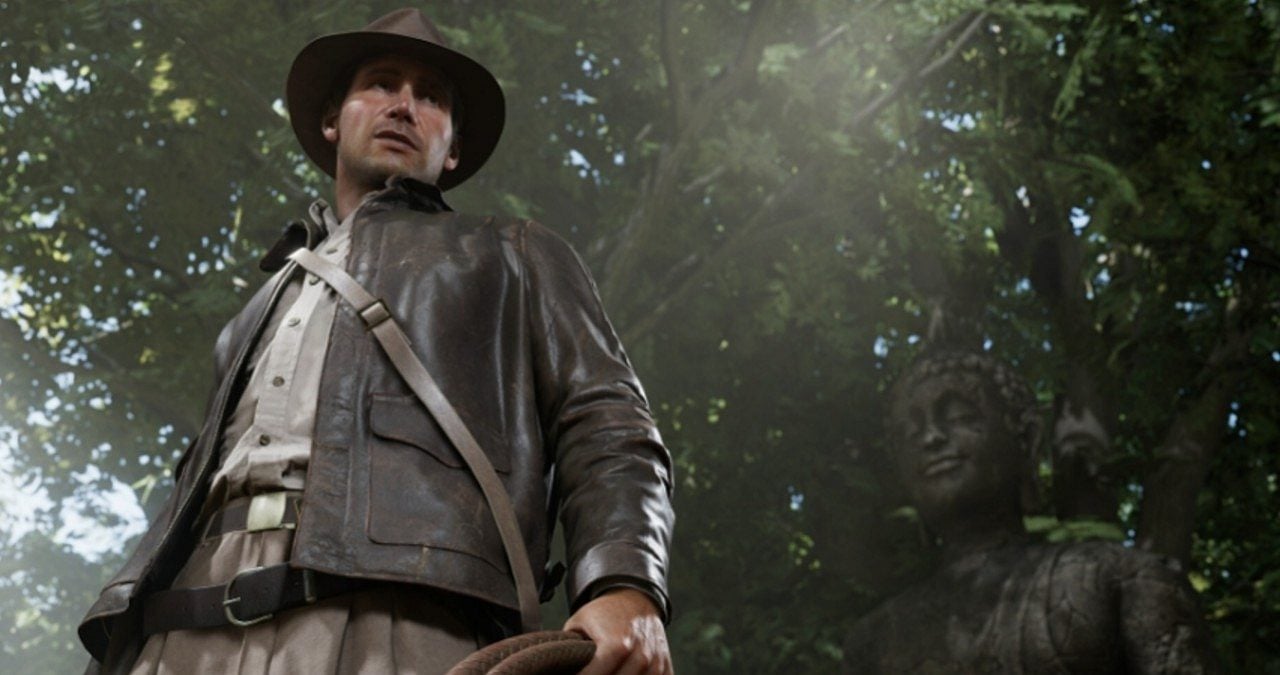
An in-depth evaluation carried out by Digital Foundry experts confirmed that the adaptation of Indiana Jones and the Great Circle for the Nintendo Switch 2 delivers an impressive result. The team at developer MachineGames has achieved the feat of maintaining cutting-edge visual effects such as ray tracing and instantly generated reflections, ensuring a graphical immersion rarely seen on a handheld device.
To enable this level of detail, the title was locked at 30 frames per second, unlike the fluid 60 fps found on traditional desktop consoles. This technical choice was accompanied by intense work on reducing the size of sound files, textures and progress data, as well as processor improvements designed exclusively for Nintendo’s new platform.
On the same topic: Indiana Jones performance on Switch 2 impresses with cutting-edge graphics
Which advanced visual effects survived the hardware transition
During the conversion process, programmers avoided cutting features that normally disappear on more modest hardware. The game maintains reflections in the screen space and contact shadows, which are essential for giving volume to the scenes. Global illumination via ray tracing is also present, ensuring that the environments explored by the archaeologist maintain the realism originally intended.
Another trick used was variable rate shading, which adjusts the quality of less important areas of the screen to alleviate processing without the user noticing the difference. Thanks to these tricks, the laptop’s global illumination can go head to head with the performance seen on the Xbox Series S, even surpassing the Microsoft console in specific scenarios.
Image performance on TV and in portable mode using artificial intelligence
The pixel count constantly adapts to what happens on the screen. When connected to the base, the game fluctuates between 540p and 1080p with the help of DLSS. The presence of this image reconstruction technology from Nvidia represents a massive generational leap for Nintendo, allowing portable mode to operate between 360p and 720p delivering final sharpness far greater than what the native resolution would suggest.
If placed side by side with the Xbox Series S, the hybrid device has an advantage in the average resolution delivered to the player. However, Nintendo’s device suffers more from jagged edges on 3D models. Shadow projection also loses definition, a problem that worsens when the user plays away from the television, damaging the sense of space in darker sections.
The geometric complexity of the objects spread across the map needed to be simplified in relation to the main edits. The system that loads the scenery elements acts more abruptly, causing textures and items to appear suddenly in the protagonist’s view. In portable format, this reduction in details becomes even more evident, leaving the environments a little more empty.
More on this story: Better than PS4: Devil May Cry 5 achieves superior performance on Nintendo Switch 2, according to experts
Drops in fluidity in moments of intense combat and story scenes
Performance analysis revealed that the target of 30 frames per second is not always sustained. During cinematic sequences, the refresh rate fluctuates a lot. The biggest bottleneck occurs in battles against several opponents at the same time, as in the sequences set in the Vatican, where fast movement causes performance to plummet to around 20 fps.
These stumbles in fluidity happen because the system reaches its limit when trying to calculate the enemies’ artificial intelligence and render complex graphics at once. The title’s creators preferred to accept these momentary hiccups in stretches of peak stress to ensure that the majority of the campaign ran in a stable manner and without compromising the beauty of the work.
Learn more: Nintendo releases in May 2026 bring nine games for Switch 2 and classic version
Engineering solutions created exclusively for the new console
The programming team didn’t just limit itself to lowering graphics settings, creating tailor-made solutions to get the most out of the newly released hardware. The central processor routines were rewritten taking into account the specific architecture of the device, highlighting the studio’s effort to deliver a polished product designed for the Japanese manufacturer’s ecosystem.
To accommodate the massive game on limited storage, three compression fronts were tackled:
- The scenery surfaces were compacted without losing their visual identity, mirroring the base version of the Microsoft console.
- The sound effects and dialogues went through an intelligent filter that reduces the file size without muffling the sound.
- The save system has been restructured to take up less disk space and speed up loading screens.
The treatment given to textures ensures that the look on the Nintendo device is practically identical to that of the Xbox Series S running without the additional high definition package. This strategy positions the adaptation at a level of excellence, balancing sharp graphics with the need to save the video game’s internal memory.
Learn more: Nintendo releases in May 2026 bring nine games for Switch 2 and classic version
Complete graphics engine guarantees the original adventure experience
All of the development engine’s fundamental tools continue to operate behind the scenes, ensuring that the structure of the journey is identical to that of other platforms. The ability to maintain ray-calculated lighting proves that the team preferred to mold the technology to the physical limitations of the console rather than simply ripping visual innovations out of the code.
This development mentality ensures that the directors’ artistic vision reaches the hands of consumers intact, even with the inevitable resolution cuts. The final balance is a conversion of the highest level, proving that the new hardware can run productions with million-dollar budgets with dignity.
The adventure starring the famous archaeologist can now be purchased by Nintendo Switch 2 owners around the world, while the full report published by Digital Foundry remains available for those who want to delve into the technical details of frame rate and resolution.