

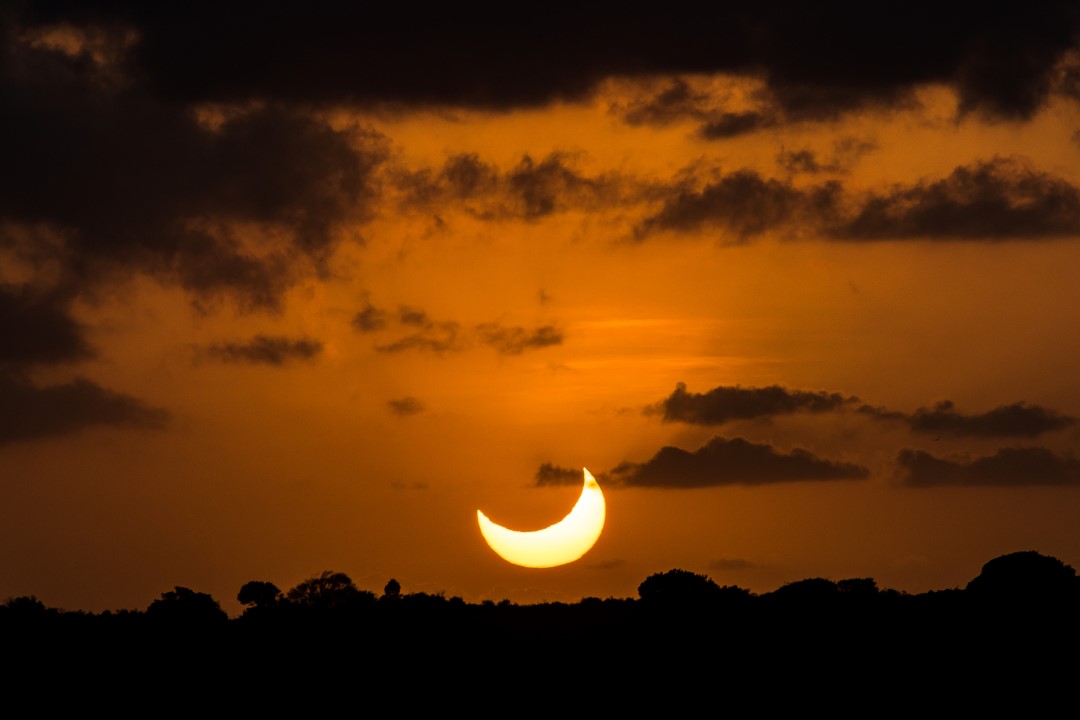
On August 12, 2026, the United Kingdom will witness a highly relevant astronomical event: a partial solar eclipse that will cover up to 98% of the Sun in some regions. This phenomenon is considered the most impactful for the country in more than ten years, promising a remarkable visual experience, even without reaching its totality.
Although the path of totality of the 2026 eclipse passes close by, overshooting the Atlantic Ocean toward Iceland and northern Spain, England will not experience a total solar eclipse until September 23, 2090. This prolonged absence makes the profound partial eclipse of 2026, which rivals the one on March 20, 2015, a rare and valuable event for local observers.
It is crucial to remember that, during a partial solar eclipse, you should never look directly at the Sun without using specific sun protection glasses for this purpose. Eye safety is essential to avoid permanent damage to your vision.
More on this story: Watch the 2026 Total Solar Eclipse
Strategic locations in the UK to observe the 2026 partial eclipse
A deep partial eclipse is a captivating sight, and the vast extent of this event allows millions of people in the UK to experience it without the need to travel. Visibility will be broad across the country.
Cities such as London, Manchester and Glasgow will have solar coverage of 91.4%, with differences of just a few minutes at the peak of the phenomenon. Belfast will record 93.1%, while Cardiff, the capital of Wales, will achieve 93.2%. In practice, these small variations are subtle, consolidating the event as a national occurrence. However, national parks such as Snowdonia and the Lake District are expected to attract crowds of enthusiasts. In County Kerry, Ireland, Great Skellig Island, for example, will have an impressive 98% coverage of the Sun.
Ideal times and positioning to see the astronomical phenomenon
This will be a late eclipse and low in the sky, which makes planning the timing even more important. The action will take place between 5:59pm and 8:10pm BST (British Summer Time), with the action expected to peak between 7:05pm and 7:13pm BST, depending on location in the UK. The Sun, deeply eclipsed, will appear as a thin crescent on the west-northwest horizon.
There will be no total darkness, as this only occurs in the range of totality, but the day will have a noticeably diminished sensation of brightness. Position will be vital: for the best experience you will need a clear, unobstructed horizon, ideally from a coastal point, hill or open landscape. Arriving early, using appropriate eclipse glasses, will allow you to follow the Moon’s progress over the Sun.
Weather forecast for the solar eclipse in the UK
Although August is generally a warmer month in the UK, it is not famous for its clear skies, as those who witnessed the 1999 eclipse in Cornwall will recall. However, weather statistics are not an absolute destination. A high pressure system on the day of the event could completely transform visibility conditions.
Learn more: Grand solar eclipse on August 12th will reach almost a billion people globally
In contrast, the path of totality covers regions with more predictable weather patterns, notably north-central Spain and the Balearic Islands, offering greater guarantees of clear skies for eclipse chasers.

The scope of the partial eclipse beyond British borders
While observers in the UK will enjoy a deep partial eclipse, those within the narrow band of totality – which stretches across eastern Greenland, western Iceland and northern Spain – will experience something fundamentally different, albeit for just a few minutes. In eastern Spain, totality will arrive just before sunset, with the fully eclipsed Sun hovering just a few degrees above the western horizon.
However, the extent of partially eclipsed sunsets across Europe and northwest Africa has been widely underestimated. Millions of people in countries such as Algeria, France, Germany, Italy, Austria and Poland will see the Sun set while it is deeply eclipsed. In some locations, the maximum eclipse will occur minutes before sunset. It will be one of the most visible and visually striking eclipse phenomena of the decade, with an estimated 283 million people observing at least 90% of a partial eclipse.
Upcoming partial solar eclipses predicted for the UK
The event of August 12, 2026 is not an isolated case. The UK is in a period of unusual activity for partial eclipses, with at least one visible almost every year until the end of the decade. Following this significant event, a more modest partial eclipse will occur on the morning of August 2, 2027, with a maximum obscuration of 48% in southern England.
On January 26, 2028, attention will once again turn to a partially eclipsed sunset, where up to 56% of the Sun will be obscured. This event will be best observed in western locations such as Cornwall and Wales. On June 12, 2029, the eclipse will be more marginal, visible only in northeast England and eastern Scotland at sunrise. Finally, on June 1, 2030, another annular eclipse will bring a partially eclipsed sunrise to the entire UK, with around 49% of the Sun blocked in the southeast.