

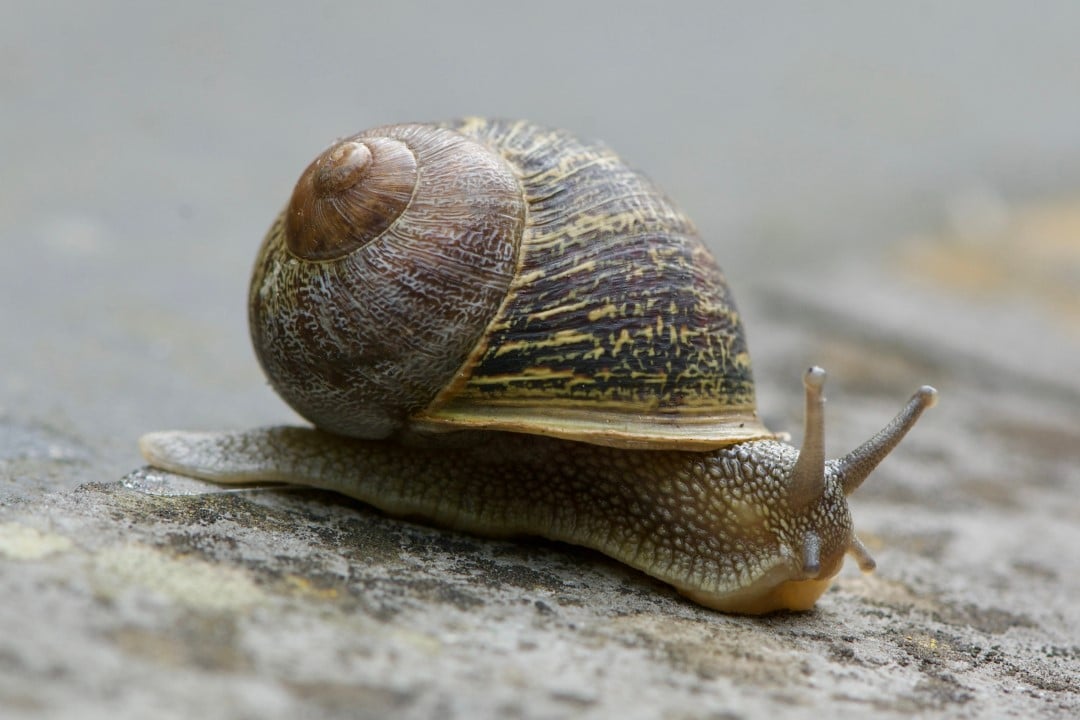
Recent research has revealed the complexity behind snails’ mucus production, a natural secret now better understood by scientists. Published in the journal *Science*, the investigation by a German team, including members of the Max Planck Institute of Colloids and Interfaces, revealed how these molluscs adjust the properties of their secretion. The key to this mucus “engineering” ability lies in the joint action of collagen and calcium.
Snail mucus, composed mainly of water, gains its viscous and slippery texture thanks to mucins and complex carbohydrates. In addition to its use in cosmetics, the substance has great potential for drug delivery. In 2020, researchers observed that combining garden snail secretions with gold nanoparticles accelerated wound healing and demonstrated anti-inflammatory effects in mice. A previous study, from 2023, had already identified three types of mucus produced by the garden snail: a moisturizer to protect the skin, an adhesive and a lubricant for locomotion.

The research team focused its studies on the wood snail (*Cepaea nemoralis*), considered ideal due to its ability to secrete five distinct types of mucus, each with a specific purpose. Just like garden snails, this group produces mucus that acts as a lubricant to facilitate movement and another adhesive, which allows the animal to adhere to different surfaces. There is also a layer of special mucus, known as the epiphragm, which is released during winter hibernation and is rich in calcite, sealing the shell and protecting the snail from predators and harsh environmental conditions.
Learn more: Global warming drives unprecedented proliferation of mosquitoes in the far north of the planet
When threatened, *C. nemoralis* also produces two additional types of protective mucus. One of them is a yellow, sticky substance, comparable to that of other molluscs, which is highly resistant to rupture. The second type is an effervescent substance that scientists believe serves to suffocate small predators or expel them from the shell.
The researchers carried out an in-depth analysis of all five types of mucus, using several advanced techniques such as proteomics, X-ray fluorescence, X-ray diffraction, cryogenic scanning electron microscopy and liquid chromatography. The analyzes revealed that, although all mucus has a similar protein composition, type IV collagen constitutes its main structural component. Variations in the mechanical properties of each type of mucus are determined by the different amounts of proteins and the presence of amorphous calcium carbonate (ACC). The two types of defensive mucus, for example, had the highest number of proteins.
On the same topic: Astronomers discover a phenomenon that weakens magnetism and allows the birth of stars
The results obtained “indicate that these proteins are used to adjust the degree of cross-linking and, consequently, the density of the network, which directly impacts its mechanical characteristics”, as concluded by the study authors. They added that “each type of mucus demonstrates a unique and complex hierarchical structure, influenced by the processing of the mucous material.” This deep understanding of the mechanisms behind mucus “engineering” opens the door to the development of new biomimetic materials with customizable properties, inspiring advances in areas such as medicine and the cosmetics industry.
Furthermore, it was observed that calcium is “actively secreted in conjunction with mucus, acting as an ion source for cross-linking or as a mineral precursor for structure reinforcement.”