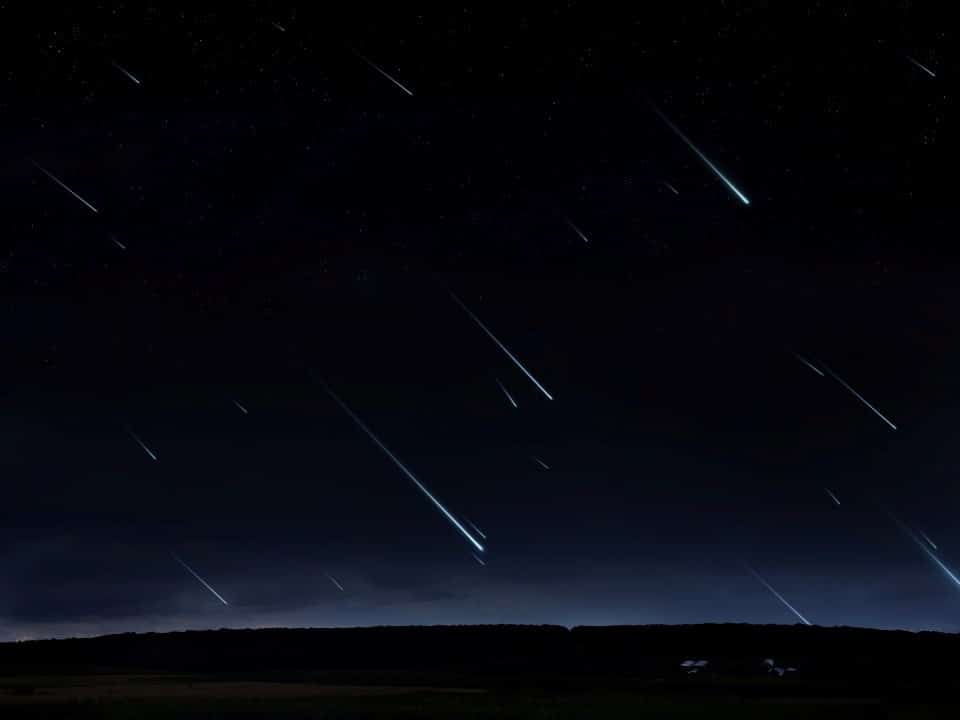
The astronomical calendar reserves an unprecedented double spectacle for August 12, 2026. Residents of parts of Europe will witness the total blocking of the Sun, while Canadians and Americans will witness a partial version of the daytime phenomenon. Just after dark, the sky will become the perfect stage for the culmination of the Perseid meteor shower. As the lunar phase will be completely absent, absolute darkness will allow enthusiasts to count up to a hundred light trails per hour in remote areas free from visual pollution.
Exact schedule of August’s astronomical attractions
The height of the space debris storm will occur during the early hours of August 12th and 13th. This window of greater nighttime light activity will open just a few hours after the solar alignment is complete.
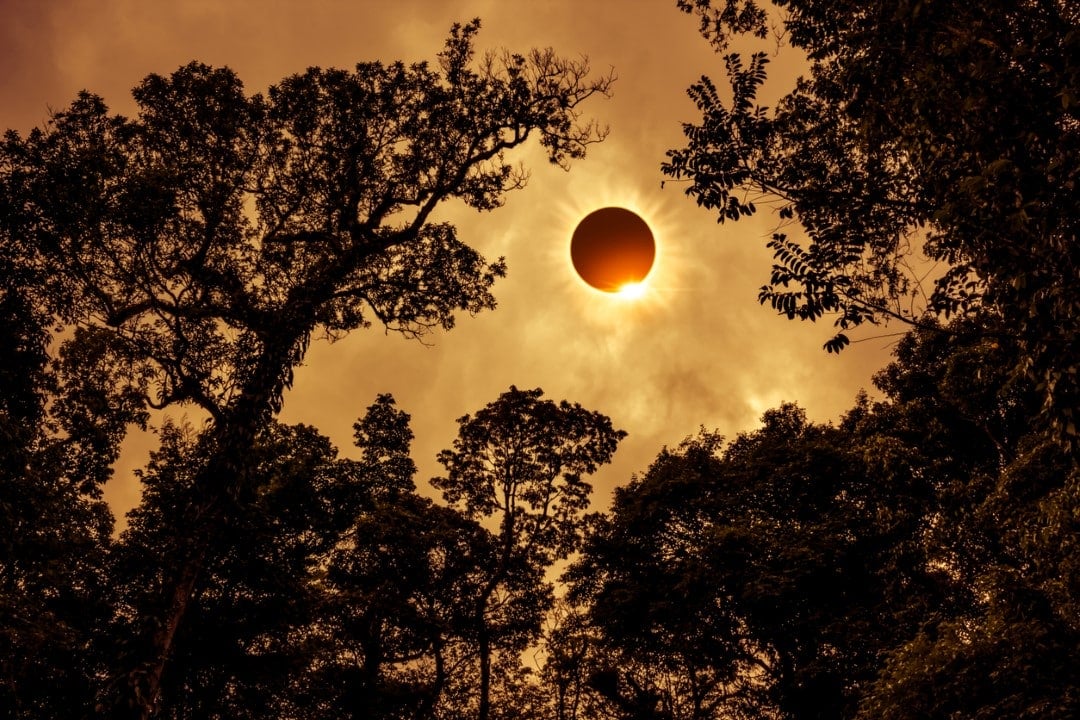
The Moon’s full shadow will trace a specific path that crosses eastern Greenland, western Iceland and northern Spain. The partial obscuration will cover a vast area that encompasses the European continent, Canada and the northeast of the United States. At the same time, the Perseid activity period will already be underway in space, traditionally extending from July 17th to August 24th.
Every solar eclipse necessarily requires the new moon phase to occur, and it is precisely this celestial mechanics that will transform the night of August 12th into one of the best observation opportunities of the decade. Experts predict that up to 100 meteors will fall every sixty minutes in pitch-black regions, while typical rural areas should record between 30 and 50 sightings. The golden interval for looking up will begin just after midnight and extend until the first rays of the sun on the 13th.
According to data from the American Meteor Society, these nighttime flares are actually dust and ice shed from comet 109P/Swift-Tuttle. When these small rocks hit our planet’s atmosphere, they travel at an impressive speed of 59 kilometers per second, generating friction and immediate combustion.
Why the coincidence of two events on the same day is historic
Watching a solar block or a storm of shooting stars already yields unforgettable memories, but the overlap of both within a 24-hour interval defies mathematical probabilities. During the afternoon, the Northern Hemisphere will look at the hidden Sun, and the same dynamics that cause the eclipse will guarantee a completely dark night sky, eliminating the lunar glow that usually overshadows smaller meteors. For those on the prime route, daytime will offer shadow dancing, while nighttime will deliver Earth’s plunge into the densest debris cloud left behind by Swift-Tuttle.
Reasons that make the passage of the Perseids an unmissable spectacle
Although December’s Geminid rain records higher absolute numbers, the Perseids reign supreme in the Northern Hemisphere due to the pleasant climate of summer nights in the middle of the year. The phenomenon is famous for generating long, fast contrails and, often, colorful fireballs that surpass the brightness of conventional stars. The peak of activity marks the exact moment in which the Earth’s orbit crosses the core of the dust wake of Swift-Tuttle, a giant comet that takes 133 years to make a complete turn around the Sun and that will only return to our horizon in the year 2126.
Best geographic locations to follow the sky
Total daytime darkness will be restricted to specific swaths of eastern Greenland, western Iceland and northern Spain, but the partial version of the event will embrace a gigantic audience. On the North American continent, the eastern Canadian provinces will have the most dramatic view, followed by fractions of the northeastern United States that will notice the lunar bite into the solar disk.
At least 26 North American states will enter the eclipse’s path on August 12, requiring the use of protective glasses throughout the observation period. Visibility and blocking percentage will vary drastically depending on the observer’s latitude:
- Alaska leads coverage in the country, with the city of Fairbanks seeing 37% of the Sun disappear at 8:27 am in the local time zone.
- On the mainland, the state of Maine will see a 28% lockdown around 1:50 pm Eastern Time.
- Cities further south will have reduced views, leaving Boston with 16% and New York with just 10% obscuration.
When twilight ends, the dynamic changes completely for residents of Europe and North America. Unlike the eclipse, which requires millimeter geographic positioning, the meteor shower is democratic: just be on the dark side of the globe and have favorable weather conditions, without clouds, to enjoy the space show.
Equipment and safety tips for the astronomical marathon
The double journey of 2026 requires different preparations, starting with the acquisition of ISO-certified glasses for solar observation or specific filters for photographic lenses and telescopes. Facing the Sun during the partial phase without the correct protective barrier causes irreversible damage to the retina in a matter of seconds.
For the night stage, the strategy changes to searching for total darkness, away from urban centers and artificial street lighting. The ideal is to consult light pollution maps to find the perfect refuge and give your eyes about half an hour to get used to the pitch black, avoiding checking your cell phone screen during this period. Forget telescopes or binoculars for shooting stars; The natural field of vision of human eyes is the best tool for capturing the flashes that cross the sky in an unpredictable way.
The name of the phenomenon derives from the constellation of Perseus, from where the rocks seem to emerge, but the most spectacular meteors usually streak areas far away from this central point. Early morning is established as the prime time for observation because, from midnight onwards, the Earth’s rotation movement places the observer facing the stream of cosmic debris, increasing the frequency of impacts on the atmosphere.
Celestial bonuses: planets, auroras and rare stars in August
The menu for August 12th also includes the presence of Venus, which will display half of its face illuminated due to its approach to Earth, providing great images for those with amateur equipment. However, the night’s big backdrop will be the Milky Way, shining brightly southward after sunset. Residents of high latitudes will also be able to witness the beginning of the northern lights season. To complete the 2026 package, astronomers recommend searching the sky for T Coronae Borealis, known as the “Flaming Star”, which is predicted to explode into a nova exactly during this period, positioning itself strategically between the giants Vega and Arcturus.