
Unprecedented solar vortices are captured by telescope in Hawaii, unraveling mysteries of the Sun

The solar surface was observed with unprecedented resolution by a telescope located in Hawaii, revealing vortices that could offer crucial information to unravel the enigmas of the Sun.
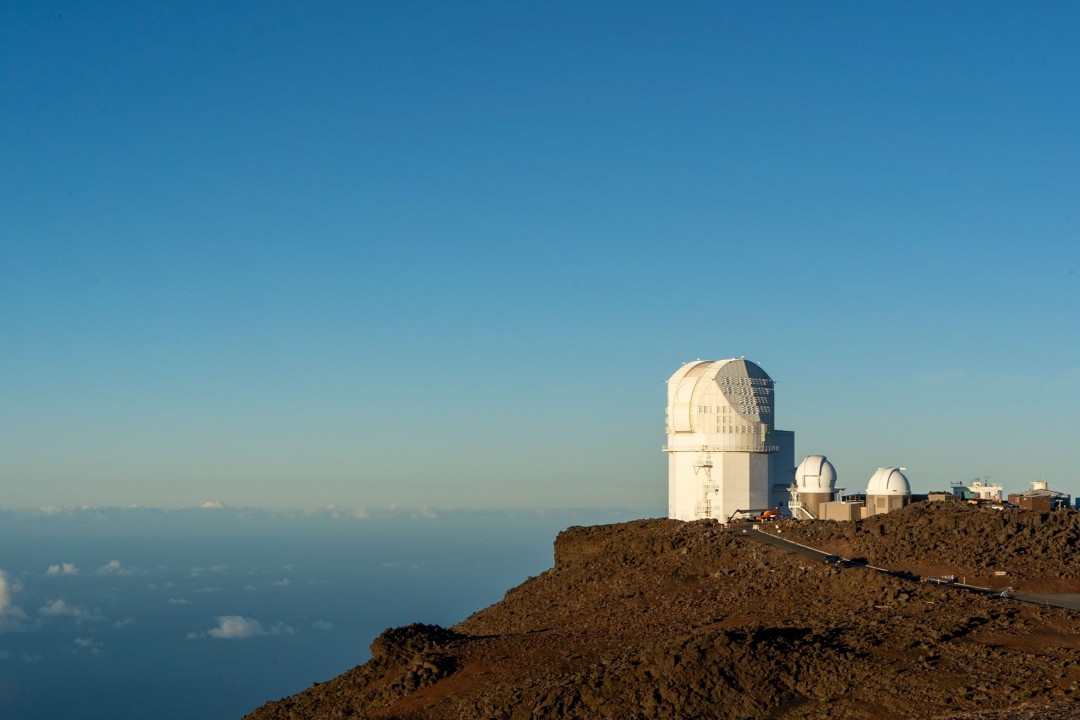
The image of the solar photosphere was obtained using the Daniel K. Inouye Solar Telescope, located in Hawaii, United States.
The image was generated from data at a wavelength of 416 nanometers, which appears purple to human vision. The National Solar Observatory (NSO) confirmed that its resolution of approximately 19 kilometers establishes it as the sharpest ever obtained from the surface of the Sun. It highlights several very faint vortices and bands, which intertwine on the edges of areas with the highest concentration of magnetic fields.
Considered the largest solar telescope in the world, the Daniel K. Inouye Solar Telescope was erected at an altitude of 3084 meters on Mount Haleakala, in Maui, Hawaii. Its structure includes a primary mirror measuring 4 meters in diameter. It is named after Daniel Inouye, a Hawaiian who became the first Japanese-American to serve as a United States senator. Since 2020, the equipment has been sharing detailed images of various solar phenomena, such as spots.
NSO researchers, including David Kuridze and Friedrich Wöger, released findings that confirm the existence of phenomena on the surface of the Sun previously anticipated by theories. The team’s conclusions were detailed in a scientific article published in the renowned journal “Nature”.,
Understand the origin of vortices on the surface of the Sun
The NSO explains that the patterns of vortices and streaks visible in the image result from “Kelvin-Helmholtz instability.” This phenomenon occurs when an initial disturbance develops as a vortex in the contact area between two fluids with different velocities.
A familiar manifestation of this instability can be seen in the clouds that create wavelike shapes in the Earth’s atmosphere. This is a widely recognized event in fluid dynamics, with a notable occurrence also in the atmospheres of gas giants such as Jupiter and Saturn.
The same principle observed in other contexts applies to the interaction between the solar magnetic field and plasma. Although the Kelvin-Helmholtz instability was already known in the Sun’s atmosphere, the NSO points out that this is the first time it has been recorded with such clarity on the solar surface.
By comparing data obtained by the Inouye Solar Telescope with numerical simulations, the team found that the distance between the vortices varied from 50 to 65 kilometers, both in observations and models. This confirmed that the observed vortices were, in fact, the result of the Kelvin-Helmholtz instability.
Understand how discovery can unravel solar mysteries
The entanglement of magnetic field lines on the solar surface occurs progressively due to the movement of their components, resulting in the accumulation of energy. The release of this energy is considered the trigger for explosive events, from small nanoeruptions to large solar flares and coronal mass ejections (CMEs). The researchers emphasize that the Kelvin-Helmholtz instability vortices, present continuously across the entire surface of the Sun, can influence the entanglement mechanism of these magnetic lines.
For a long time, scientists have sought to understand why the corona, the outermost layer of the solar atmosphere, reaches temperatures exceeding 1 million degrees Celsius. Furthermore, the Sun’s magnetic activity follows a cycle of about 11 years, but current models do not elucidate the effective dispersion of the magnetic flux accumulated during this period. The newly identified Kelvin-Helmholtz instability on the Sun’s surface emerges as a possible solution to these ancient enigmas.
Kuridze stated that the solar magnetic field is produced by a dynamo process, converting rotational energy into magnetic energy. However, the solar magnetic cycle, lasting just 11 years, is considered short on a cosmic scale, requiring efficient dissipation of the magnetic flux. “Conventional models have failed to adequately explain this rapid diffusion, but the Kelvin-Helmholtz instability in the photosphere that we discovered may be an important factor in this magnetic field diffusion that had not yet been explained,” said the researcher.
Wöger also commented on the discovery: “We are just beginning to recognize the far-reaching implications that this discovery of the Kelvin-Helmholtz instability will have for our understanding of the relationship between the movement of magnetized plasma and the transport and release of energy in the Sun’s upper atmosphere.” He suggests that daily “micro” vortices on the Sun’s surface could be the start of mechanisms that affect solar “macro” activity.





