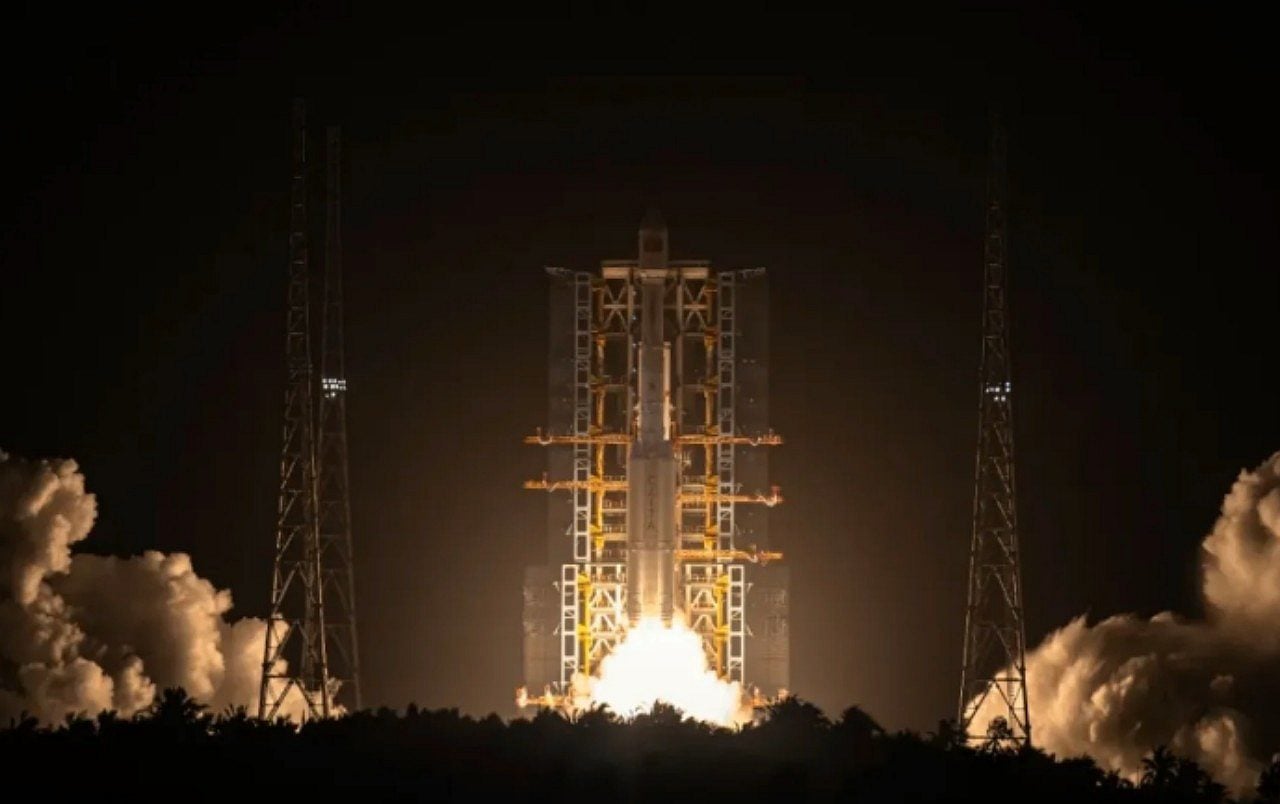
A serious setback hit China’s aerospace sector on August 10, 2026, when a Long March 7A launch vehicle suffered a catastrophic failure in mid-flight. The equipment disintegrated in the sky approximately a minute and a half after leaving the launch pad at the Wenchang space center, a strategic complex located on the tropical island of Hainan. State news agency Xinhua officially confirmed the total loss of the rocket and its payload, attributing the incident to an unspecified anomaly during the initial ascent phase.
The exact moment of ignition occurred at 8:02 pm local Beijing time, which corresponds to 9:02 am in the Brasília time zone. Immediately after the flash in the sky, residents of the region and astronomy enthusiasts began sharing videos on social media, showing an immense ball of fire consuming the metallic structure. Authorities cordoned off the maritime perimeter near the base to begin searching for debris, while a commission of inquiry was formed to determine the exact causes of the structural collapse.
Analysis shows total disintegration of the vehicle at low altitude
Images captured by local observers provided the first visual data on the dynamics of the accident. Jonathan McDowell, a renowned astronomer linked to the Center for Astrophysics at Harvard & Smithsonian, carried out a preliminary technical evaluation of the video records. The expert indicated that the destruction of the equipment happened while the set was still traveling at a relatively low speed and altitude, which prevented any chance of the fragments or the satellite reaching the planned Earth orbit.
The time interval in which the explosion occurred, about 85 seconds after takeoff, coincides with a critical phase known in aerospace engineering as maximum aerodynamic pressure. During this flight window, friction against the dense lower atmosphere exerts the greatest level of physical stress on the rocket’s fuselage. Any microcrack in manufacturing, software failure in thrust control or excessive engine vibration can result in the immediate rupture of highly flammable fuel tanks.
The abrupt interruption of this mission breaks a remarkable sequence of operational successes. Since overcoming problems on its maiden flight, the model has been considered one of the most reliable parts of the Chinese fleet for medium-sized missions, accumulating a positive history that will now need to be reevaluated by state engineers.
Technological damage involves high-capacity telecommunications satellite
The main objective of the aborted operation was to position the ChinaSat-4B in space, an advanced communications equipment that also receives the internal designation of Zhongxing-4B. Although the Chinese government maintains secrecy about the exact specifications of its payloads, a technical report briefly published by China National Radio and later deleted from the Baidu platform confirmed the artifact’s identity. The document also classified the launch vehicle as a modified variant designed specifically to push heavy payloads into higher orbits.
This satellite belonged to the same technological lineage as ChinaSat-4A, which was successfully placed into orbit in 2024. Equipment in this category is designed to operate in geostationary orbit, a band located approximately 35 thousand kilometers above the equator, where the satellite’s speed follows the Earth’s rotation, making it appear fixed in the sky to the receiving antennas on the ground.
The primary function of this family of satellites is to provide data transmission infrastructure, voice services and radio and television signals to areas that are difficult to access. The loss of ChinaSat-4B represents a delay in expanding telecommunications coverage in remote regions of Chinese territory and partner countries, which depend exclusively on orbital relays to overcome the absence of terrestrial fiber optic networks.
History of the model and the strategic importance of the coastal spaceport
The Long March 7A was developed to fill a vital gap in the Asian space program, acting as a workhorse for missions requiring intermediate power. The model’s history records only one previous failure, which occurred precisely at its debut in March 2020. After that first stumble, the designers implemented rigorous corrections that allowed more than a dozen perfect launches to be carried out over the last five years.
The choice of the Wenchang complex to house these operations reflects a modernization in the country’s space logistics. Unlike the old bases built in the interior of the continent during the Cold War, this installation offers undeniable technical advantages for the success of modern missions.
- The coastal location ensures that discarded rocket stages fall safely into ocean waters, eliminating the risk of hitting populated villages.
- The geographic proximity to the Equator provides the planet’s natural rotational momentum, which saves fuel and increases payload capacity.
- Direct access from the sea allows cargo ships to deliver gigantic components that would be impossible to transport through the tunnels and narrow railways of the Chinese interior.
With the recent accident, all operations involving this family of rockets will enter a period of preventive suspension. Investigators will need to audit the entire supply chain to find out whether the failure was due to a faulty batch of parts, human error in assembly or inadequate procedures carried out at the Hainan facility.
Consequences for the ambitious exploration program of the lunar south pole
The impact of the explosion reverberates far beyond the commercial satellite market, raising concerns about the timing of China’s most anticipated scientific mission: Chang’e-7. The Wenchang space center is the preparation stage for this monumental project, which aims to send a complex set of probes and robotic vehicles to explore the Moon’s south pole. Global interest in this lunar region is due to the confirmed presence of water ice at the bottom of craters that never receive sunlight.
Government authorities had stipulated the launch of Chang’e-7 for the second half of 2026, with international analysts predicting the opening of the flight window for the end of this month. The lunar mission will use the Long March 5, a heavy-class launch vehicle that has a completely different architecture, engines and dimensions than the rocket that exploded on August 10th.
Despite being different machines, sharing the same ground infrastructure raises logistical concerns. If the ongoing investigation finds that the accident was caused by fuel contamination, assembly crane failures or problems with the Wenchang base’s control software, the lunar launch could face mandatory delays. The discovery and control of water reserves on the Moon are fundamental steps towards the production of space fuel outside Earth, making any change in schedule a decisive factor in the current space race between the great global powers.