

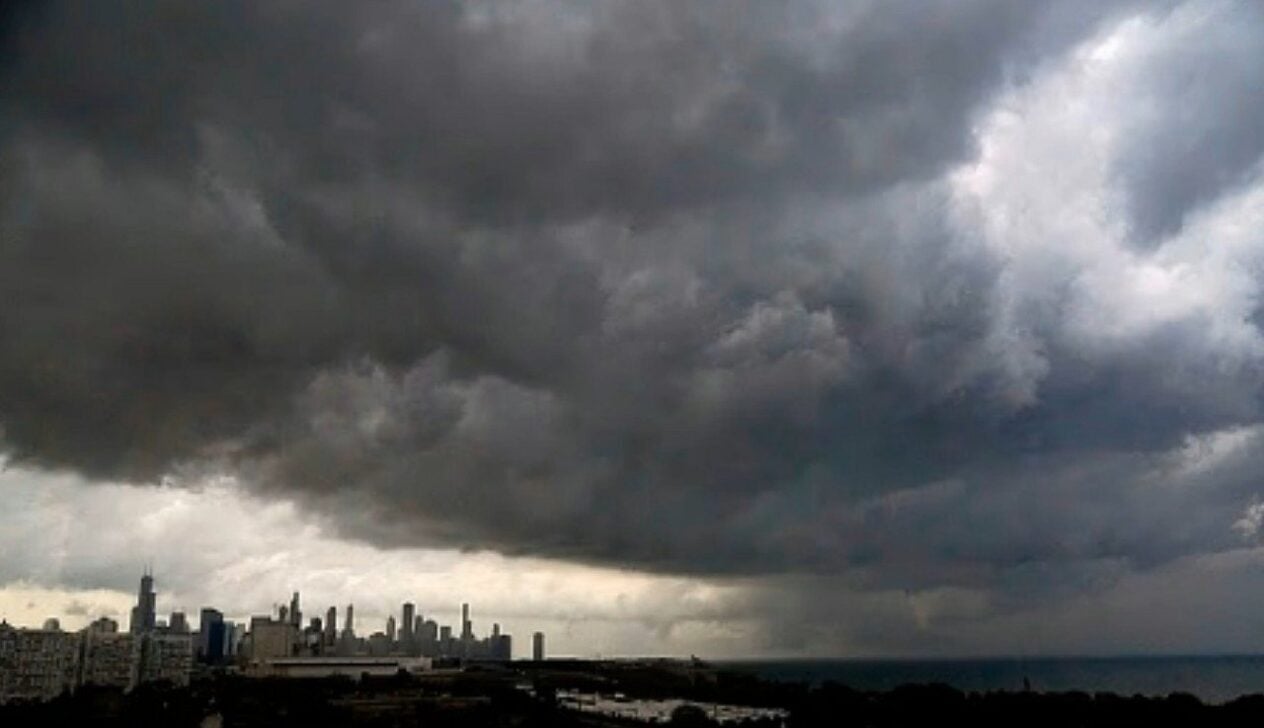
An extremely violent weather front swept the Chicago metropolitan area, in the state of Illinois, on August 11, 2026, leaving a trail of considerable destruction in several communities. Residents of the Tinley Park area, especially near the busy intersection of I-80 and Harlem Avenue, witnessed the formation of at least two tornadoes confirmed by local public safety authorities. Measuring instruments recorded wind gusts that reached 90 miles per hour, equivalent to about 145 kilometers per hour, strong enough to compromise urban infrastructure and collapse the area’s electricity distribution system. Climate experts point out that winds of this magnitude fall into the EF1 category of the Improved Fujita scale, having a proven ability to uproot trees and tear apart solid buildings.
Direct impact on the power grid affects hundreds of thousands in the Midwest
The collapse in electricity supply reached massive proportions shortly after the storm hit, directly affecting the daily lives of more than 880,000 homes and commercial establishments across the American Midwest. The fall of hundreds of large trees on the main and secondary transmission lines made load distribution unfeasible, creating a widespread blackout scenario that required the immediate mobilization of emergency teams from local utilities. In densely populated locations like Tinley Park, broken power lines posed a severe additional risk to rescue teams trying to clear main roads and ensure ambulance access. The power distribution model in the United States, largely dependent on overhead wiring supported by wooden poles, makes the grid particularly vulnerable to the extreme wind events documented on this date.
More on this story: Hurricane Lala intensifies and could be the first to touch Hawaii in 34 years
The work of restoring electricity in situations of natural disaster involves complex logistics of replacing burst transformers and kilometers of broken cables. Maintenance teams had to wait for the low pressure system to complete to safely begin repairs, using trucks with overhead baskets to reach critical points in the damaged network. The absence of functioning traffic lights at the main road intersections also generated major congestion, forcing the highway police to manually guide traffic to avoid secondary accidents on evacuation routes.
Data collection reveals the extent of the blackout in neighboring states
Figures consolidated by the independent monitoring platform PowerOutage.us during the afternoon of August 11th detailed the severity of the situation on a national scale, accounting for exactly 880,232 customers disconnected from the electricity grid. Digital mapping of the blackout demonstrated that the structural failure was not limited to the territory of Illinois, extending with similar force to the neighboring states of Indiana and Ohio, which also suffered from the relentless passage of the frontal system. The most impressive and documented physical damage occurred in the suburb of Tinley Park, where atmospheric pressure and sheer force of winds tore the entire roof off a large building. Residents who were sheltering nearby managed to record on video the exact moment in which large pieces of metal, thermal insulation and wood were thrown into the air, transforming the debris into dangerous projectiles that hit parked vehicles.
Weather system dynamics over the Great Lakes region
The origin of all this atmospheric instability is directly linked to an extensive and rapid line of storms that formed and moved over the Great Lakes basin, fueled by the heat and humidity typical of summer in the Northern Hemisphere. Meteorologists from the national service monitored the evolution of the system using high-precision Doppler radars, which allowed multiple tornado warnings to be issued minutes before the funnels touched down in inhabited areas. This technical anticipation, communicated through external sirens and emergency messages on cell phones, was essential for the population to seek underground shelters or safe rooms inside homes. The destructive capacity of this particular weather formation caught the attention of researchers, as the straight-line winds associated with the gust front demonstrated the same potential for structural damage as the rotating tornadoes observed in Tinley Park.
Main consequences recorded after the passage of tornadoes
The preliminary assessment of the damage caused by the severe storm illustrates the vulnerability of urban and suburban infrastructure in the face of extreme and sudden weather phenomena. State and local authorities have begun the process of cataloging structural damage to request emergency funds and coordinate reconstruction efforts in commercial and residential areas hardest hit by the weather event.
- Partial and total destruction of roofs on commercial and residential properties in the Tinley Park region, generating a large volume of debris.
- Interruption of power supply to more than 880 thousand customers, with the cuts distributed mainly between Illinois, Indiana and Ohio.
- Blocking of important roads for the flow of vehicles, including vital access points near the I-80 highway and Harlem Avenue, due to the fall of centuries-old trees and light poles.
- Mass activation of the emergency siren and alert system throughout the Chicago metropolitan area, mobilizing first response teams.
Cleaning and repair operations began immediately after the storm’s most severe core dissipated, with absolute priority given to clearing emergency routes, access to hospitals and fire stations. Trucks from power utilities from unaffected states were deployed to the Midwest in a joint mutual aid effort to speed up the replacement of broken poles and reconnect downed substations. The National Weather Service maintained survey teams on the ground to assess destruction patterns on the ground, measure the width of the damage trail, and officially classify the intensity of tornadoes. As heavy debris removal work progresses, guidance from public safety departments remains focused on keeping residents strictly away from areas with exposed electrical wiring and unstable architectural structures.