

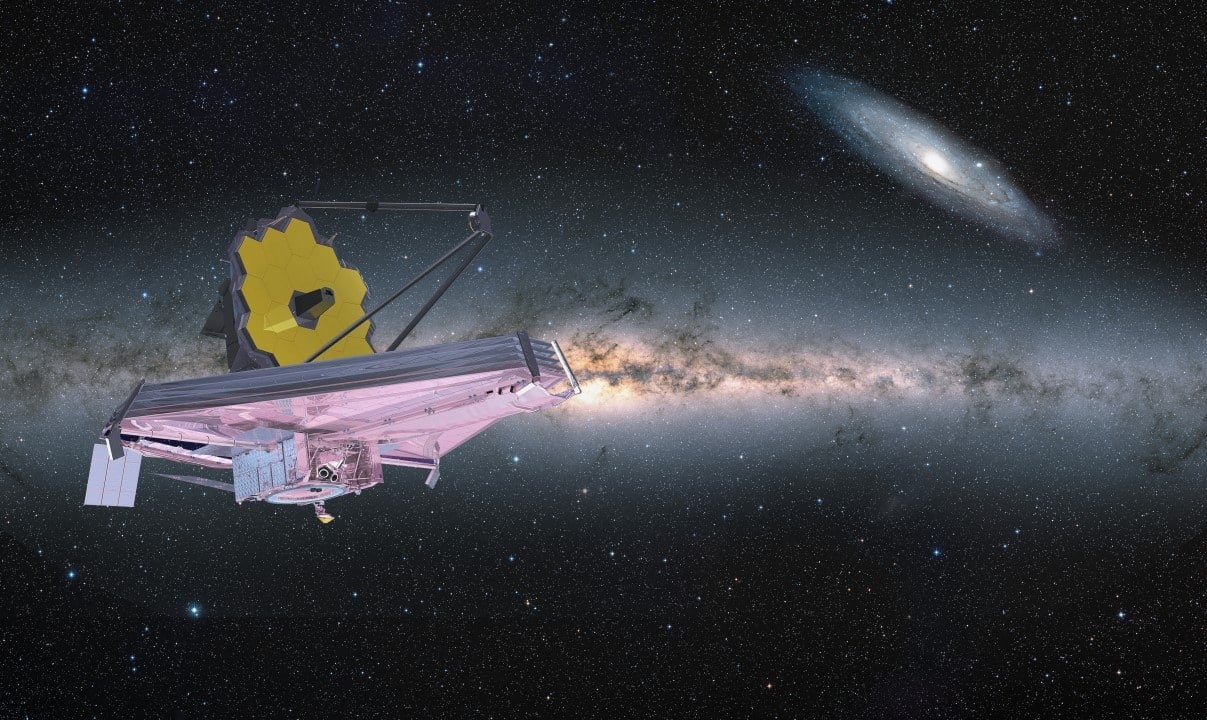
NASA’s James Webb Space Telescope has identified a giant exoplanet that was hidden in one of the most studied planetary systems in the Milky Way. This discovery highlights the potential of new observation techniques that explore the atmospheric chemistry of celestial bodies.
The young star Beta Pictoris, relatively close to Earth, was already recognized as harboring two massive planets, Beta Pictoris b and Beta Pictoris c. The planet Beta Pictoris b was one of the first to be captured directly in images. With the recent confirmation of Beta Pictoris d, the system now has three known planets, making it only the second to have at least three photographed planets.
However, astronomers did not initially detect Beta Pictoris d as a visible bright spot. Identification occurred through the unique chemical signature of its atmosphere. Scientists point out that this methodology could represent an innovative and effective approach to finding planets around other stars, especially in places where the presence of dust and debris makes it difficult to capture traditional images.
“This discovery adds a new piece to an already fascinating planetary system,” said Aidan Gibbs, lead author of a new study released in Astrophysical Journal Letters and a postdoctoral researcher at the University of California, San Diego. He added that “Beta Pictoris has been a laboratory for understanding how planetary systems form and evolve, and now we have another planet that helps us tell that story.”
What the young planetary system Beta Pictoris looks like
The Beta Pictoris system is located approximately 63 light-years from Earth, with an estimated age of around 23 million years. Their relative youth and proximity offer astronomers a unique chance to observe the interaction between the newly formed planets and the surrounding disk of dust and debris left over from the system’s formation.
The researchers calculate that Beta Pictoris d has a mass at least twice that of Jupiter. Even so, it appears to be the smallest of the three identified giant planets that orbit the star.
More on this story: National Astronomical Observatory of Japan finds atmosphere on body smaller than Pluto 2002XV93
Computer modeling suggests that the planet orbits Beta Pictoris at a distance of approximately 30 astronomical units. This position places it in an area similar to that of Neptune in our solar system. Among the three known planets in the system, Beta Pictoris d has the widest orbit, although it is still within the inner boundary of the debris disk.
Chance in the discovery of the new planet
The research team was not using the Webb telescope with the intention of finding a new planet. Beta Pictoris d emerged unexpectedly while astronomers were analyzing Beta Pictoris b’s atmosphere using Webb’s Near Infrared Spectrograph (NIRSpec).
The scientists employed the NIRSpec Integral Field Unit, a device that records both an image and a spectrum for each pixel. A spectrum divides light into its constituent wavelengths, allowing astronomers to investigate the chemical composition and movement of distant celestial bodies.
“We weren’t looking for a new planet,” Gibbs said. He added that “we were trying to understand something that already existed. Then this telltale sign appeared in the data where we didn’t expect it.”
Learn more: UK scientists advance nuclear fusion with stable high plasma pressure
Instead of a smooth spectrum generated by light reflected by the dust, the researchers found a pattern of peaks and valleys. The signal featured carbon monoxide absorption lines arranged in a barcode-like sequence, a feature expected in the atmospheres of giant planets.
Spectroscopy also enabled the team to measure the object’s radial velocity, which describes its movement toward or away from the observer. The speed, location and alignment with the debris disk matched scientific expectations for a planet orbiting Beta Pictoris.
These measurements were crucial in ruling out other hypotheses, such as a distant background star or a brown dwarf that also had carbon monoxide in its atmosphere.
The chemical test that confirmed the hidden world
“There was an unexpected bright light source within the Integral Field Unit images, but we learned not to trust bright patches in the images,” said Jean-Baptiste Ruffio, a research scientist at the University of California, San Diego, and principal investigator on the first Webb observations where the discovery was made. He added that “they could be instrumental artifacts or other structures in the debris disk. By obtaining a spectrum simultaneously with the image, we were able to quickly confirm our suspicions.”
Astronomers later performed additional observations with Webb’s Mid-Infrared Instrument (MIRI) through a Director’s Discretionary Time request. These analyzes detected water vapor and methane, providing further evidence that the object was a planet and revealing details about its atmosphere.
This method gave researchers a significant advantage compared to traditional imaging techniques. From the first observation, they were able to not only determine that the object was a planet, but also begin investigation of its atmospheric chemistry and physical properties.
“A spectrum contains an incredible amount of information,” said Ruffio. He explained that “you don’t just discover that something is a planet; you immediately begin to learn about its temperature, chemistry, and motion.”
On the same topic: Astronomers confirm the unprecedented presence of sugar in space and reinforce the theory of extraterrestrial life
An independent imaging investigation also corroborated the finding. This work was led by Ben Sutlieff of the University of Edinburgh and Markus Bonse of the European Southern Observatory. Using data from the European Southern Observatory’s Very Large Telescope and Webb’s NIRCam (Near Infrared Camera), researchers independently confirmed the existence of Beta Pictoris d.
How to locate a planet in the cosmic fog
Beta Pictoris d has escaped detection for years as it is embedded in one of the brightest debris disks ever observed by astronomers.
The dust present in the disk scatters the light from the central star, generating an effect similar to that of fog. This excessive brightness complicates the use of conventional imaging methods to differentiate a planet from nearby dust structures and other light sources.
Webb’s spectroscopic method allowed researchers to overcome much of this confusion. Rather than relying solely on the planet’s visible brightness, scientists have isolated specific molecular signals that are characteristic of a planetary atmosphere.
The presence of Beta Pictoris d may also help astronomers understand the unusual appearance of the system’s debris disk. The disc has a well-defined internal boundary, in addition to several other structures that have been difficult to explain.
Astronomers had previously suggested that an as-yet-undiscovered planet, similar to Beta Pictoris d, could be shaping the disk and giving rise to some of these features. Their discovery now offers researchers a possible explanation for the disc’s unique architecture.
More on this story: Rare comet from the Oort Cloud passes by Earth with observation possible
A promising new method for searching for exoplanets
The discovery does more than just add a new world to the Beta Pictoris system. It demonstrates a novel strategy for detecting exoplanets in complex, dust-filled environments.
Beta Pictoris d is the first planet captured by direct imaging and was discovered primarily through moderate-resolution spectroscopy. The result shows that astronomers can locate worlds by identifying the molecular “fingerprints” of their atmospheres, rather than relying exclusively on traditional coronagraphic imaging.
This ability could prove particularly valuable when planets are hidden by luminous debris disks or other structures that make them difficult to distinguish in ordinary telescopic images.
The researchers plan to continue analyzing the Webb observations to improve estimates of Beta Pictoris d’s temperature, atmospheric composition, and orbit. Such studies could offer an even deeper look at one of the best-known planetary systems outside our own.
The Webb Telescope and its expanded view of distant worlds
The James Webb Space Telescope is the world’s premier space science observatory. Webb is unlocking mysteries in our solar system, exploring distant worlds around other stars, and investigating the enigmatic structures and origins of our universe and our place in it. Webb is an international program led by NASA, in partnership with ESA (European Space Agency) and CSA (Canadian Space Agency).