The James Webb Space Telescope, in operation since 2022, has delivered unprecedented views of the cosmos. Its sharp images show a significant advance over the Hubble Space Telescope, allowing for more detailed observations of the universe. Recently, a study presenting new findings was released on the preprint server arXiv.
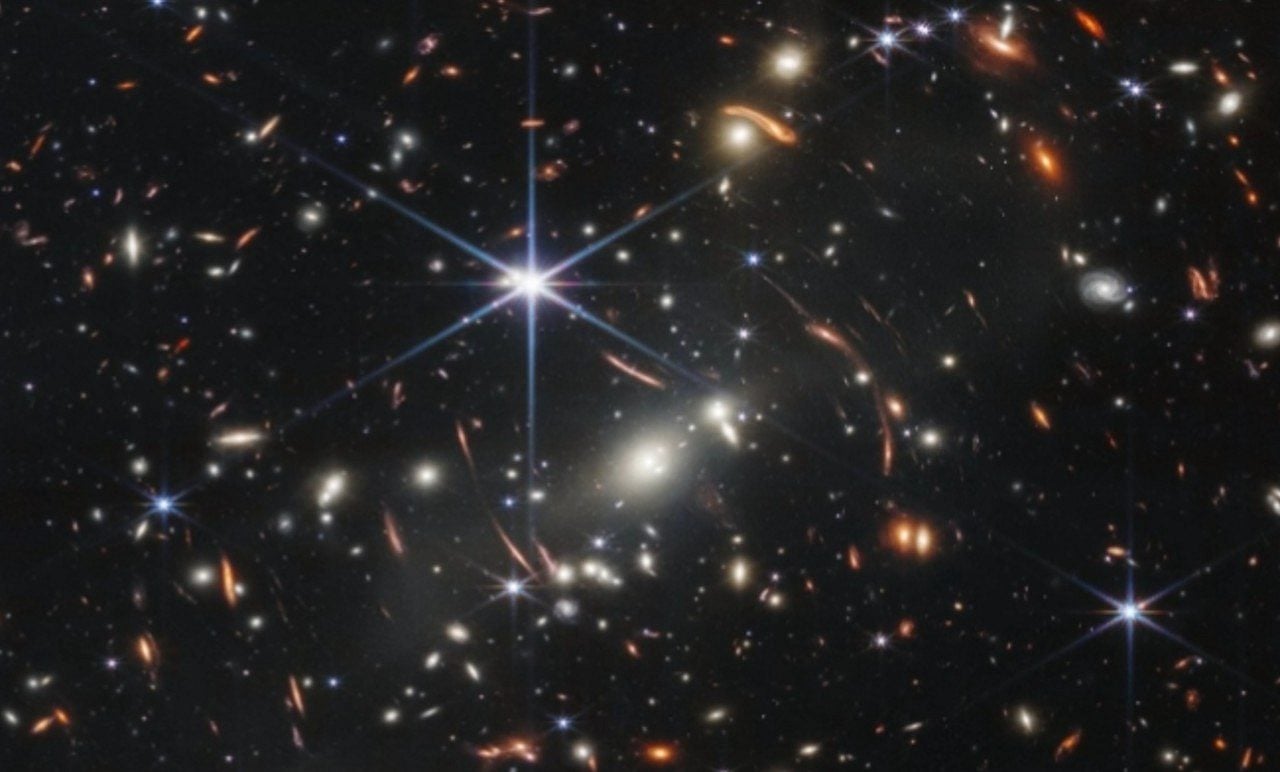
This Webb capability became clear with analysis of the galaxy cluster MACS J0308.9+2645, a record that initially came from Hubble. This area of space, rich in galaxies and gravitational lensing phenomena, had previously revealed star systems formed approximately 13 billion years ago, when the universe was just 1 billion years old. Such galaxies appeared as deformed “gravitational arcs”, with their light amplified by the mass of the cluster. However, other discoveries were waiting to be revealed.
In recent research, astrophysicist Homer Dávila Gutierrez located a new object that may be a gravitational arc within the same cluster MACS J0308.9+2645.
Gutierrez is known as the founder and director of SKYCR.ORG, a Spanish-language news portal dedicated to astronomy and space exploration. He is also the first citizen of Costa Rica to be elected a member of the Royal Astronomical Society and the European Astronomical Society.
The researcher confirmed the detection of the arc candidate, called A1, after examining historical data from the James Webb Space Telescope’s Near Infrared Camera (NIRCam). This information was collected during Webb’s General Observation 5293 campaign.
Gravitational lensing, a phenomenon predicted by Albert Einstein’s Theory of General Relativity, occurs when massive objects curve space-time. Light, when passing through this gravitational field, is distorted and amplified. For many years, astronomers have used these natural “lenses”, formed by objects in the foreground, to visualize fainter and more distant light sources.
The galaxy identified by Gutierrez displays the typical hallmarks of this effect, with a stretched and curved shape. He discovered the A1 object by reviewing 54 public areas captured by JWST’s NIRCam, evaluating 1,591 potential candidates. Among all, only A1 proved to be a strong candidate for a gravitational arc, indicating its possible existence in the early stages of the universe.
As explained by Gutierrez, three essential factors make the A1 unique. Its geometry, being quite elongated with an axial ratio of approximately 6.5, and its precise tangential alignment with respect to the center of the cluster, are consistent with deformation by gravitational lensing. Furthermore, its brightness makes it the brightest source among the elongated ones in the region, facilitating measurement. Finally, A1 is not included in any existing catalog of gravitational lenses, such as SIMBAD, NED or VizieR.
The astrophysicist reported that, upon contacting the team responsible for the GO-5293 program, it was confirmed that the object did not overlap with other systems under study. “A real, bright, uncatalogued arc-like source in a massive cluster selected by Planck is what made the investigation interesting,” he said.
Using the EAZY photometric tool for a multiband analysis, Gutierrez calculated a redshift value of z ≈ 4.4. This data places A1 in the first 1 billion years of the existence of the universe. A subsequent analysis, using a method developed by Israeli astrophysicist Ana Acebron in 2018, imposed limits on the mass of the MACS J0308.9+2645 cluster, indicating that the A1 object underwent a seven-fold magnification.
With the photometric adjustments made, A1 reveals itself to be a galaxy with a redshift of approximately z ≈ 1.4, which means that we are observing what it was like 9 billion years ago. This object is located behind the cluster MACS J0308.9+2645, which has a redshift of z = 0.356 and is one of the most massive ever detected. The light from A1, when passing through the cluster, was subjected to a simple gravitational lens, resulting in an image stretched and slightly magnified by the gravitational force of the cluster, and not multiple images.
“A1’s estimated position, about 51 arcseconds from the cluster’s X-ray center, and its tangential elongation are in good agreement with the observed image,” Gutierrez said. He added that the final test, which involves an updated gravitational lensing model of the cluster with recent JWST data, remains under development.
The research also indicated the presence of a second potentially similar object, called A2, which shares geometric characteristics with A1. However, this light source is considerably weaker, smaller, more stretched, and its photometric measurement is less accurate. The projected distance of A2 in relation to the central cluster is similar to that of A1.
“This situation is relevant because the photometric problem that influenced the initial estimate of A1’s redshift – where catalog measurements capture only a small part of the light from an extensive source – further impacts a less luminous source like A2,” explained Gutierrez. He considered the nature and redshift of A2 as points to be clarified, pending the same corrected reanalysis applied to A1.
The most exciting result of these findings is the indication that countless other early galaxy candidates may be hidden in the data collected by the Webb Telescope.
“Webb’s public collection is growing at a pace that exceeds the capacity of individual analysis, and this discovery demonstrates that previously released data holds crucial information, accessible to dedicated researchers,” said Gutierrez. He also pointed out an important lesson: automated catalog photometry can generate significant errors for large sources, as in the case where a much larger redshift was initially suggested. Therefore, verification, new independent measurements and communication with the original program team are essential.
“The most rewarding step in this entire process was collaboration: the GO-5293 team gave their support, confirmed that the object was not cataloged, and now we are jointly developing their updated lens model to define the nature of A1,” he concluded. He highlighted the importance of partnerships between autonomous researchers and program teams using public data, exemplifying the ideal functioning of the Webb archive.