
Fossil from Argentina rewrites origin of viviparity in mammal ancestors over millions of years


The discovery by paleontologists in Argentina, announced on August 13, 2026, revealed new information about the evolution of mammals. By examining a 236-million-year-old cynodont fossil, the team found the oldest recorded evidence of viviparity — the birth of live offspring — in the ancestral lineage that gave rise to mammals, advancing this origin by up to 90 to 95 million years.
Dr. Leandro Gaetano, paleontologist at the National Council for Scientific and Technical Research (CONICET), together with his colleagues, explained that “viviparity represents a crucial evolutionary acquisition for mammals, being a distinctive characteristic of current therians and considered essential for their success in evolution”.
He also clarified that “this reproductive method differs from oviparity, which is the ancestral and most primitive condition among vertebrates.”
Despite this, viviparity emerged independently on more than 150 separate occasions throughout the evolution of vertebrates, according to scientists.
Contemporary therians, a group that includes placental and marsupial mammals, have a series of complex and interconnected traits, such as placental development, milk production and hormonal controls, which indicate viviparity as a shared characteristic of their group.
In contrast, monotremes, although they also exhibit a form of placentation – which involves the absorption of secretions from the oviduct, unlike the yolk sac or chorioallantoic placentas of therians – are known to lay eggs.
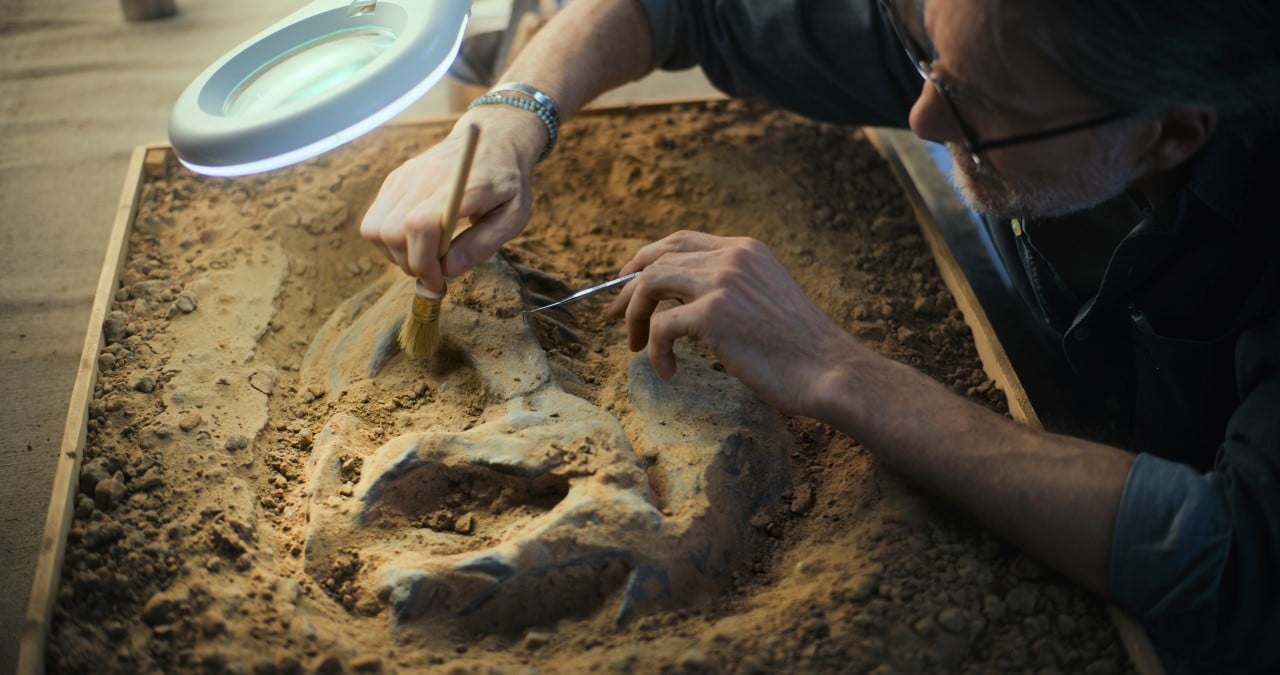
For the study, scientists analyzed the fossilized remains of a cynodont, a creature called Chiniquodon theotonicus, which had the size of a domestic cat and inhabited northwestern Argentina during the Triassic period.
When inspecting thin sections of the animal’s femur and ulna under a microscope, a clear change in the bone tissue was observed near the center of each bone. This “neonatal line” is an indicator of the moment of birth, a characteristic already recognized in extant mammals, but unprecedented in a non-mammalian relative from such a remote era.
Bone circumference measurements along this line made it possible to estimate the cynodont’s body mass at birth: around 1.68 kg, contrasting with its almost 12 kg when it reached adulthood.
This proportion—the newborn weighing between 10% and 20% of the adult weight—is remarkably similar to that of today’s placental mammals, and does not resemble that of oviparous reptiles, birds, marsupials, or monotremes, which generally give birth to smaller young.
Furthermore, a statistical analysis that compared the fossil with data from nearly 1,900 species of mammals, 2,600 species of reptiles and 780 species of birds consistently categorized the ancient creature alongside placental mammals.
“With this research, we demonstrate for the first time that live birth of young existed in at least one mammalian ancestor, Chiniquodon theotonicus, which lived approximately 236 million years ago,” said Dr. Gaetano.
“This finding suggests that viviparity among the oldest cynodonts arose in the mammalian lineage at least 95 to 90 million years earlier than previous estimates,” added the researcher.
The new findings question the long-held belief that all non-mammalian cynodonts reproduced through eggs and that the birth of live young evolved once, specifically in the therian mammals that gave rise to contemporary placentals and marsupials.
Given this, scientists have presented two evolutionary scenarios that they consider equally likely: viviparity may have developed independently both in the Chiniquodon theotonicus lineage and, later, in therian mammals; or alternatively, this trait may have arisen only once in early mammalian ancestry, with oviparous monotremes such as the platypus representing a return to a more primitive condition.
“There is a strong possibility that Chiniquodon theotonicus is not the only example of viviparity among cynodonts,” noted Dr. Gaetano.
“This discovery may indicate a broader transition, from eggs to the birth of live offspring, that occurred early in the evolution of the mammalian lineage,” the expert added.
“However, more evidence is needed to confirm this hypothesis”, pondered the paleontologist.
“Even so, it is clear that some cynodonts had characteristics very similar to those of today’s mammals,” he concluded.
The complete results of the work were published in the journal Frontiers in Mammal Science, on August 13, 2026.



