

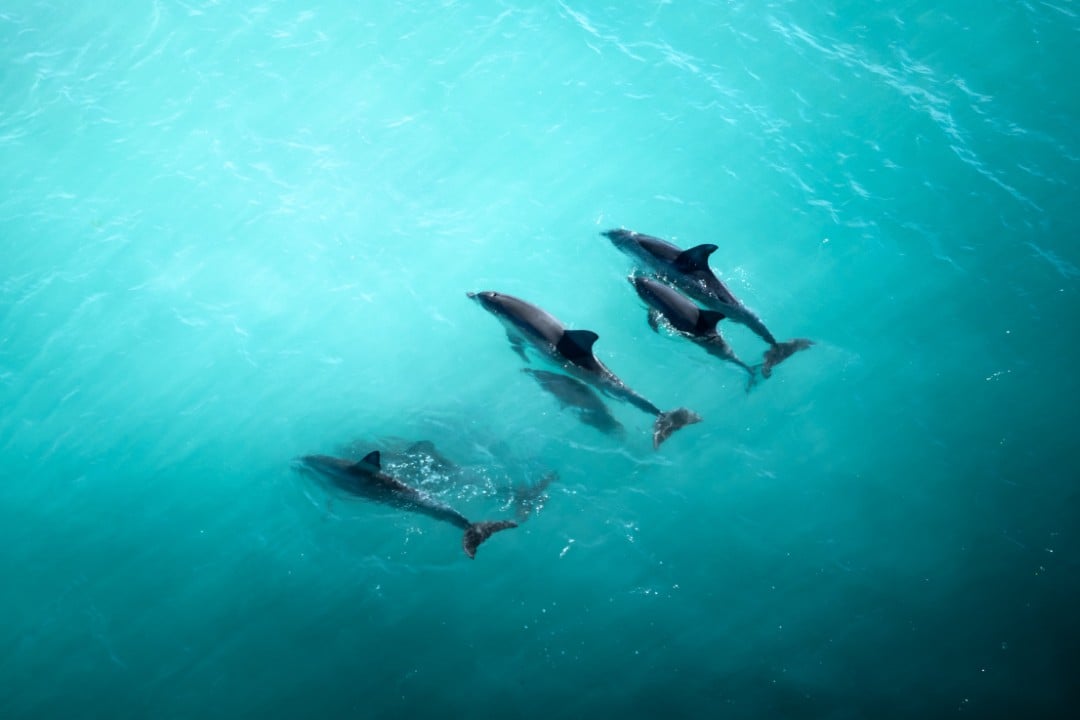
Marine scientists have recorded Indo-Pacific bottlenose dolphins (Tursiops aduncus) using large shells to hunt fish off the coast of Queensland, Australia. The discovery, made public on August 12, 2026, marks the second global site to document this technique, known as “shelling.”
The image from January 4, 2019 illustrates a shelling episode. The photo was attributed to Levengood et al., according to the scientific article.
The “shelling” technique involves a dolphin lifting an empty gastropod shell — in this case, the bucket shell (Melo amphora), which can reach the size of an American football — to the surface of the water. He then tilts it to drain any fish that may be hiding inside.
On the same topic: Veterinary research documents first cow in the world to use tools to scratch its body
This behavior is classified as a form of tool use, an unusual ability in the animal kingdom. This particularity has generated great scientific interest, as it can reveal important information about cognition and culture in nature.
The new observations took place in Hervey Bay, an area of the Great Sandy Marine Park. This location is a considerable distance from Shark Bay, Western Australia, which was until then the only known point where the tactic had been confirmed.

Dr Alexis Levengood, a researcher at the University of the Sunshine Coast, reported the experience. She stated: “We were on a research boat near Hervey Bay when we saw a dolphin lifting something big out of the water. I started screaming because I know what a dolphin breaking shells looks like.”
She explained the process: “It is a hunting behavior in which dolphins chase fish to large empty shells, bring the shell to the surface and then shake it so that the fish flows into their mouth.”
“We were able to record images and take photographs of dolphins collecting shells in the Great Sandy Marine Park, which represents the first published record of this phenomenon on the east coast of Australia”, added the doctor.
The scholars recorded two “shelling” moments in 2025. Older photos, provided by a local whale watching operator, dated 2013, were also included in the analysis.
More on this story: Scientists record Austrian cow using a brush to scratch its body
In the first sighting, on July 6, 2025, an adult female, nicknamed Stevie Nicks, was seen manipulating a fishing shell at the surface before releasing it.
The second record, on October 1, 2025, brought more revealing data. A mother dolphin, named Maserati, emerged with a shell containing a fish and then dropped the shell to chase her prey. A few minutes later, in the same location, her puppy, Bentley, was observed picking up the shell and repeating the behavior.
This sequence offers the first indication that the ability is transmitted directly from mother to offspring. This pattern is known as vertical social transmission.
Full coverage: Latest News (EN)
Dr. Levengood detailed what happened: “We saw the mother emerge with a shell, the fish inside escaped and the dolphin dropped the shell to chase the fish.”
“Then, minutes later, the baby dolphin picked up the shell and held it in the same way as its mother,” she said.
The researcher reported that “Our footage provides the first potential evidence of maternal social transmission — a process by which puppies learn behaviors by observing their mother’s actions.”
Learn more: Thousands of dolphins jump and surround boat in surprising encounter recorded in Mexico
“This questions the belief that dolphins learn to use this tool from their peers”, pondered the expert.
“These discoveries highlight how intelligent, cunning and innovative dolphins are,” she said.
Dr. Levengood concluded by saying, “More research is needed to understand the nuances of shell digging and to clarify transmission pathways and links to ecology, cognition, culture, and evolution.”
A study detailing the findings was published on August 8, 2026 in the journal Marine Mammal Science.