
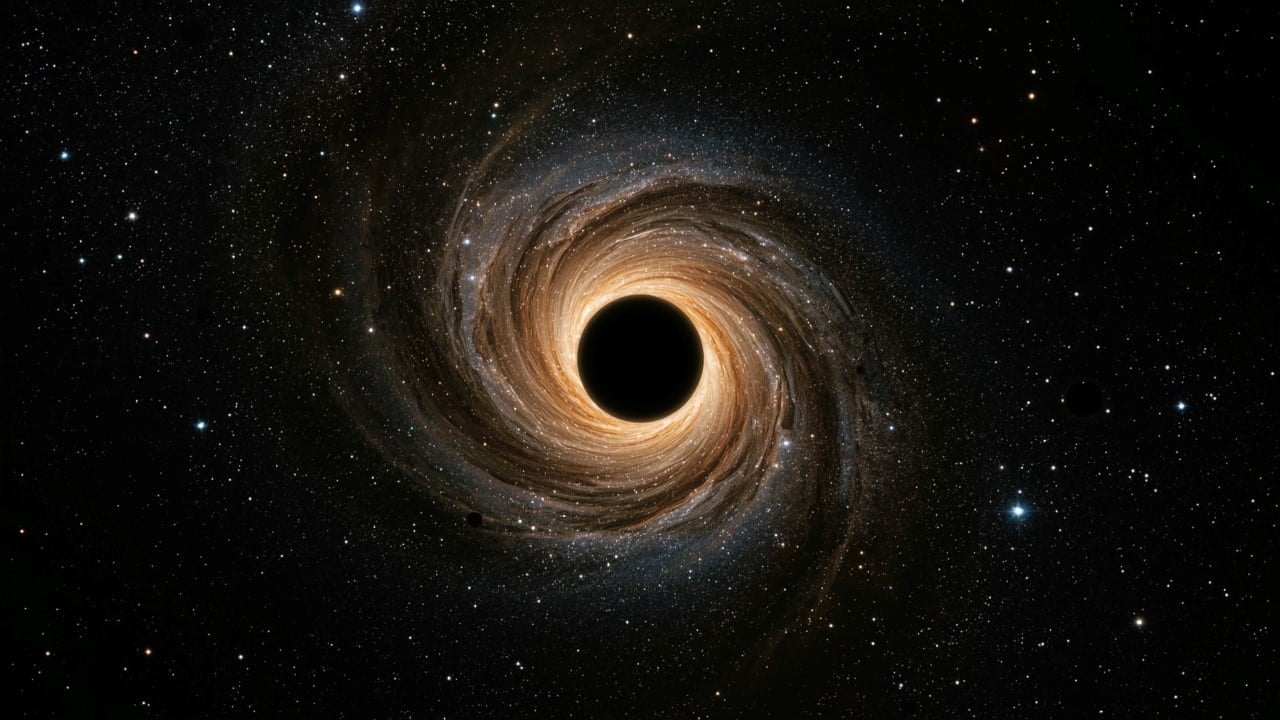
A significant advance in astronomy has been announced with the first detection of three fully active supermassive black holes, all located in a single distant galaxy. The discovery, made by an international team, offers new insights into the formation and evolution of galaxies in the early cosmos.
Led by the Max Planck Institute for Extraterrestrial Physics, the group of researchers identified these celestial giants in the galaxy J0148-4214. This star system is more than 12.5 billion light years from Earth, which corresponds to a period of approximately 1.2 billion years after the Big Bang, the event that gave rise to the universe. The research used spatially resolved integral field spectroscopy (NIRSpec-IFS) data from the James Webb Space Telescope (JWST).
Hannah Übler, who leads the research group at MPE and is the study’s lead author, said this is the first evidence of multiple active black holes in a single galaxy this remote. She explained that two of the black holes are close together in the galactic center, just 620 light years apart. A third was found in an outer area, about 5500 light-years from the center. Übler said the existence of this “cosmic trio” suggests that events in the early universe were highly efficient at grouping together massive black holes, which sets the conditions for the mergers that future gravitational wave observatories like LISA hope to capture.
How the presence of black holes was identified
Scientists have been able to identify black holes through their spectral “fingerprints,” which are the signatures of high-speed hydrogen atoms within the black holes’ powerful gravitational field. In the central region of the galaxy, the spectrum showed a complex structure, which was best explained by the presence of two very close black holes. To distinguish them, the team applied the technique of spectro-astrometry, which precisely measures small spatial changes in line emission across the galaxy. This approach made it possible to determine the location of black holes, even though they could not be visually separated as individual points. The third black hole was found in the furthest area.
The research team also analyzed and ruled out other possible explanations for the spectral signatures, such as supernovae, shocks, stellar winds or very massive stars. Detailed analysis of other spectral signatures confirmed that the detections did indeed correspond to active black holes.
Measurements of the masses and growth of these cosmic objects
Analysis of the data indicated that the black holes have masses of approximately 80 million, 0.6 million and 2 million times the mass of the Sun. The most massive black hole among the three is accumulating material at a lower rate compared to the black hole of 0.6 million solar masses, which is actively feeding and even surpasses the maximum accretion limit predicted by basic black hole growth theories, known as the Eddington limit.
Dr. Giovanni Mazzolari, second author of the study and researcher at MPE, detailed that the JWST information was crucial not only to identify the three black holes, but also to estimate their masses, accretion rates and the galaxy’s stellar mass. He reported that the galaxy has a total stellar mass of about 1.3 billion solar masses and that black holes represent a significant portion of that total.
The pair of central black holes is expected to merge within the next few hundred million years. Roberto Maiolino, professor at the University of Cambridge and co-author of the study, called the results “extremely exciting”, indicating that the merger of black holes could be a rapid and additional path to the accelerated growth of these objects in the early universe.
The third black hole, located outside the galactic nucleus, may be the remnant of a previous merger, having been ejected from the center by a gravitational “recoil”, or it may be currently migrating towards the center of the galaxy.
New perspectives for research into the distant universe
These observations demonstrate the importance of full-field spectroscopy as a vital tool for identifying multiple active black holes in distant galaxies. Without the spatially resolved data provided by NIRSpec-IFS, it is likely that only one of the three black holes would have been detected, limiting understanding of the system.
The discoveries bring new insights into understanding the growth of supermassive black holes and the galaxies that host them. They reinforce the idea that mergers and interactions played a crucial role in the early universe and identify this system as a potential precursor to future black hole mergers that could be observed by upcoming gravitational wave facilities such as LISA.





