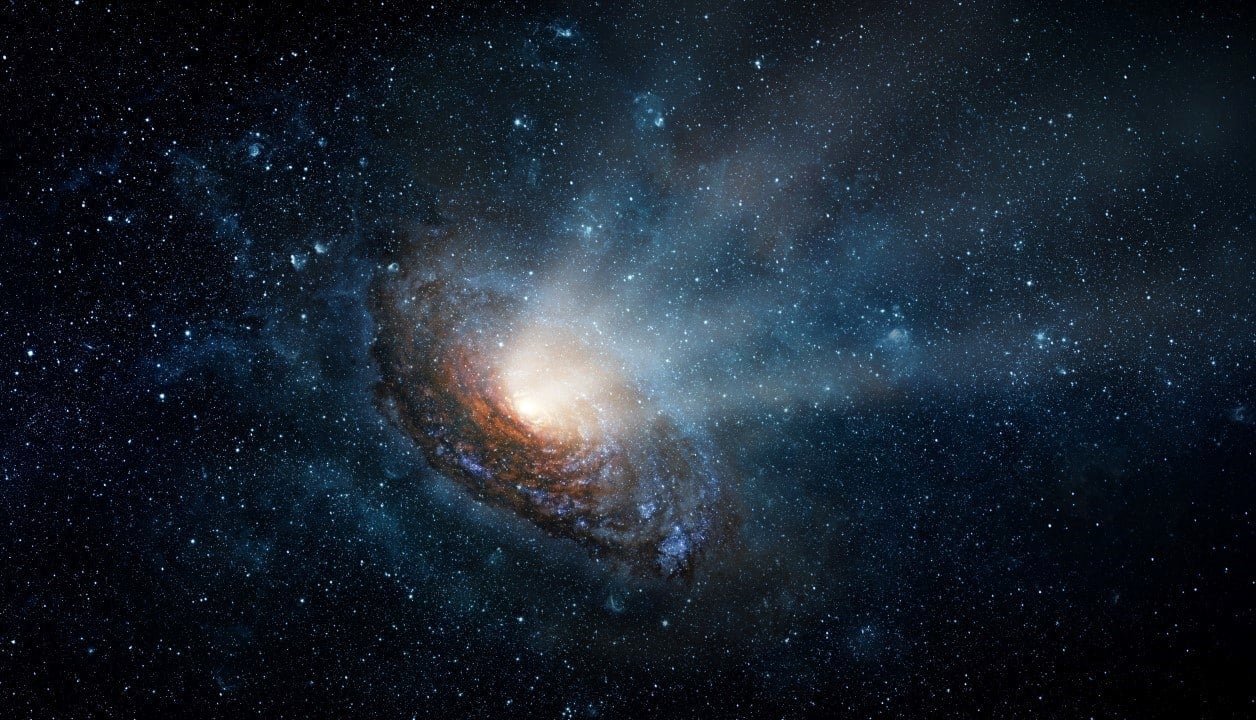
Astronomers have confirmed the observation of a supermassive black hole moving through space, expelling a trail of hot gas at hundreds of thousands of kilometers per hour. The rare event challenges conventional understanding of how these cosmic giants interact with their host galaxies. The discovery offers a unique window into the dynamic processes that can eject such massive objects out of their galactic centers.
Unraveling the origin of a wandering black hole
Scientists are investigating how a black hole can be ejected from its home galaxy with such speed. One of the most accepted theories suggests that the expulsion could be the result of a galaxy collision, where two supermassive black holes merge. During this merger, the emission of gravitational waves can be asymmetric, generating a “recoil” that launches the newly formed black hole out of the galactic center.
Another hypothesis considers the interaction of multiple black holes in compact systems. In a three-body encounter, gravity can act as a kind of cosmic slingshot, flinging one of the black holes away at high speed. This phenomenon is rare, but not impossible, and requires very specific conditions regarding the mass and trajectory of the bodies involved.
The trail of destruction and formation through the cosmos
The journey of a wandering black hole is not silent. As it traverses intergalactic space, it leaves behind a trail of superheated gas and compressed material. This high-speed passage creates powerful shock waves in the diffuse gas that permeates the universe, energizing it to extremely high temperatures and, in some cases, triggering the formation of new stars.
The observed wake, more than 200,000 light-years long, acts as direct evidence of the black hole’s gravitational and thermal impact on its environment. It is estimated that millions of stars could be born along this path, transforming vast regions of the cosmos. This process, driven by an object that does not emit light, reveals an unexpected way of seeding new stellar generations.
The complexity of detecting an invisible object
The nature of a black hole, which absorbs all light and radiation, makes its detection a colossal challenge for astrophysicists. They are identified by their gravitational effects on surrounding matter and energy, not by direct observation. In the case of the runaway black hole, the key to its identification was the observation of the trail of ionized gas and the intense X-ray radiation it produces when interacting with the interstellar medium.
Advanced instruments such as the Hubble Space Telescope and other X-ray observatories have been crucial in capturing these indirect signatures. Analysis of the light spectrum of the ejected gas allowed scientists to determine its speed and composition. Confirming the existence of this traveling black hole highlights the importance of multifaceted approaches in observational astronomy.
The role of these objects in the evolution of the universe
Supermassive black holes, usually located in the hearts of galaxies, play a fundamental role in cosmic evolution. Its influence extends from regulating stellar growth to shaping galactic structure. The existence of runaway black holes, although uncommon, suggests that galactic centers may be much more dynamic and violent environments than previously imagined.
These extreme events offer a new perspective on the distribution of dark matter and the formation of galaxies. By studying these cosmic travelers, astronomers hope to unlock secrets about the earliest stages of the universe, the interaction between galaxies and the fundamental nature of gravity in its most extreme manifestations. The study of wandering black holes continues to push the limits of modern astrophysics.