

Astronomers operating the James Webb Space Telescope have identified an unusual cosmic object, shining with the energy equivalent to about 100 billion suns, but which is not a conventional star. Discovered on August 17, 2026, the celestial body, nicknamed MoM-BH*-1, turned out to be an intensely feeding black hole, surrounded by a dense layer of gas that gives it the appearance of a colossal star in the early universe. This phenomenon, which occurred approximately 660 million years after the Big Bang, offers important clues about the formation of supermassive black holes in the early cosmos.
Identification of an unusual cosmic object by the James Webb Telescope
MoM-BH*-1 was initially detected in an extragalactic field as a distinct red dot, catching the attention of scientists. The James Webb images, taken through the NIRCam camera’s F356W and F444W filters, showed a point light source that disappeared at shorter wavelengths. This peculiarity in the color sequence and its extreme brightness, without being resolved as a direct stellar structure, indicated that the object did not fit into traditional astronomical classifications.
Spectroscopic analysis performed by Webb’s NIRSpec provided the crucial evidence. Multiple features of the spectrum pegged its redshift at 7.7569, confirming its existence in a universe just 660 million years old. The spectrum revealed a massive change in brightness across the Balmer limit, a phenomenon that puzzled researchers.
The unusual nature of a “black hole star”
Unlike stars that generate energy through nuclear fusion, the intense radiation from MoM-BH*-1 is powered by an accreting black hole, deeply buried in a kind of cocoon of extremely dense gas. The matter that spirals towards the black hole releases gravitational energy, heating and filtering through this gaseous atmosphere. This process causes the object to radiate from a much larger effective surface, mimicking the appearance and radiative behavior of a star, which led astronomers to call it a “black hole star.”
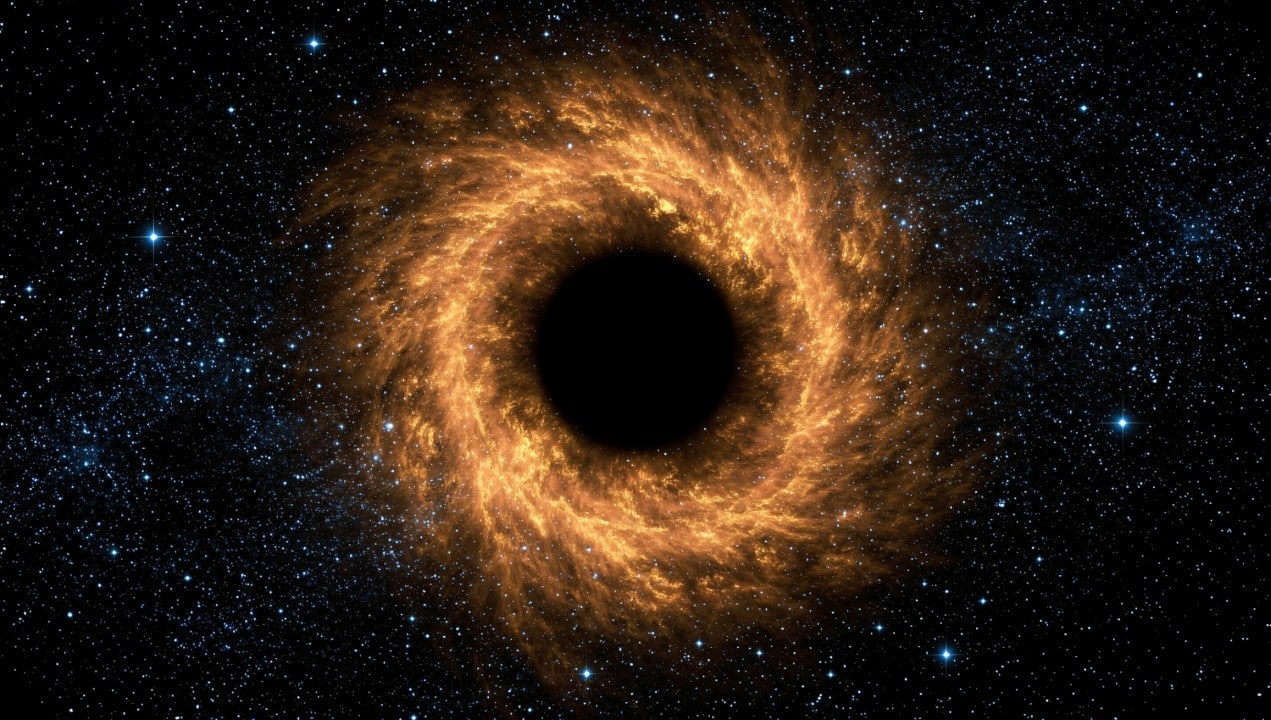
The theory is that the dense gaseous “photosphere”, which extends about 10 to 100 astronomical units, reprocesses radiation from the central engine. This mechanism allows the object to shine with a bolometric luminosity close to 10^45 ergs per second, equivalent to 10^11 solar luminosities. It is important to emphasize that this comparison refers to the emitted power, and not to the mass or diameter of the object, which are significantly smaller.
Spectral clues: the enigmatic “Balmer leap” and other evidence
James Webb Telescope measurements revealed unique spectral features that defied common models of stars and galaxies. The “Balmer jump”, caused by the absorption of photons by hydrogen atoms, was measured at a strength of 7.7, a value far above that expected for dust-free stellar populations, which would reach a maximum of about 3. Even a hypothetical limit of type A stars would be below 5.
- A strong “Balmer jump” that indicated an abrupt change in brightness in certain bands of light.
- Hydrogen-beta emission with multiple spikes, suggesting turbulence around the object.
- Absorption in hydrogen-beta and hydrogen-gamma, adding complexity to the spectral profile.
- A narrow oxygen doublet that confirmed the redshift, placing the object in the cosmic chronology.
These observations, combined with the absence of dust in the gaseous cocoon in the researchers’ preferred model, contrast with usual explanations of quasars reddened by dust. It is believed that hydrogen gas itself blocks and reprocesses shortwave radiation, generating the sharp “Balmer jump.”
How discovery could rewrite the formation of ancient black holes
The existence of MoM-BH*-1 and other “little red dots” observed by Webb raises crucial questions about how quickly supermassive black holes could form in the early universe. Black holes with billions of solar masses already existed in the first 700 million years after the Big Bang, which is a puzzle for current models of growth from stellar remnants.
An opaque gas cocoon like the one surrounding MoM-BH*-1 could be the key to unlocking this mystery. This dense layer can trap or redistribute accretion energy, decreasing the external force that would normally eject fuel from the black hole. This would allow the black hole to grow much faster than usual, before the cocoon dissipates and reveals an active galactic nucleus or more conventional quasar. MoM-BH*-1 offers a glimpse into a rare and crucial phase in the early growth of massive black holes.
The next steps in the MoM-BH*-1 investigation
Although the interpretation of a “black hole star” fits well with observational evidence, the study authors describe their model as simplified. The internal geometry of the object is not uniquely proven, and factors such as the assumed accretion spectrum, gas shape and energy transport can vary.
To confirm this hypothesis, future observations will be essential. Longer-term monitoring, deeper spectra and observations at longer wavelengths could test whether the source varies like an active black hole and whether its cocoon behaves as predicted. Such studies will help refine the model and fully understand the nature of objects as unique as MoM-BH*-1, providing a crucial link to understanding the evolution of the universe.





