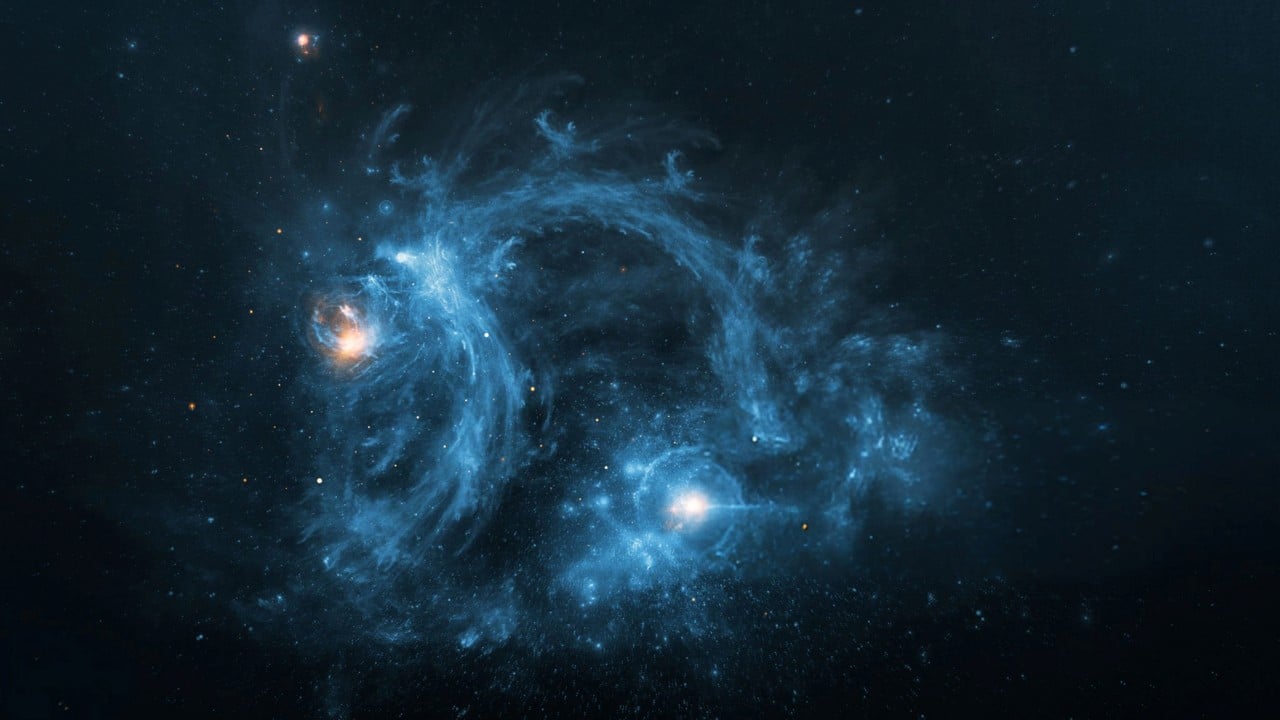
New evidence from the James Webb Space Telescope (JWST) is helping astronomers unravel one of the most fascinating enigmas of the early universe. Seemingly insignificant dots, dubbed “red dots,” seen in Webb’s first deep-field images may actually be complete, as-yet-unrecognized galaxies hidden in the vastness of the cosmos. A recent study advances the understanding of these objects, using the observation of a distant spiral galaxy that was nicknamed Saguaro.
The mystery of the “red dots” of the distant universe
Since its first observations, the James Webb Space Telescope has revolutionized cosmology, offering unprecedented views of the nascent universe. One of the surprises was the abundance of small, reddish light sources, the so-called “red dots”, which defied the expectations of galaxy formation models. These extremely distant objects appear red due to the strong redshift of their light caused by the expansion of the universe, indicating that the light has traveled billions of years to reach us. The main puzzle was determining whether these dots were young, compact galaxies or some other type of cosmic phenomenon.
Most previous cosmological models did not predict such a high density of galaxies in the early stages of the universe. The presence of these “red dots” in large numbers suggests that stellar and galaxy formation may have occurred more quickly and intensely than previously imagined in the first million years after the Big Bang. Understanding the nature of these objects is crucial for mapping the evolution of the universe and calibrating existing theories about how cosmic structures formed. They represent a challenge and an opportunity to adjust our knowledge about the infancy of the cosmos.
The Saguaro galaxy offers new clues for research
The recent study focuses on a detailed observation of the Saguaro spiral galaxy, located in a particularly dense region of the universe. Astronomers used Webb’s high-resolution infrared instruments to examine Saguaro and its surroundings. The analysis revealed that, around Saguaro, several of the “red dots” display spectral and morphological characteristics that are consistent with the presence of compact but already formed galaxies composed of ancient, dusty stellar populations. The Saguaro galaxy itself is a well-defined spiral, a type of structure that was believed to be less common in the early eras of the universe.
The new observations suggest that many of these “red dots” are not just clusters of stars in formation, but rather galaxies that have already undergone a significant period of development. Cosmic dust, which absorbs visible light and re-emits it in the infrared, plays a key role in making these objects “red” and difficult to detect by telescopes operating at other wavelengths. Webb’s ability to “see” through this dust is what allows us to further this investigation and reveal the true nature of these celestial bodies. The structural complexity and apparent maturity of these “dots” alter the perspective on the pace of galactic evolution.
Why points of light can be entire galaxies for science
For the non-specialist public, the idea that a “point” of light is, in fact, an entire galaxy may seem counterintuitive. However, the universe operates on unimaginable scales of time and space. Light from these objects travels billions of light years, traversing the vastness of intergalactic space as the universe expands. This enormous distance makes intrinsically large objects appear as mere dots in the sky, even to the most powerful telescopes. It’s a question of perspective and how distance affects our perception.
Furthermore, the expansion of the universe stretches light waves from distant objects, shifting them to the red side of the electromagnetic spectrum. Visible light emitted by young stars in distant galaxies, for example, is stretched to infrared wavelengths. That’s why James Webb, with its infrared-optimized instruments, is so crucial to this research. It can capture this “red” light that other telescopes would not see, revealing details that would otherwise remain hidden. A point of light is the signature of a massive but distant object where millions of stars shine together.
The essential role of the James Webb Space Telescope in discoveries
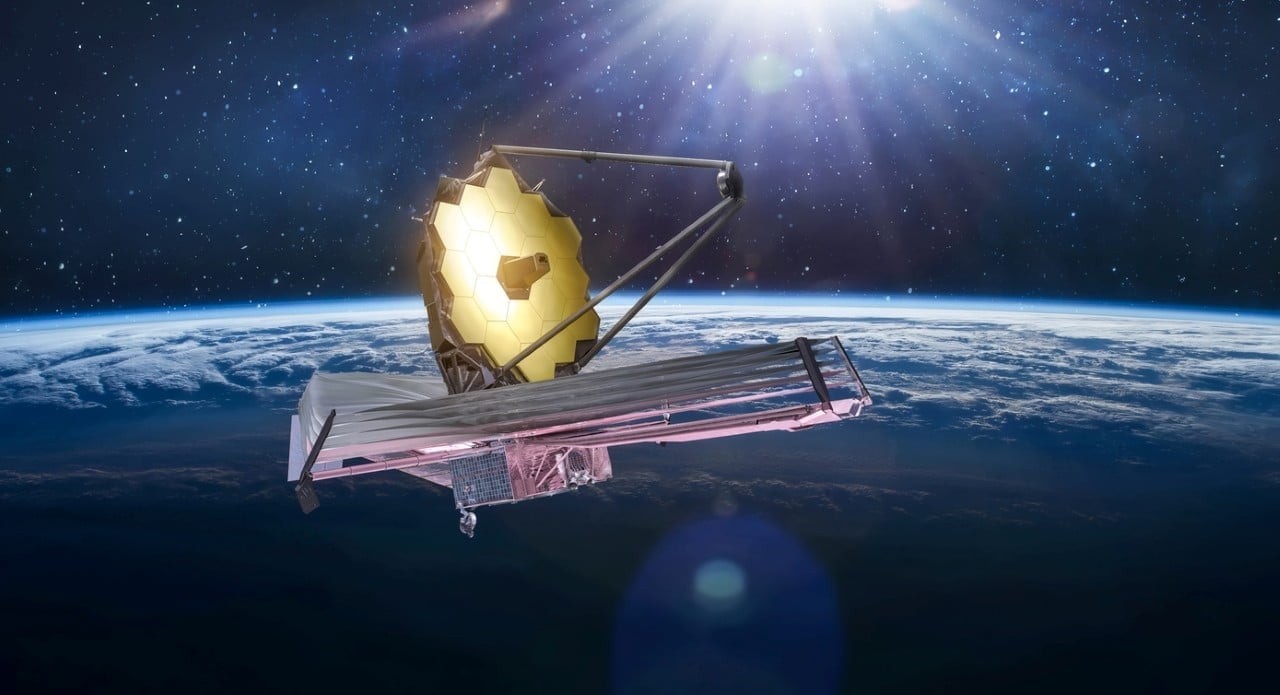
The James Webb Space Telescope represents a technological leap forward over its predecessors, especially with regards to its ability to observe the universe at infrared wavelengths. Unlike Hubble, which focuses mainly on visible and ultraviolet light, Webb is designed to capture infrared light, which is essential for investigating the beginnings of the cosmos. The light from the first galaxies, emitted billions of years ago, is strongly redshifted due to the expansion of the universe and can only be detected effectively in the infrared.
Equipped with a 6.5-meter-diameter primary mirror, the largest ever sent into space, and a suite of highly sensitive instruments, Webb can detect even the faint glow of galaxies at record distances. Its location at the L2 Lagrange point, about 1.5 million kilometers from Earth, guarantees a stable and cold environment, essential for its infrared observations. This combination of mirror size, sensitivity and spectral range allows Webb to unlock the secrets of a previously inaccessible cosmic era, offering a unique window into the formation of the first stars and galaxies.
Implications of the new evidence for star formation and galactic evolution
Confirming that the “red dots” are, in fact, entire galaxies would have profound implications for current cosmological models. This suggests that the formation of galaxies and stars occurred at a much faster pace in the first billion years of the universe than previously predicted. If these galaxies were already mature and had ancient stellar populations so far back in time, this challenges the idea of a longer cosmic “dark age” where the formation of large structures was less frequent.
These findings could indicate the need to review star formation rates and the mechanisms that led to the initial growth of galaxies. The presence of cosmic dust in these distant galaxies is also notable, as the dust is generally produced by older, more massive stars in later stages of their lives. The detection of this dust so early in cosmic history implies that generations of stars had already been born, lived and died, enriching the interstellar medium and setting the stage for new formations. These observations refine our understanding of the life cycle of galaxies and the distribution of heavy elements in the early universe.
Upcoming investigations and the future of cosmology with Webb
Despite the advances brought by the study of the Saguaro galaxy, research into Webb’s “red dots” is just beginning. Astronomers plan to perform more high-resolution spectroscopic observations to confirm the nature and properties of these objects. Spectroscopy makes it possible to analyze the chemical composition, age of stars and the internal dynamics of these galaxies, offering a more complete picture of their evolution. It will be critical to distinguish between galaxies that are actively forming stars and those that have already reached a stage of “retirement.”
The James Webb Space Telescope will continue to be an indispensable tool on this journey of discovery. The expectation is that, with more data and in-depth analysis, scientists will be able to build a more detailed panorama of the cosmic “timeline”, from the first moments after the Big Bang to the formation of the complex galaxies we observe today. Future investigations will seek not only to confirm the abundance of these primordial galaxies, but also to understand how they group, interact and influence the evolution of other structures in the evolving universe. The search for answers continues to shape our understanding of the origin and destiny of the universe.