
Evidence of water on Mars reinforces the planet’s past with life conditions
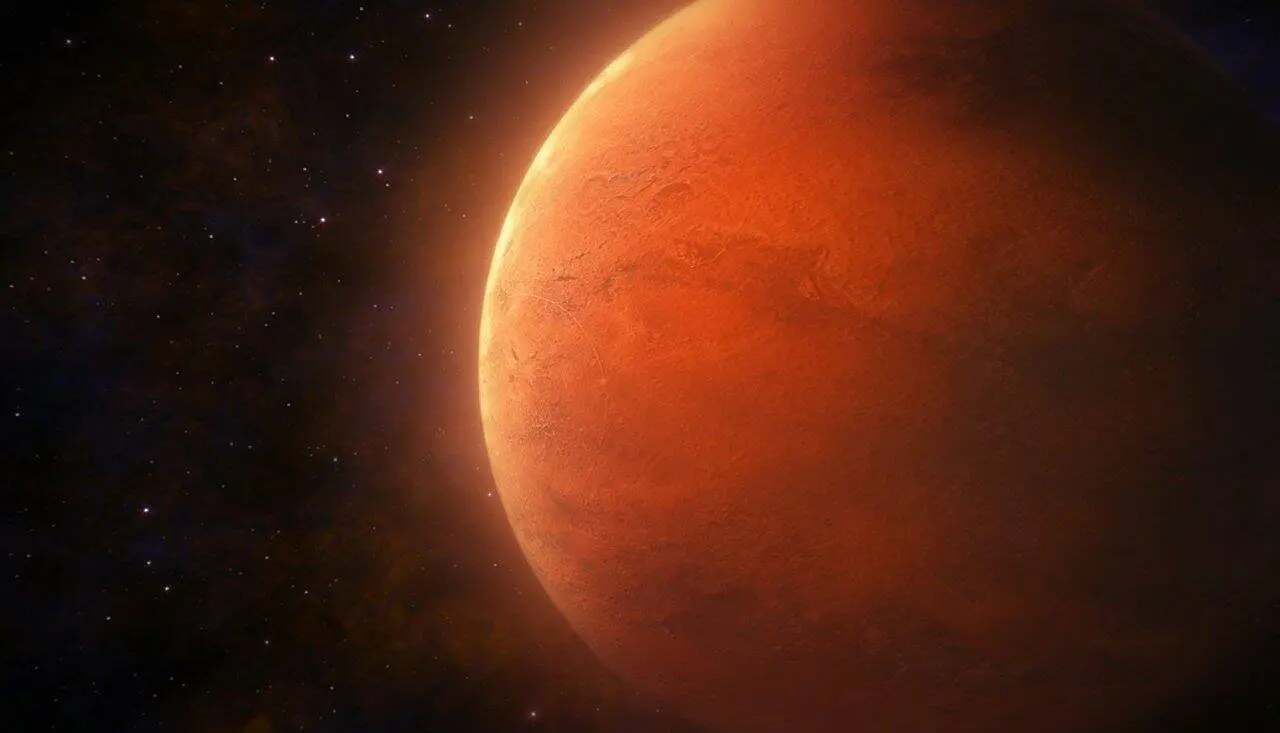
Recent international research has revealed concrete evidence of the existence of water in Mars’ distant past. The discovery, driven by European scientists, contradicts the current image of the Red Planet as an arid, dust-covered celestial body.
The study points to a very different scenario in the planet’s history, suggesting that significant amounts of water were stored in its rocks billions of years ago. This finding has profound implications for understanding Martian evolution and the search for signs of life beyond Earth.
Read also: The disappearance of water from Mars has two explanations: loss to space and underground reserves
Researchers use innovative technique to analyze Martian meteorite
In a significant advance for space research, a team of scientists has employed non-destructive imaging methods to investigate the interior of meteorite NWA 7034, famous as “Black Beauty”. This innovative technique made it possible to examine the rock without the need to cut or damage it, something essential for such valuable samples.
The “Black Beauty” meteorite is considered one of the most important ever found, as its composition dates back to extremely ancient periods of the formation of Mars. Fragments analyzed date back around 4.48 billion years, offering a primordial record of the planet’s evolution.
Learn more: Scientific survey in Science demystifies the rule of two liters of water per day and points out variations
Combination of tomography reveals hydrogen in the rock’s internal structure
To uncover the meteorite’s secrets, researchers combined X-ray tomography, effective in detecting dense materials, with neutron tomography. This last technique is particularly useful in identifying hydrogen, a key element in the discovery of water and hydrated minerals.
The union of these two technologies allowed the construction of a detailed three-dimensional map of the internal structure of “Black Beauty”. With this, it was possible to locate specific regions with a high concentration of hydrogen, confirming the presence of water without compromising the integrity of the sample.
Fragments of the meteorite contained up to 11% water in their composition
The detailed analysis of “Black Beauty” revealed that its structure is not homogeneous, but a mosaic of different rock fragments, called clasts. These small pieces may have originated in different regions or geological eras of Mars, preserving crucial information about the planet’s past.
Understand the case: New tomography reveals 11% of water hidden in fragments of the Martian meteorite Black Beauty
Among these fragments, the team identified groups rich in iron and hydrogen oxides, known as H-Fe-ox. Although they represent only around 0.4% of the total sample volume, these small clusters, with dimensions similar to a fingernail, showed a notable water concentration, reaching 11%.
This high concentration of water in minerals is a strong indication of the presence and circulation of water resources in the primitive Martian crust, reinforcing the idea that the planet had a much more complex water history than previously thought.
Impact of water identification on understanding the history of Mars
This finding is crucial because, although Mars is today a planet without liquid water on its surface, the presence of hydrogen in minerals indicates a past with substantial storage of the resource. Water is a fundamental element in determining whether a planet had, at some point, conditions favorable to the development of life.
The research, published in preliminary version on arXiv and led by Estrid Buhl Naver, from the Technical University of Denmark, points to the existence of a possible reservoir of water in the crust of early Mars, preserved in its minerals. This does not mean that oceans or rivers currently exist, but rather that water was present and accessible in the remote past.
More on this story: Water inside the Earth is much older than previously thought, study reveals
Advances in the analysis of extraterrestrial materials after this discovery
The methodology used in the “Black Beauty” study not only provided vital information about Mars, but also opened new doors for the investigation of extraterrestrial materials. The ability to analyze rare and valuable samples in a non-destructive way revolutionizes astromineralogy and cosmochemistry.
The technique allows future research to explore meteorites and other space samples with greater precision and without the risk of destruction. This is essential to unveil more secrets about the formation of other celestial bodies and the ongoing search for answers about the origin of life in the universe.
More news in Latest News (EN)
See more → Sony clarifies launch timing and hardware price plans for PS6
 Sony PlayStation 6 cost nears $950 as memory prices climbAfD state election triumph prompts urgent review of Germany’s democratic foundationsAaron Judge returns to Yankees lineup, igniting playoff push after three-month rib injury absenceHigh-altitude tragedy: Climber perishes after fall on Aspen-area 14er summitEgyptian TV personality and 11 co-defendants condemned to death for large-scale synthetic drug traffickingPlayStation 6 component bills surge to $960 amid memory crunch
 Rockstar North adds canine waste throwing to GTA 6 world
More news on Mix Vale
- 1Families turn to online networks for flood victim data amidst official silence near Tibet border
- 2Indian civil servant gains widespread social media fame leading aggressive food safety crackdown
- 3LSU coach Lane Kiffin reveals strategic delay in Clemson game to gain competitive edge
- 4Trump demands Bombardier relocate production to US for market access, escalating trade tensions
- 5Rockstar North details dog mechanics and street combat in GTA 6
- 6Corporate ChatGPT users gain custom text style replication
- 7Workplace ChatGPT starts copying individual writing styles
- 8Top Ukrainian prosecutor resigns following probe into vast illegal call center network scheme
- 9Calls intensify for Australia to assert foreign policy independence over extensive US military presence
- 10Saxony-Anhalt results underscore growing momentum for European far-right parties ahead of key votes