
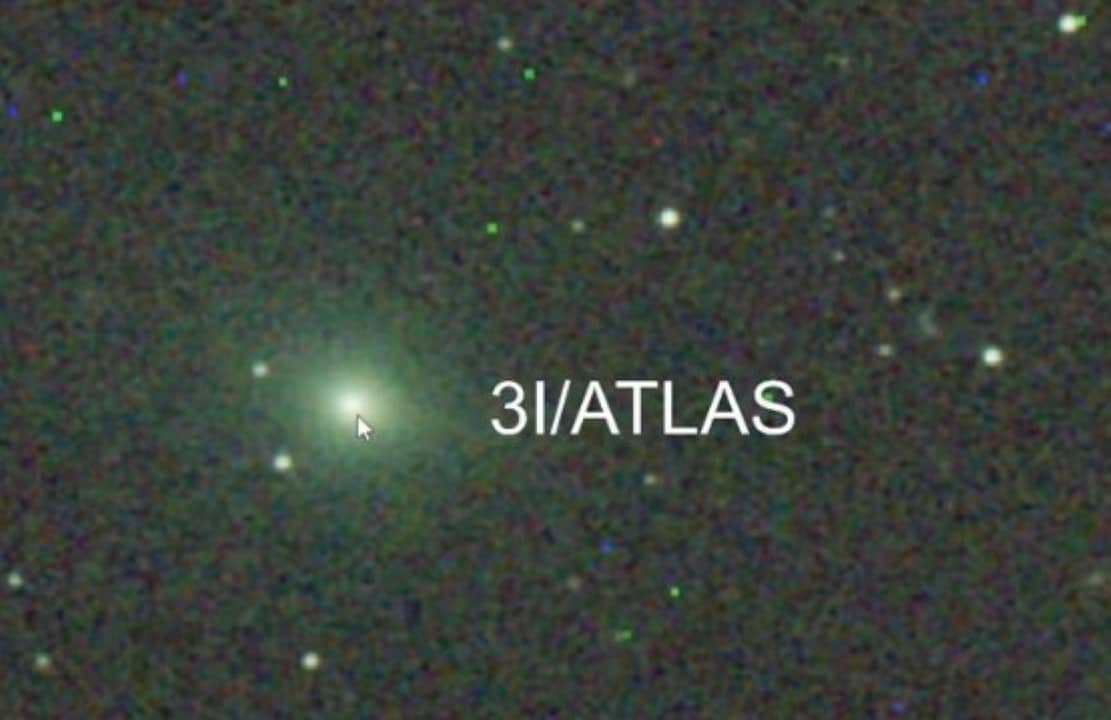
Researchers have detected a massive presence of methanol in 3I/ATLAS, which is the third celestial body confirmed to visit our Solar System from deep space. Recent analyzes indicate that this organic compound emanates both from the rocky center and from the ice particles that form its temporary atmosphere, creating a unique chemical trail that points to an origin in an unexplored corner of the galaxy.
This unexpected molecular structure was captured by the high-precision equipment of the ALMA observatory, installed more than five thousand meters above sea level in the Atacama Desert, in Chile. The wandering celestial body, officially recognized as the third intruder from outside our cosmic neighborhood, exhibited extremely high levels of this primordial alcohol during its approach to our sun.
Prominently released in June 2026, the detection represents a crucial milestone for experts dedicated to uncovering the raw material from other corners of the Milky Way. The records occurred exactly when the star was receiving solar radiation, a phenomenon that triggered the evaporation of dust and gases from its core, opening a window of opportunity for mapping its chemical identity in a vacuum.
3I/ATLAS trajectory and substances break patterns of space visitors
The path taken by this traveler draws the attention of the scientific community, since the passage of extrasolar bodies through our neighborhood is an extremely rare event. Until now, only the stars 1I/’Oumuamua and 2I/Borisov had the seal of proven alien visitors, and both presented dynamics completely isolated from each other.
Now, the newly discovered celestial body inserts an unprecedented variable into this select astronomical group. While its predecessor Borisov exhibited features very similar to the comets that were born here, 3I/ATLAS drew attention due to its abundance of organic alcohol, indicating that its stellar cradle had environmental characteristics radically different from those that shaped our system.
Equipment in Chile records record levels of organic compounds
The Atacama Large Millimeter/submillimeter Array (ALMA) radio telescope complex managed to capture clear signatures not only of methanol, but also of hydrogen cyanide in the cloud surrounding the star. Such substances emit unmistakable signals when read at submillimeter frequencies, which granted scientists the ability to measure the exact proportion of each gas released.
What surprised the team of astronomers most was the colossal volume of the alcohol when placed side by side with the levels of hydrogen cyanide. This imbalance placed the errant body at the top of the list of the stars most loaded with this organic substance ever documented in history, easily surpassing objects formed in the vicinity of our own star.
Fundamental role of simple molecules in the formation of new planets
The mention of “alcohol” in deep space is far from the product consumed or used on Earth on a daily basis. It is a basic organic structure that acts as one of the main building blocks for prebiotic chemistry, and is a key piece for researchers trying to unravel how complex matter develops in the frigid regions where new worlds are being born.
This specific type of compound often grows on tiny fragments of dust in the coldest parts of the universe, places where slow interactions convert primary elements into elaborate molecular networks. Due to this dynamic, the substance functions as a kind of thermometer and fossil diary, revealing the exact pressure and temperature conditions of the environment that gave rise to the comet.
Prolonged evaporation spreads gases from ice particles
Another detail that caught attention in the 3I/ATLAS study is that the organic gas does not just emerge from the object’s central rock. The data confirms that a significant portion of this material emanates directly from small pieces of ice that float in the coma, that dense fog of debris that forms when the celestial body approaches solar heat.
Experts classify this process as extended evaporation, a dynamic where frozen crystals orbiting the nucleus gradually melt and eject more compounds into the vacuum. In practice, this transforms the star’s temporary atmosphere into an active gas emission plant, which greatly facilitates the tracking of its chemical signature by ground-based telescopes.
Hydrogen cyanide behavior reveals different structural layers
In contrast to methanol spread throughout the cloud, hydrogen cyanide demonstrated a much more concentrated dispersion dynamic. The readings indicate that this second substance gushed almost exclusively from the rocky center of 3I/ATLAS, a behavior that mirrors exactly what happens with the stars native to our space backyard.
This discrepancy in the way the two gases escape into space proves that the internal substances react in completely isolated ways to the increase in temperature. It is evident that the interstellar visitor is composed of multiple geological and chemical layers, each responding at its own pace to the thermal impact caused by its approach to the Sun.
Previous data from the James Webb telescope already pointed out anomalies in the star
Long before radio telescopes focused on organic alcohol, the infrared lenses of the James Webb Space Telescope had already detected that the haze of this celestial body deviated from normality. The first scans identified a striking presence of carbon dioxide, reinforcing the initial thesis that the traveler’s structure did not fit into any known astronomical catalogue.
Now, with the crossing of information captured in Chile, the puzzle has become even more complex. Confirmation by two of humanity’s largest observation instruments states that the chemistry of this intruder is an exception to the rule, delivering a package of elements so peculiar that it makes any direct comparison with the comets that orbit our star unfeasible.
What Frozen Dust Teaches About Nurseries on Other Planets
Deciphering the gases from 3I/ATLAS is equivalent to sending an imaginary probe to a solar system that humanity will never have the technology to physically reach. Because it was born in the orbit of another star, the ice trapped inside it keeps an intact record of the radiation levels, the extreme cold and the soup of elements that floated in the dust disk where it was forged.
Even though astronomers still can’t pinpoint on the galactic map which star ejected this celestial body, the abundance of the organic compound screams that its past was turbulent and unique. The high concentration suggests that its formation occurred on the most frozen edges of a distant system, under chemical rules that would be difficult to replicate in Earth’s neighborhood.
Impact of new discoveries on the future of deep space exploration
Further research into this object takes on a gigantic dimension precisely because the catalog of extrasolar visitors is practically empty. With only three confirmations in the history of astronomy, any new molecule found forces theorists to rewrite the books on how matter clusters around alien suns.
The history of observations of these wandering bodies reveals completely different profiles, consolidating a scenario of extreme cosmic variety:
- The pioneering 1I/’Oumuamua shocked the world because it was a dry rock with no visible atmosphere.
- 2I/Borisov reassured scientists by acting very similar to a common comet in our system.
- 3I/ATLAS messed up theories again with its methanol storm and atypical chemistry.
This rollercoaster of profiles definitively proves that the galaxy’s nomads carry a much vaster and more unpredictable structural diversity than science dared to imagine during early astronomical observations.





