
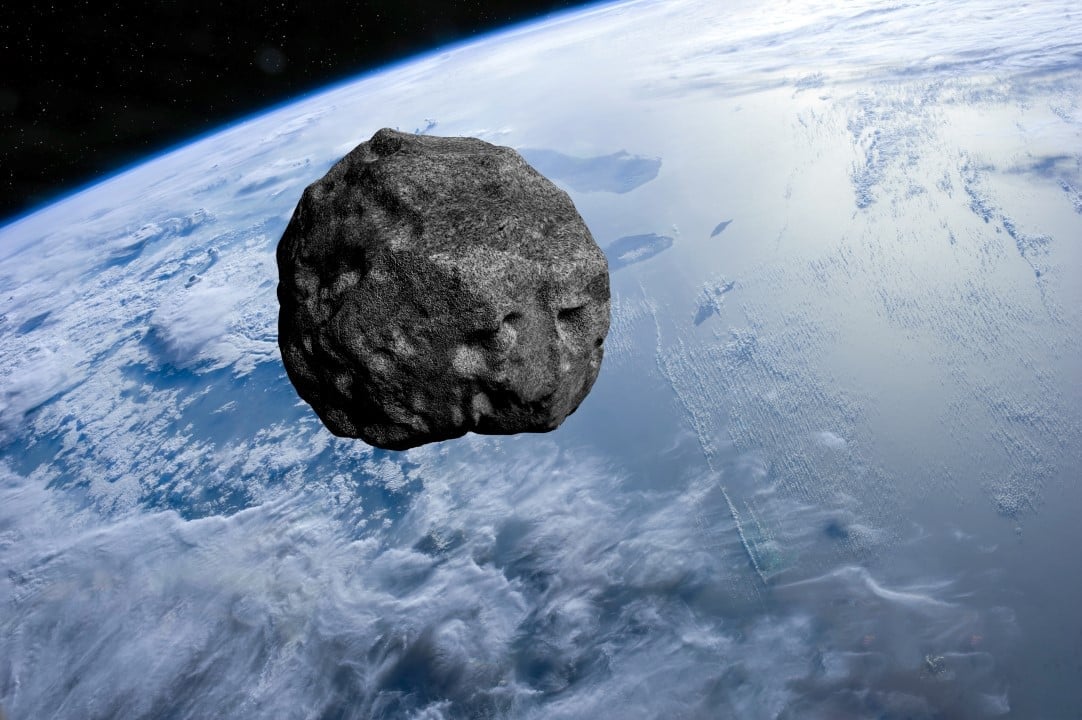
The month of August recorded an impressive phenomenon on astronomical radars, led by the asteroid 2026 PC6, which established the closest approach of a celestial body to our planet this year. Information validated by the Center for Near-Earth Object Studies, a department belonging to NASA, indicates that the space fragment reached exactly 20,400 kilometers from the center of the Earth. The culmination of this meeting took place precisely at 00:50 (by Coordinated Universal Time) on August 12, 2026, mobilizing surveillance teams on several continents.
In an attempt to measure how close the object came, experts resort to the standard measurement that calculates the path between the Earth and the Moon. The boulder traveled a fraction of 0.053 of that lunar distance, an index that elevates the event to the top of academic research priorities. If the measurement is made from the Earth’s ground, the flyby occurred at a height of 14,000 kilometers, invading an orbital band where thousands of artificial equipment operate.

Surveys carried out through the second week of August indicate that scientists have already detected 101 rocky bodies breaching the lunar-distance barrier throughout 2026. However, 2026 PC6’s approach was unparalleled in terms of extreme proximity. The flight broke all records recorded in previous months, becoming indispensable analysis material for professionals dedicated to identifying imminent dangers in our cosmic neighborhood.
Real risk to in-orbit telecommunications infrastructure
Reaching the 14,000 kilometer height mark means penetrating one of the most sensitive areas for the functioning of contemporary society. Geostationary devices, which provide TV signals, internet and weather forecasts, float around 35,700 kilometers above the Equator. The celestial body crossed space in a layer much lower than this very expensive network, even passing below the orbit of GPS satellites, which are in the range of 20,200 kilometers.
The presence of a natural intruder in geosynchronous orbit causes immediate concern among flight controllers and aerospace safety authorities. A possible hit against an active satellite would generate thousands of uncontrolled fragments, which could start a destructive domino effect against other neighboring machines. Luckily, mathematical simulations confirmed that the route taken by the asteroid did not cross any man-made structures.
Researchers focused on orbital movement warn that incidents like this highlight the urgency of improving monitoring technologies. The surroundings of our planet become progressively more crowded due to the constant sending of fleets of private satellites. When a rock travels at hypersonic speed through this tangle of cables and solar panels, nations need to act in an integrated manner to quickly calculate any chance of a shock.
Short warning window highlights failures in planetary surveillance
The way 2026 PC6 was found exposes the real obstacles that Earth protection projects still need to overcome. The initial capture of the image occurred thanks to ATLAS-TDO, a network of extremely powerful lenses housed at the Teide Observatory. Located on the island of Tenerife, in the Spanish Canary archipelago, the equipment works by mapping the darkness daily to identify non-standard light points.
The data confirming the presence of the fragment landed on the servers of the Minor Planets Center (MPC) at exactly 01:20 UTC on August 11. This timeline brings worrying information to astronomers: scientists were only 23 and a half hours ahead of the closest point. Such a tight margin would make it impossible to plan any interception strategy if the final target was a terrestrial metropolis.
Smaller fragments represent an enormous viewing challenge against the black backdrop of the universe, especially when they appear overshadowed by the Sun’s brightness. As they have a low reflection rate and move extremely quickly, they usually only trigger alarms when they are already stuck in the atmosphere. The success of the base in Tenerife proves that it is vital to spread robotic cameras to all corners of the globe, working without interruptions.
Structural profile and the consequences of a possible fall
The scientific community has placed 2026 PC6 in the Aten family, a select group of rocks that orbit close to Earth. The main hallmark of these travelers is that they complete the majority of their journey around the Sun on the inside of our own orbit, frequently intersecting the Earth’s path. This behavior requires permanent vigilance, as the gravitational attraction of Venus and Mercury can modify these routes over the years.
Studies based on light variation suggest that the body measures somewhere between 6.8 and 15 meters wide. As a basis for comparison, the bolide that detonated in the skies over Chelyabinsk, Russia, more than a decade ago, was approximately 20 meters long and released energy equivalent to 500 kilotons of TNT. That bang shattered windows in countless buildings and left hundreds injured, proving that seemingly tiny stones have an extremely high destructive power.
If 2026 PC6 had plunged toward the ground, its dimensions indicate that it would not have had the strength to open an impact crater. The brutal friction against our planet’s gas barrier would raise its temperature to the extreme, causing it to disintegrate in mid-flight. The resulting glow would illuminate the sky over vast regions, while the pieces that resisted the heat would reach the ground only as harmless gravel.
Mathematical parameters reveal the asteroid’s exact path
The Jet Propulsion Laboratory (JPL) manages a detailed file on smaller elements of our system, and records of this new visitor are already in the system. The calculations that define the rock’s displacement make it possible to project its exact location for the coming years, preventing humanity from being caught off guard again. The coordinates show a very sharp oval path around our main star.
The metrics captured by astronomical sensors translate how the fragment behaves in the void of space. The shape of your journey was calculated with extreme accuracy by NASA supercomputers:
- The semi-major axis was established at 0.749 Astronomical Units.
- The perihelion, the moment of greatest heat near the Sun, reached 0.426 Astronomical Units.
- The aphelion, which marks the star’s limiting distance, reached 1.073 Astronomical Units.
- The eccentricity of the orbit was 0.432, confirming the elongated design of the path.
- The tilt angle registered 19.8 degrees when compared to the central axis of the solar system.
Such indicators prove that the gravel faces severe thermal shocks during its cycle. Upon reaching perihelion, it grazes Mercury’s orbit and ends up bombarded by intense radiation. At aphelion, the rock subtly crosses the terrestrial border and enters freezing areas of the cosmos, preparing to repeat the entire route.
Global effort to map invisible threats in the cosmos
Closing the dossier on 2026 PC6 required a task force of astronomers working around the clock. The MPC recorded exactly 101 photographs of the celestial body in the interval between 01:20 and 23:41 UTC on August 11. This frantic sequence of visual records gave computer programs the necessary basis to draw the streak left by the asteroid in contrast to





