
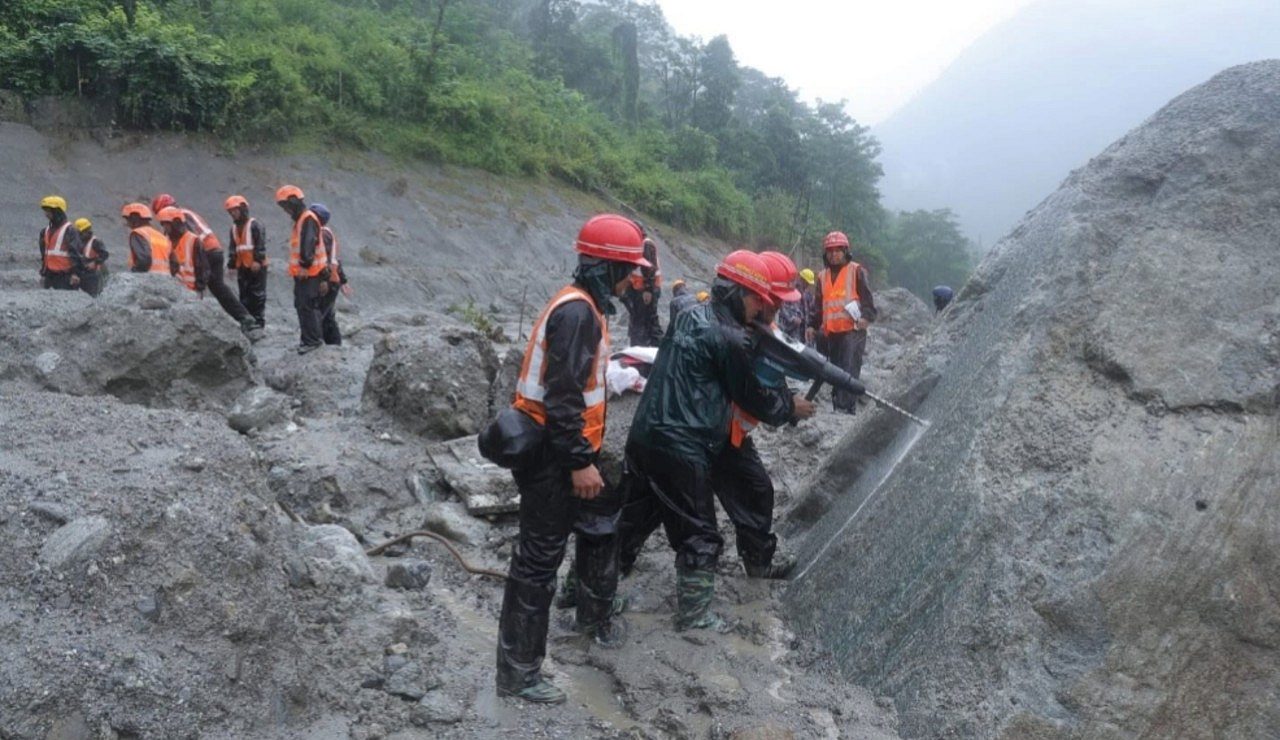
The government of Nepal has decided to accept assistance from the international community to strengthen search and rescue actions following severe floods caused by the collapse of a glacier in the Himalayan region.
The authorities’ reconsideration came just hours after an initial statement that minimized the need for external assistance, highlighting the escalation of the seriousness of the situation.
Rescue operations, which had been temporarily halted due to heavy rain and fog, resumed on August 29, 2026, taking advantage of improving weather conditions.
Meanwhile, approximately 3,000 individuals remain unknown between Nepal and China.
This total includes 2,426 missing in Nepal and 554 in Chinese Tibet, including residents, tourists, pilgrims and hydroelectric plant workers. Of this group, at least 540 are foreigners.
On August 28, 2026, Nepal’s Ministry of Foreign Affairs had communicated that the country did not require international teams for general rescue activities.
Minister Shisir Khanal stated, at the time, that the government only needed specialized technical support for tasks such as tunnel rescues, victim identification and DNA tests.
“We think there is no need for repetition in this,” Khanal said.
A few hours later, however, the government changed its position and began receiving international aid. Specialized teams from India are already engaged in the search, and another contingent from China is expected.
Relief operations are currently focused on evacuating isolated survivors and reaching a hydroelectric plant tunnel where around 100 people remain trapped.
Toll of victims: deaths reach 676 in Nepal and Tibet
The most recent survey, released on August 29, 2026, indicates that 669 people lost their lives in Nepal. In Chinese Tibet, another seven deaths were confirmed, bringing the total number of victims to 676.
Authorities warn that the number of deaths could rise as new areas become accessible to rescue teams.
The disaster began on August 26, 2026, when the collapse of a glacier released a large mass of ice, rocks, mud and debris into rivers in the border region between Nepal and China, resulting in the destruction of villages, bridges, roads, schools, hospitals and hydroelectric plants.
Identification and burial: bodies will undergo DNA testing
Three days after the tragedy, some of the recovered bodies are in an advanced state of decomposition, which makes visual identification impossible.
The Chitwan district administration reported that DNA samples will be collected before burials, in order to preserve the possibility of future identification and reduce health risks.
In Kathmandu, family members continue to search for information about the missing, trying to recognize the victims through photographs displayed on the walls of the Maharajgunj Medical Campus, where some bodies were sent.
Rescue of survivors continues in isolated areas
In the city of Bidur, located about two hours from Kathmandu, hundreds of residents wait for helicopters to return to their affected communities.
A military base was adapted and transformed into a support center for survivors who are rescued by air.
Aircraft are prioritizing the evacuation of people who are still isolated, while some land routes are gradually being reopened to allow access by land.
However, the danger of new floods persists. Two lakes formed after the glacier collapsed remain under monitoring by authorities in Nepal and China.
One of these lakes began to slowly drain on August 29, 2026, reducing the immediate risk of overflow, but experts warn that the threat will only be reduced when both are completely empty.
Reconstruction of Nepal could generate billion-dollar costs
Finance Minister Swarnim Wagle estimates that reconstruction costs will reach between US$4 billion and US$5 billion (equivalent to R$20.8 billion to R$26 billion), although the exact accounting of the losses is still in progress.
In addition to financial resources, the government requested technical assistance for rescue operations in tunnels, reestablishing infrastructure, identifying victims, carrying out DNA tests and expanding body storage capacity.
India has already sent approximately 60 tons of emergency supplies, including food, medicines and blankets, in addition to providing technical teams and prefabricated bridges to assist in infrastructure recovery.
The International Federation of Red Cross and Red Crescent Societies indicates that around 93,000 people were affected by this catastrophe.





