
Astrophysicists unravel the mystery of the brightness of stars that survive black holes

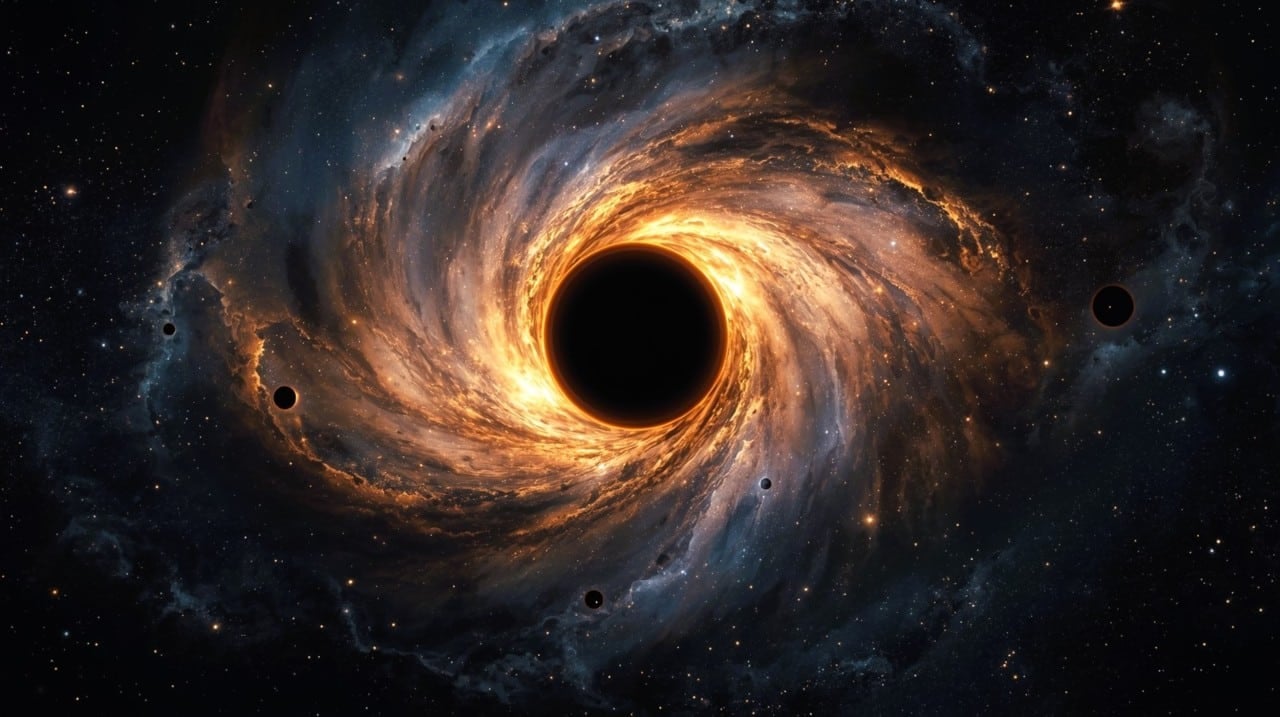
Researchers at Syracuse University have found the answer to a puzzling behavior in the world of astrophysics, resolving a debate that has lasted for years. The focus of the study is on stars that manage to escape total destruction after passing close to supermassive black holes. The key to understanding changes in the light emission of these celestial bodies lies in the speed at which they were already rotating before the first gravitational encounter.
The extreme dynamics between gravitational giants and neighboring stars
In the hearts of most galaxies live black holes with masses that exceed that of our Sun by billions of times. When a stellar body crosses the path of these entities, the colossal gravitational force usually shatters the object completely. The debris is pulled towards the center, generating an intense glow that telescopes can capture for weeks or months, allowing indirect observation of these dark regions of the cosmos.
However, the outcome is not always fatal for the visiting star. If the trajectory maintains a minimum safe distance, the star’s core resists the attraction, only losing its outer layers to space. This survivor remains trapped in the black hole’s orbit and returns periodically, generating new flashes with each passage, in a cycle that scientists classify as a repetitive partial tidal disruption event.
The challenge of explaining the progressive drop in light emission
Continuous monitoring of deep space using scanning telescopes has revealed dozens of such interactions over the past few decades. Astronomers cataloged about ten systems where the phenomenon repeats itself, but four of them presented an anomaly that defied computer simulations. Instead of emitting flashes with the same intensity each time around, these four stars became progressively dimmer.
The hydrodynamic simulations used until recently failed to reproduce this drop in luminosity. Basic logic suggested that if the star lost less mass with each revolution, its brightness should naturally drop. However, the calculations showed that the tidal force accelerated the star’s rotation, causing the debris to return to the black hole faster, which kept the light constant in the virtual models.
Prior rotation as a fundamental element for new calculations
The team led by researcher Ananya Bandopadhyay, together with Benjamin Amend and professor Eric Coughlin, published in The Astrophysical Journal a new theoretical approach to the problem. They detailed that the internal architecture of the star determines the volume of gas and dust removed. Low-mass stars function as fragile structures that easily fall apart under gravitational stress. The most massive ones operate with overlapping layers, preserving a rigid core that survives successive approaches almost intact, losing only the surface material.
To resolve the brightness paradox that intrigued experts for two years, scientists introduced an unprecedented variable into the simulations: the star needed to have a very high rotation before even suffering the first rupture. When the object is already rotating at high speed, the black hole’s gravitational force is unable to accelerate it significantly in subsequent passes, breaking the rule of old models.
Without this extra boost in rotation, the time it takes for debris to fall into the black hole remains stable. The study established a direct relationship that explains the phenomenon observed in telescopes, based on a clear physical sequence:
- The star loses a smaller amount of matter with each new orbital revolution.
- The absence of rotational acceleration keeps the debris return time unchanged.
- The maximum rate of material fall decreases drastically.
- The end result is increasingly weaker explosions of light with each interaction.
The role of binary systems and the connection with the Milky Way
The realization that the star needed to rotate quickly raised another question about how it acquired this characteristic and ended up trapped in such a short orbit. The answer lies in the Hills mechanism, an astrophysical concept proposed in the late 1980s by scientist Jack G. Hills, which is now gaining practical proof. The model describes what happens when a pair of stars travel together and approach a supermassive black hole.
Extreme gravity breaks the bond of the binary system, flinging one of the stars away and capturing the other in a tight orbit. As stars that travel very close together usually have their rotations synchronized, they rotate around their own axes at very high speed. This dynamic perfectly justifies the initial conditions required by the Syracuse Physics Department team’s new calculations.
Professor Eric Coughlin highlights that the destruction of binary systems unifies all the pieces of the theoretical puzzle, representing a leap in the understanding of space physics. In addition to resolving the behavior of distant galaxies, this discovery has direct implications for understanding our own environment. Many of the stars orbiting Sagittarius A*, the Milky Way’s central black hole, were likely captured by this same process, providing a natural laboratory for future astronomical investigations very close to Earth.





