
James Webb Telescope Discovers How Giant Planet Survived the Death of Its Star


Billions of years ago, a star with characteristics similar to those of our Sun reached the end of its evolutionary cycle, inflating violently until it became a red giant and then expelling its layers to become a white dwarf. This extreme event normally disintegrates any celestial body in its vicinity, but researchers have identified a gaseous world with Jupiter-like proportions spinning in an orbit incredibly close to this stellar remnant.
To understand how this gas giant escaped annihilation, a global group of astronomers turned to the infrared precision of the US space agency’s James Webb Space Telescope, monitoring the celestial body known as WD 1856 b as it passed in front of the dead star. The data captured revealed not only the heat emitted by the star, but also the chemical composition of its atmosphere, providing fundamental answers about its orbital trajectory and offering a glimpse of what may await our own planetary system.
The detailed conclusions of this astronomical investigation were officially released on Wednesday (1st), forming an unprecedented article in the renowned scientific journal Nature.
The alien world WD 1856 b was detected for the first time in 2020, thanks to the joint work of the Transiting Exoplanet Survey Satellite (TESS) and the former Spitzer observatory. Located at a distance of 80 light years from our planet, it orbits the dead nucleus called WD 1856+534. The study’s lead researcher, Ryan MacDonald, linked to the University of St. Andrews, in the United Kingdom, highlighted that the system’s dynamics are curious, as the planetary body is the size of Jupiter, while the star it surrounds has shrunk to the volume of Earth, making the planet seven times larger than its own sun.
The trajectory of WD 1856 b is close to its white dwarf, maintaining a distance fifty times smaller than the space that separates the Earth from the Sun. If the gas giant had been positioned in the same location since the formation of the system, the expansion phase of the red giant would have completely swallowed and vaporized it. This extreme proximity creates a true astrophysical puzzle about the mechanisms that allowed this world to resist the stellar apocalypse and park itself in the region where it is today.
Thermal analysis reveals secrets about the gas giant’s mass and heat
During the new phase of studies, the powerful Webb observatory monitored the exact moment the star crossed the line of sight of the dead star. This temporary blockage of starlight, known as transit, gave scientists unprecedented parameters to calculate the object’s density, pointing out that its total mass varies between four and eleven times that of Jupiter.
In addition to the weight, the experts were able to map the thermal signature of the WD 1856 b with high precision. At the time of the partial eclipse, the capture of visible light fell drastically, but the infrared sensors recorded a much more subtle decrease, proving that the planet itself emits heat independently. The readings showed a surface temperature of around 126 degrees Celsius, a level far above what would be generated simply by the reflection of the white dwarf’s weak light, transforming this extra heat into the main clue to unraveling its orbital history.
Scientist Christopher O’Connor, a researcher at Northwestern University and co-author of the survey, was in charge of modeling the thermal evolution of the star over the eons. He explained that the biggest challenge was to understand the celestial body’s journey to its current position, working with two central hypotheses: either the gas giant was swallowed by the dying star and resisted intact within the stellar envelope, or it was pushed closer by external gravitational forces, as the system is composed of three stars that could have destabilized the original orbit of WD 1856 b.
When crossing the data, the team realized that the current environment does not offer any source of energy capable of keeping the star so hot, which means that the heat detected is a leftover from a violent event in the past. By applying cooling simulations to substellar bodies and feeding computers with Webb’s recent captures, astronomers were able to virtually rewind time. This reverse calculation revealed the exact moment the temperature peak occurred, helping to rule out the theory of stellar engulfment in favor of a late change of course.
Calculations demonstrated that the extreme heating occurred in a window between 3 and 5.5 billion years after the formation of the star’s dead core. This indicates that during the red giant’s destructive phase, the planet was safely in a much more distant orbit, beginning its journey to the center of the system only billions of years later. According to O’Connor, the late approach caused the intense gravitational force of the white dwarf to generate internal friction on the planet, heating it brutally before starting the slow cooling process that we observe today.
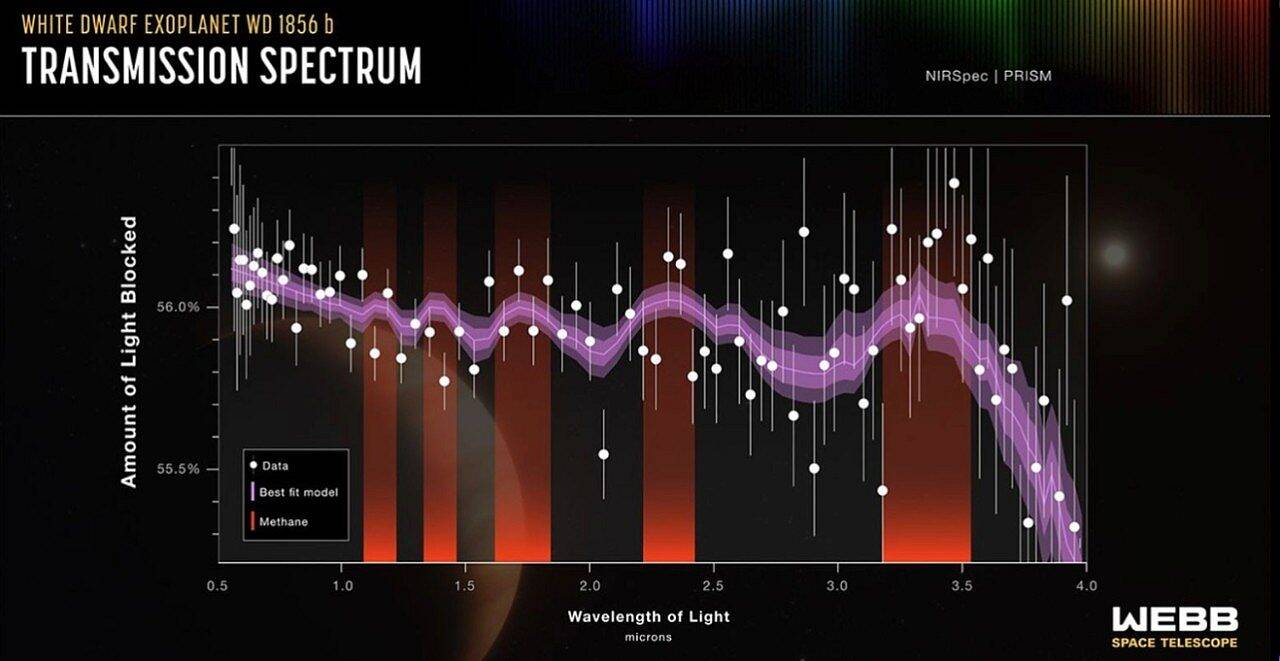
The filtering of starlight through the planet’s edge also allowed a deep dive into its atmospheric composition. Researcher Victoria Boehm, from Cornell University, highlighted that the sensors captured clear traces of cloud particles and hydrocarbons, with a strong indication of the presence of methane, marking a historic feat in the observation of atmospheres on worlds that orbit stellar corpses. She added that the scientific consortium has already secured four more observation sessions with the space telescope to further detail this alien chemistry.
What the fate of this distant world teaches about the end of the Earth
Approximately five billion years from now, our Sun will exhaust its nuclear fuel, inflating a hundred times its current proportion and taking the form of a red giant before shriveling to a white dwarf. In this catastrophic process, Mercury, Venus and most likely the Earth will be completely charred. However, what will happen to gas giants like Jupiter and Saturn is still a mystery to science. Analyzing planetary systems that survived this stellar apocalypse serves as a natural laboratory for predicting the final chapters of our own cosmic neighborhood.
Reflecting on the impact of the discovery, MacDonald noted that astronomy traditionally works as a window into the past, but this research reverses logic by projecting the fate of distant planets after the death of their parent star. For the scientist, observing the current dynamics of WD 1856 b is the equivalent of getting into a time machine and traveling to the remote future of our solar system, revealing that planetary life can continue even after the main star goes dark.





