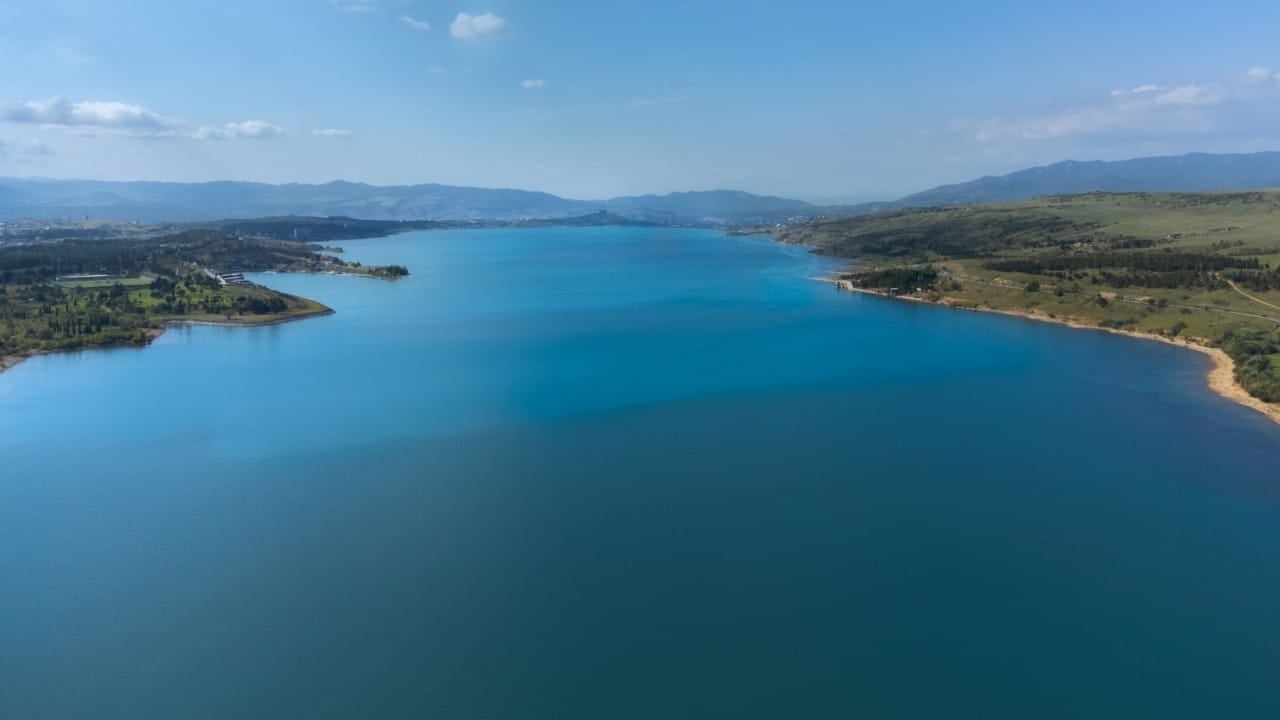
An intriguing natural phenomenon has captured attention in Canada: a floating, vegetation-covered island that unexpectedly appeared and disappeared in Lake Williston, British Columbia’s largest reservoir. The island’s presence was initially reported by residents in early August 2026, but was only confirmed by satellite image analysis, which documented its appearance and subsequent disappearance within a short period. The event raises questions about the dynamics of aquatic ecosystems in large reservoirs.
The first reports and the caution of local authorities
The mysterious island began to be seen by residents in the Lake Williston area, located north of the city of MacKenzie, in the first days of August 2026. Images and videos of the floating object quickly spread across social media, shared by users such as Rocky Avery, who attributed the material to a local sailor. The online repercussion generated curiosity, but also a certain skepticism on the part of the authorities.
Bob Gammer, a spokesman for the British Columbia Hydro and Power Authority (BC Hydro), the energy company that manages the gigantic reservoir, admitted he had initial doubts about the veracity of the images. He highlighted the ease with which visual content can be manipulated today, including with the use of artificial intelligence. “We certainly hadn’t heard of anything like this before. And as few people reported it, it was difficult to locate the information,” said Gammer, emphasizing the rarity and difficulty of verifying such an atypical event.
Satellite evidence and the island’s enigmatic movement
Definitive confirmation of the island’s existence came from an unexpected source: satellite images. Analysis of spatial recordings taken on July 21 revealed the island clearly visible in the main portion of Williston Reservoir. It was located west of Finlay Bay, about 100 kilometers from the WAC Bennett Dam, one of the largest in British Columbia. This concrete evidence validated the reports of local observers and added crucial information to the mystery.
However, the transient nature of the island soon became apparent. In new satellite data, dated August 5, the formation had disappeared. Gammer explained that this does not necessarily mean that the island sank. “We have been taking increasingly recent photos and we can no longer see the object. Then it disappeared. It may have returned to a more protected location along the shore,” said the spokesperson, indicating that the island could simply have moved to a more secluded area of the lake. BC Hydro continues to monitor the region to record any new appearances or movements.
Remarkable dimensions and reappearance in a new location
The mysterious island has considerable proportions, with an estimated width of 70 meters and a length of 140 meters, totaling an area of approximately 9,800 square meters. This dimension makes it a significant formation to float on a body of water. On August 31, just a few weeks after its “disappearance” via satellite, Rocky Avery reported on his social media that the island had been spotted again.
This time, the location was different: the island was found in the Ospika River, a tributary that flows into Lake Williston. This new positioning suggests that the island is truly mobile and can be influenced by currents entering and leaving the reservoir, as well as winds. The island’s ability to travel considerable distances through different sections of the lake’s water system is an aspect that intrigues researchers and residents.
How Floating Islands Form: Williston Theories and Context
The formation of floating islands is a natural phenomenon that occurs in many parts of the world, although it is relatively rare in large artificial reservoirs such as Lake Williston. Generally, these islands are composed of a dense mass of vegetation, organic soil (peat) or debris that detaches from the bed or banks and, as they have a lower density than water, begin to float.
In the case of Lake Williston, BC Hydro proposed a theory that aligns with the reservoir’s specific conditions. Bob Gammer suggests that the island may have formed over many years on one of the lake’s shores, where currents would have deposited large amounts of wood and other debris. Over time, this base of accumulated material would have allowed plants to take root, forming a layer of soil and vegetation on the surface. The crucial factor for its detachment would be the record increase in the water level in the reservoir.
- Key elements of BC Hydro’s hypothesis:
* Prolonged accumulation of debris and wood on the lake shore.
* Growth of vegetation, which helped to consolidate the mass.
* Lake Williston reached capacity for the first time in 14 years, which drastically raised the water level.
* The rising water would have “lifted” and detached the island from the coast.
The raising of the water level of Lake Williston to its maximum capacity, an event that has not happened in 14 years, is a key fact that reinforces this explanation. This massive increase in water volume and pressure may have been the catalyst that dislodged the formation of the coast. While the island does not pose a significant danger, its presence underscores the constant interaction between nature and large water infrastructures, and how even human-controlled environments can produce unpredictable phenomena.