
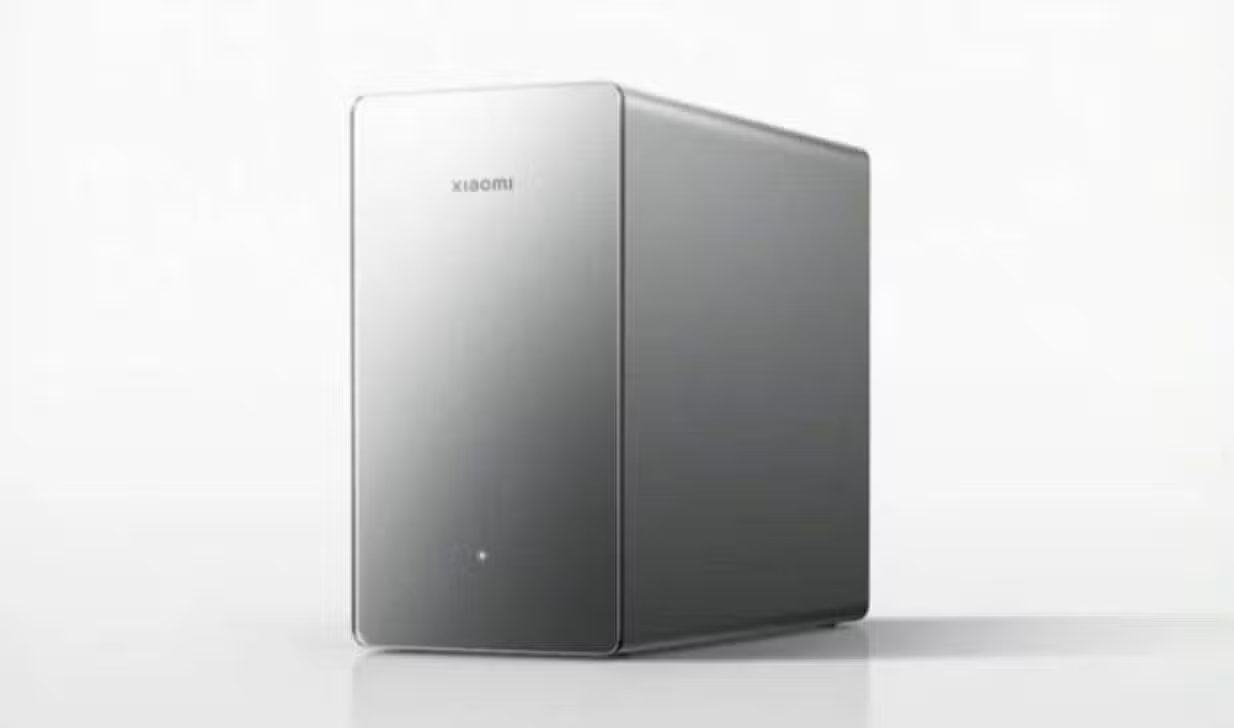
The Asian technology giant revealed its newest equipment focused on residential data management, called Xiaomi Smart Storage. The device represents the manufacturer’s debut in the category of local network servers, aiming to serve consumers who seek to integrate their personal files with home automation systems in the Asian market.
The equipment’s biggest difference is that it delivers a private file center fully connected to the HyperOS interface, creating a physical alternative with no monthly fees. With the constant increases in Google One and iCloud storage plans in recent years, maintaining your own server at home has become a financially smart and safer option for those who accumulate many gigabytes of information.
Discover the physical structure and internal components of the new server
Following the clean visual identity that has established the Mijia family of products, the chassis has a discreet shape created to not draw attention to the environment’s decoration. The product’s engineering relies on a two-bay system, giving the owner the freedom to manage the disks together or separately, optimizing the physical space on the work table.
Preliminary information indicated that the machine would accept conventional hard drives and solid state drives in traditional SATA standards. However, the units that hit the shelves first come with only flash memory components from the factory, guaranteeing superior read and write speeds from the first use.
System integration and automated backup tools
To avoid the stigma that network servers are difficult to configure, the device’s interface focuses on intuitive usability. The main asset of the internal program is the ability to pull photographs and videos from cell phones invisibly to the user, performing continuous backups without requiring manual commands.
The equipment’s communication breaks down barriers between platforms, communicating perfectly with Android cell phones and Apple devices. This versatility also extends to computers, ensuring stability when exchanging files with machines equipped with Windows, macOS and Linux-based systems, transforming the home router into a true digital safe for monitoring cameras and notebooks.
Deep details about the motherboard, such as the exact processor speed and bandwidth limits, are still kept confidential by the manufacturer. However, registrations with certification bodies indicate that the rear connection doors have plenty of capacity to withstand the intense traffic of a modern home.
Although this is the brand’s most ambitious project in the network drawer sector, the company had already tested this audience in the past with the Mi Router HD line, which embedded disks of up to 2 TB within the Wi-Fi emitter itself. This transition to dedicated equipment reinforces the company’s plan to create a digital environment where all electronics in the house converge to a single point of trust.
Technical sheet and detailed specifications of the network equipment
- Product Category: Local File Server (NAS)
- Internal construction: Double drawer system (dual-bay)
- Appearance: Reduced cabinet with straight lines
- Available capacities:
The entry model delivers 4 TB divided into two 2 TB disks. The intermediate version doubles this capacity to 8 TB, using two 4 TB pieces. The edition aimed at demanding users reaches an impressive 16 TB, adding two 8 TB drives.
- Memory format: High-speed solid-state drives (SSDs)
- Flexibility: Supports expansion with mechanical hard drives
- Virtual environment and functions:
Control of the entire operation takes place under the HyperOS umbrella, which provides user-friendly navigation panels for laypeople. The sync tool works silently, protecting image galleries and important documents without interrupting your smartphone use.
- Supported systems: Mobile and desktop platforms (Windows, macOS, Linux, Android and iOS)
- Target audience: People who need to save security images, save work data and empty cell phone memory
Official prices and arrival dates for the Asian market
The commercial strategy chosen for the debut involves a crowdfunding platform, with the campaign running between the 1st and 8th of July 2026. Reaching the fundraising target guarantees the start of mass manufacturing, in addition to guaranteeing aggressive discounts on the final value for those who invest in the project in the first few days.
Consumers will be able to choose between three closed packages, which come out of the box ready to plug into the socket:
- The basic 4 TB package costs ¥2,299 (around R$1,750) in pre-sale, jumping to ¥3,499 (R$2,665) in physical stores.
- The 8 TB option costs ¥2,899 (around R$2,205) for initial backers, with a final price set at ¥4,499 (R$3,425).
- The top of the line with 16 TB requires an investment of ¥4,699 (R$3,575) in financing, reaching retail for ¥6,999 (approximately R$5,330).
Until the closing of this publication, the Asian headquarters had not issued any statement about exporting the server to other continents, leaving the Western public waiting for a global launch.