An international team of scientists has just recorded an unprecedented phenomenon in astronomy: the simultaneous presence of three supermassive black holes in full activity in the galaxy J0148-4214. The historical record, made possible by the extremely high sensitivity of the James Webb Space Telescope, shows the system as it was just 1.3 billion years after the Big Bang, when the cosmos was less than 10% of its current age. As light had to travel a journey of 12.5 billion years to reach our equipment, the finding revolutionizes what was known about the speed of formation of colossal structures in the early days of space.
What makes this incident so peculiar is the fact that it houses a trio of matter-eaters with completely different dimensions and locations within the same galactic environment. The main pair inhabits the central region of the system, separated by a distance of only 620 light years, while the third member orbits at a more distant margin, 5,500 light years from the nucleus. To date, the scientific community does not know how to predict whether these giants will end up colliding in a cataclysmic event or whether they will follow isolated paths.
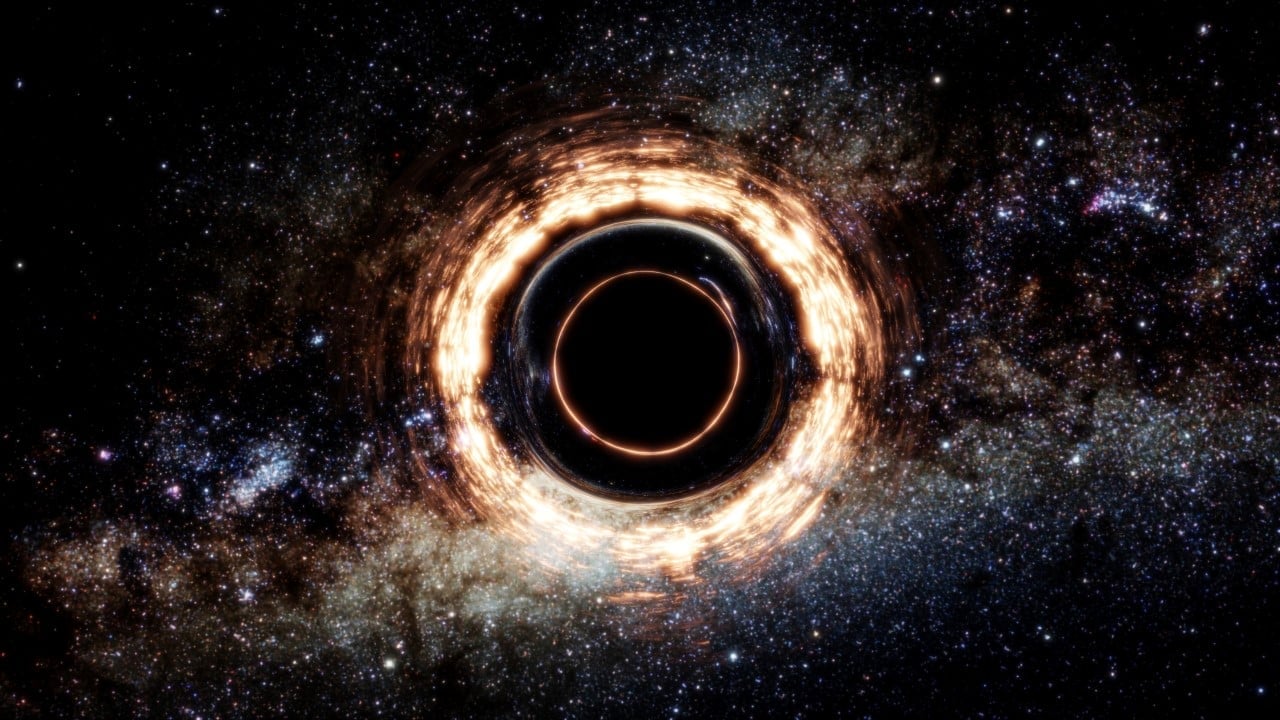
Infrared technology has made it possible to map the gas around cosmic giants
A crucial detail is that the supermassive bodies did not appear as bright spots in the lens of the James Webb Space Telescope, as their extreme gravity prevents light from escaping. Detection was only possible thanks to the Near Infrared Spectrograph (NIRSpec), an integral field instrument that tracked the thermal signature and the frantic displacement of clouds of ionized hydrogen gas that rotate at very high speed around each singularity.
According to Hannah Übler, a researcher linked to the Max Planck Institute for Extraterrestrial Physics and coordinator of the survey, this is the first proven case of an active triple system operating in a single galactic structure in the far reaches of deep space. All the technical data and analyzes on the dynamics of J0148-4214 were highlighted in an article recently published in the pages of the prestigious scientific journal Astronomy & Astrophysics.
Extreme mass differences mark the trio located in the galaxy J0148-4214
Each of the components of this rare cosmic grouping exhibits unique properties and very particular levels of voracity:
- The central giant: The largest of the three dominates the core of the system and concentrates a colossal mass equivalent to 80 million times that of our Sun.
- The accelerated devourer: Positioned 620 light-years from its larger neighbor, this body is the lightest, with 600 thousand solar masses. It swallows matter at such a frenetic pace that it exceeds the Eddington limit — the physical boundary where the pressure of the emitted radiation should, in theory, push the gas away and slow its growth, something that astronomers consider unsustainable for long periods.
- The peripheral traveler: 5,500 light years away from the center, the third member has about two million solar masses. To give you an idea of the scale, it is exactly half the size of Sagittarius A*, the black hole that rules the center of our own Milky Way.
Giovanni Mazzolari, also a specialist at the Max Planck Institute for Extraterrestrial Physics, highlighted that the entire structure of J0148-4214 has a stellar weight of 1.3 billion suns. In this scenario, the three matter-eaters account for a surprisingly high fraction of the entire mass contained in the system.
Collisions between galaxies explain rapid growth at the beginning of time
The astrophysics team’s main hypothesis is that the most distant member, and perhaps even the smallest member orbiting the center, were not born there, but were captured during violent galactic mergers in the past. This process of cosmic cannibalism provides a valuable clue as to how these gravitational anomalies managed to gain so much weight when the universe was still in its infancy.
Roberto Maiolino, a professor at the University of Cambridge who collaborated on the study, explains that the clash between space titans works as an efficient shortcut for the accelerated evolution of these primordial structures. The finding reinforces the thesis that the grouping of colossal masses was common in the first eras, generating disturbances in the fabric of space-time that the next generations of telescopes will try to capture.
Slingshot effect can expel the third member into deep space
The great enigma that intrigues researchers now is the vector of movement of the two-million-solar-mass body: would it be falling towards the nucleus or fleeing the galaxy? The answer to this dynamic dilemma may lie in the classic and chaotic three-body problem, a physics concept that describes the instability of multiple orbits.
According to simulations, it is likely that the two smaller black holes formed a binary system before crossing the path of the monster of 80 million suns. During this turbulent encounter, the central giant would have kidnapped the lighter body and, through pure conservation of energy, hurled the medium-sized object away with extreme force. A similar dynamic occurs in the Milky Way, where pairs of stars that come too close to Sagittarius A* end up dismembered, with one star being swallowed and the other ejected as a hypervelocity projectile.
As current instruments are still unable to pinpoint the exact three-dimensional trajectory of the third component of J0148-4214, its final destination remains open. Scientists await further measurements to find out whether it will make a U-turn for a triple collision or be banished forever, wandering the darkness of intergalactic space.
New space observatories will be needed to capture merger echoes
When gravitational monsters of this caliber finally merge, they emit gravitational waves of very low frequency and gigantic wavelengths. Unfortunately, ground-based detectors operating today, such as LIGO, Virgo and KAGRA, are calibrated for smaller events and do not have the sensitivity to listen to the tremors generated by supermassive black holes.
To fill this technological gap, hope lies with the future LISA (Laser Interferometer Space Antenna) mission. The innovative project will operate directly from space, using three satellites linked by triangle-shaped lasers, separated by an impressive 2.5 million kilometers. When it comes into operation, this mega-observatory will be the definitive key to tracking the clash of titans in the distant universe and confirming the theories raised by the current discovery.