
Astronomers watch distant icy body turn into active comet

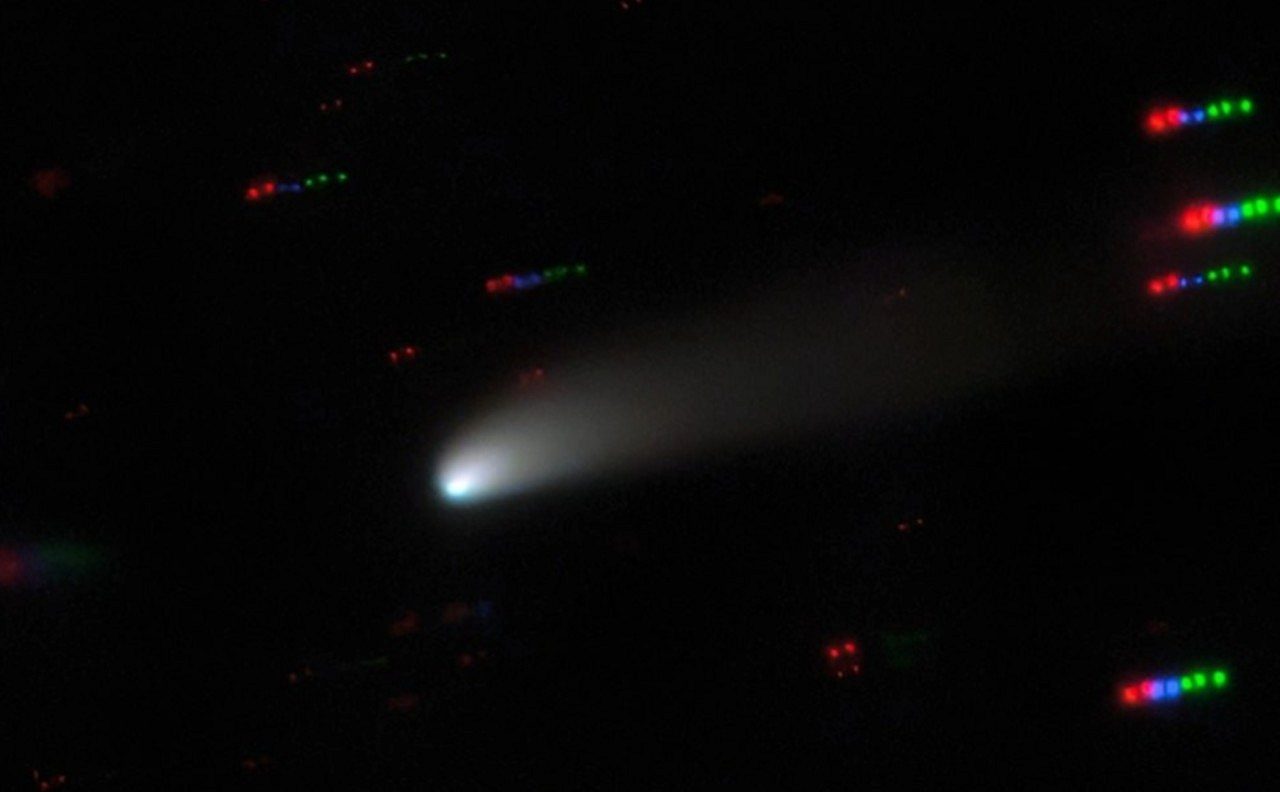
Astronomers tracked physical changes around the distant icy body 450P/LONEOS in the outer solar system on September 7, 2026. Observations confirmed that the object developed cometary activity after remaining dormant for years.
The centaur 450P/LONEOS formed an expanding cloud of gas and dust as its trajectory brought it nearer to the Sun.
Centaurs orbit the Sun between Jupiter and Neptune after drifting inward from the Kuiper Belt located beyond Pluto. Giant planets repeatedly cross their paths and destabilize their trajectories over millions of years.
Astronomers note that gravity from Jupiter regularly captures inward-moving centaurs and converts them into short-period comets that orbit in under 20 years.
Telescopes detect expanding cloud of gas around the active nucleus
Planetary scientist Charles Schambeau from the University of Central Florida led the team that identified early cometary activity around 450P. Using the Gemini North telescope located in Hawaii, researchers tracked the steady expansion of dust and gas surrounding the solid nucleus between 2019 and 2024 as the celestial body accelerated directly toward its August 2024 perihelion, which marked its closest orbital approach to the Sun. The brightness of the cloud increased steadily throughout that monitoring window.
Instruments aboard the James Webb Space Telescope analyzed the chemical composition of the expanding coma and identified carbon dioxide gas along with crystalline water-ice particles. The absence of water vapor confirmed that carbon dioxide drives the gas emissions instead of traditional water-ice sublimation.
“At 450P’s distance from the sun, the nucleus is too cold for normal water-ice sublimation to be the main activity source, so detecting carbon dioxide gives us an important clue about what is powering the coma,” Schambeau said.
Gravitational pull from Saturn pushed the icy body toward the Sun
Orbital calculations revealed that 450P flew within 2.9 million miles of Saturn in 1992. Saturn altered its course. That gravitational encounter shifted its perihelion to 5.4 astronomical units, or approximately 506 million miles from the Sun, placing the object just beyond the 5.2 astronomical units of Jupiter.
Higher temperatures from the closer orbit penetrated the surface and subsurface of 450P, freeing volatile matter trapped since earlier epochs.
“That increased solar heating can warm the surface and the subsurface layers of the nucleus,” Schambeau said. “As those layers heat up, volatile ices or trapped gases can be released, which can drag dust away from the surface and produce a coma.”
Saturn altered the trajectory decades earlier, moving 450P into regions where stronger solar heating triggers dust and gas releases.
Infrared instruments identify crystalline structures forming in outer space
Observations from the James Webb Space Telescope detected no water vapor but found potential crystalline water-ice particles in the coma of 450P. This frozen structure provides evidence of how solar heating alters the centaur.
Pristine objects in the Kuiper Belt contain amorphous water ice with disordered molecules that trap volatile gases in porous pockets. As 450P approaches the Sun, warming transitions this material into an organized crystalline form. Escaping gases break free during this structural shift, lifting dust grains into space.
“The possible crystalline water-ice is also interesting because it suggests that some of the ice in the coma has experienced heating or physical processing, rather than remaining completely unchanged since formation,” Schambeau said.
Only a small fraction of centaurs show visible cometary activity, making 450P an uncommon subject for studying the early evolutionary shift toward comets. Its frozen materials preserve physical conditions that date back approximately 4.5 billion years to the formation of the solar system.
“Centaurs are scientifically important because they are thought to be transitional objects that originated further out in the solar system and are slowly evolving toward becoming Jupiter-family comets,” Schambeau said, adding that they preserve primitive matter reacting to heat.





