
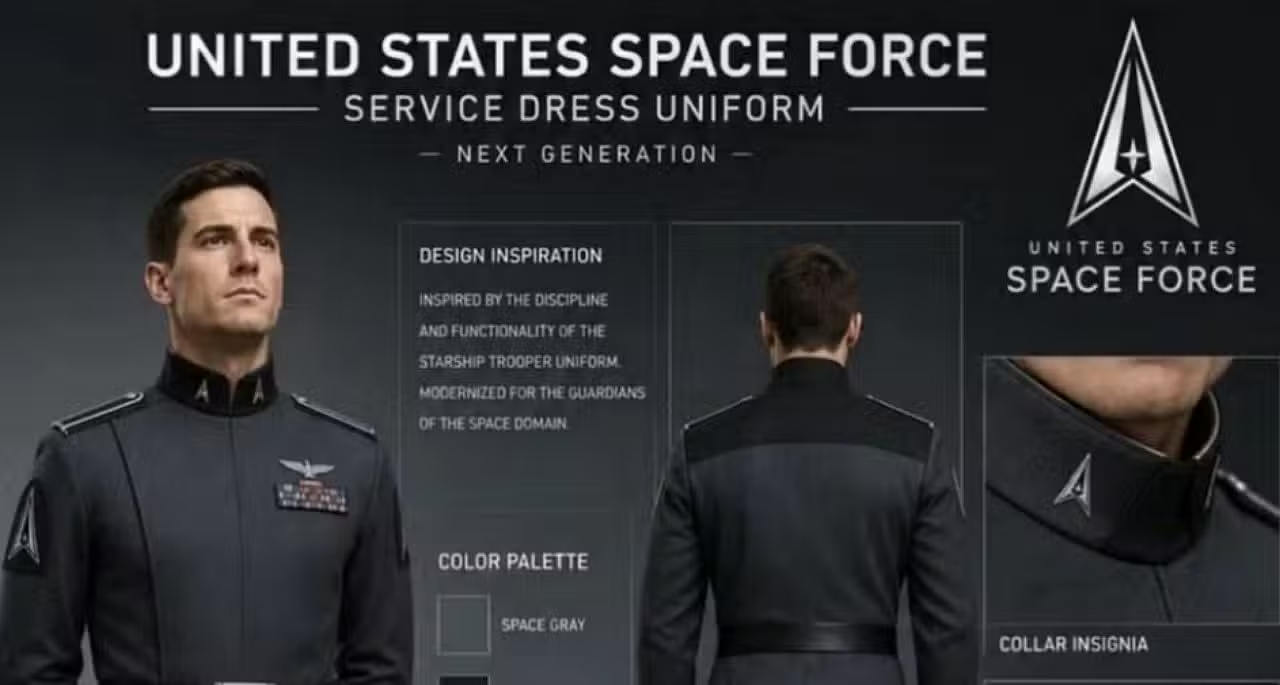
United States President Donald Trump unveiled a visual design concept for the future service dress uniform of the United States Space Force on September 6 through his personal account on Truth Social. The digital graphic presented an operational outfit tailored for the newest military branch established to protect American strategic interests beyond the atmosphere. Trump framed the computerized model as a modern aesthetic developed specifically for the next generation of military personnel entering service across the defense network.
Produced with artificial intelligence software, the graphic depicted an operational military uniform featuring a sharp color palette dominated by dark gray and black tones. The design incorporated form-fitting trousers tucked into high leather boots that reached just below the knee, complemented by a wide utility belt fastened around the waistline. A stiff, peaked service cap designed for commissioned officers completed the striking ceremonial look portrayed in the digital preview. The dramatic styling generated an immediate wave of commentary and critical reactions from users across online social platforms.
Trump shared a digital image.
Visual parallels emerge between movie costumes and historical uniforms
Commentators on social media swiftly drew visual parallels between the proposed dark ensemble and the formal uniforms worn by the SS, the infamous paramilitary organisation that carried out state terror in Nazi Germany. Observers pointed to the combination of midnight-black tailoring, high-riding leather boots, and the angular military cap as design elements reminiscent of totalitarian European dress from the twentieth century. Internet users also highlighted striking aesthetic similarities between the Space Force concept and the garments worn by Galactic Empire officers and villains within the Star Wars film franchise. Although the digital rendering triggered immediate debate across online platforms concerning military symbolism, Donald Trump omitted all technical fabric specifications, structural textile standards, domestic supply chain contracts, and federal procurement schedules required to manufacture the proposed garments for service personnel across the armed forces. His social media post acknowledged a distinct cinematic influence, clarifying that the visual concept drew inspiration from the functional uniforms seen in the science fiction universe of Starship Troopers.

Donald Trump specifically dedicated this design template to the guardians serving within the specialized military branch tasked with safeguarding American satellite networks and defending orbital operational zones. Critics noted sharp ideological contradictions between the official defense mission of the branch and the specific Hollywood war film chosen by the White House as creative inspiration.
Paul Verhoeven directed the satirical science fiction film in 1997
The motion picture referenced by the president originally arrived in commercial theaters across the United States in 1997. Dutch filmmaker Paul Verhoeven directed the adaptation, depicting recruits of the militarized United Citizen Federation engaged in brutal planetary warfare against giant alien arachnids. Verhoeven explained across multiple public forums that he deliberately structured the production as an aggressive parody targeting fascism, imperialist aggression, and hyper-militaristic propaganda. The satirical tone of the story mocked nationalist obedience and authoritarian government structures through exaggerated military pageantry.
Starship Troopers initially suffered severe commercial and critical disappointment during its 1997 theatrical release.
Film historians, political theorists, and global audiences later reevaluated the cinematic work, celebrating its subversive critique of authoritarian state systems and martial culture. By directly citing the movie on Truth Social, Donald Trump intensified scrutiny regarding whether his administration grasped the original anti-fascist critique embedded in the aesthetic. Military officials in the Pentagon have not published administrative paperwork confirming that the Armed Forces intend to formally standardize or adopt these conceptual garments. The social media post left defense observers uncertain whether the visual represents a genuine institutional initiative or merely an informal digital idea from the president.
Executive actions expand military aerospace education and lunar ambitions
Donald Trump broadened his aerospace messaging on September 6 by publishing supplementary statements regarding territorial dominance above the atmosphere of the Earth. The president uploaded a photograph of the Moon accompanied by a declarative caption asserting that the celestial body belongs to the United States, displaying a digital image of the American flag planted on the cratered lunar surface.
The online declaration reinforced established rhetoric from the administration concerning geopolitical supremacy in extraterrestrial territory. Executive branch officials advanced concrete organizational policies for the sector in late August by creating the United States Space Academy. The newly chartered military institution secured presidential authority to recruit promising candidates and build comprehensive technical training programs. Federal policymakers organized the academy to support long-term national security priorities amid escalating satellite deployment and commercial operations in low Earth orbit. The founding charter charges the leadership with preparing specialized personnel for competitive operational environments beyond terrestrial borders.
The executive order signed by Donald Trump established instructional pathways for a wide range of professionals.
- Astronauts and commissioned military officers
- Aerospace engineers and specialized research scientists
- Industrial operators, private contractors, and civilian government administrators
Individuals who graduate from these rigorous educational programs carry a binding statutory obligation to complete active service assignments inside the United States Armed Forces or within research centers operated by NASA. Federal planners designed this mandatory service structure to guarantee a steady workforce of technical experts for national orbital initiatives. The recruitment mandate ensures that the federal government retains operational talent as rival nations expand competing space programs.