
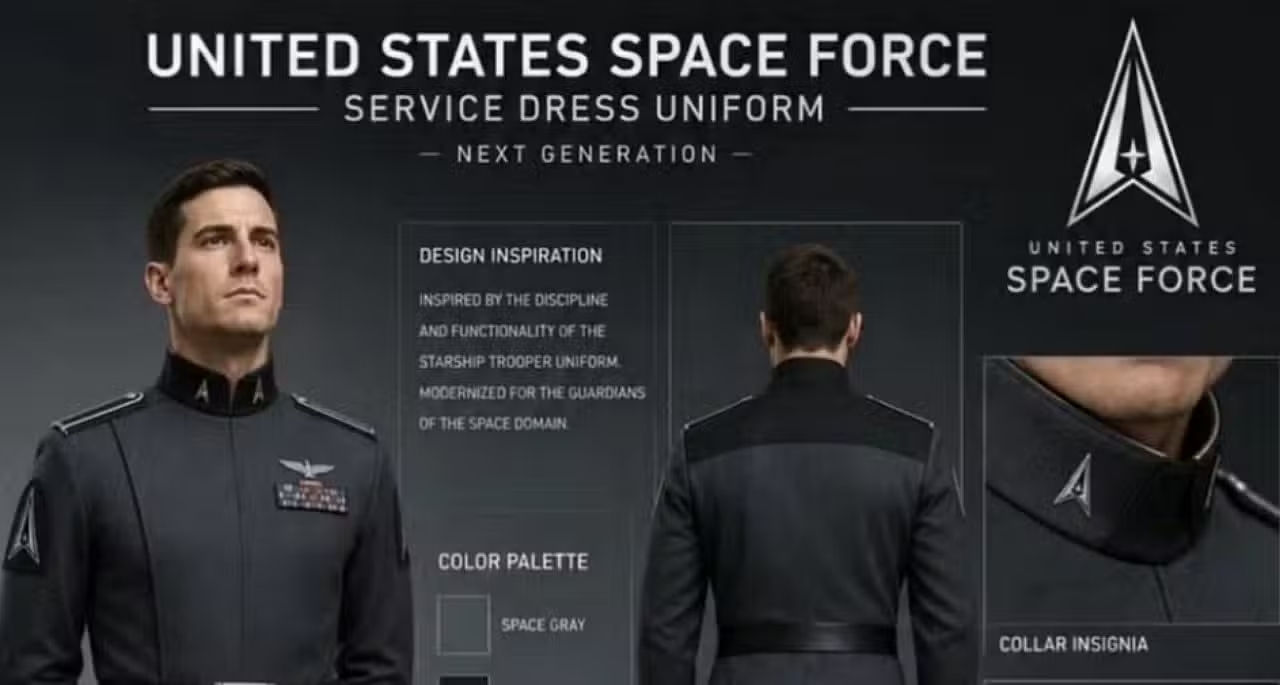
Donald Trump published a computer-generated uniform design for the United States Space Force on Truth Social on September 6. The American leader framed the visual presentation as operational attire intended for the country’s next generation of military personnel.
Artificial intelligence software created the graphic render featuring dark gray and black fabrics fitted with knee-high boots, a wide waist belt, and an officer-style peaked cap. Digital users quickly circulated the images across social platforms after the morning upload. The composition prompted immediate criticism regarding its aesthetic direction.
Trump shared a synthetic depiction.
Online observers draw parallels between mockups and twentieth century German forces
Commentators linked the dark garments, peaked cap, and high boots to uniforms worn by the SS paramilitary group during the Nazi regime in Germany. Many internet users also likened the visual aesthetic to evil factions portrayed in the Star Wars film franchise. Donald Trump provided no technical documentation detailing textile specifications or official manufacturers for prospective mass production.
The Republican leader explicitly cited the science-fiction movie Starship Troopers to explain the styling and utilitarian discipline of the attire. His social media post credited the Hollywood production with inspiring the functional posture of the illustrated guardians.

Donald Trump specifically addressed the conceptual mockup to members of the United States Space Force. The message attempted to assign a contemporary combat identity to service members guarding orbital territory. Detractors argued that adopting visual cues from that specific movie universe created ideological contradictions. These critics noted the awkward nature of using an overt parody for genuine armed forces.
Director Paul Verhoeven designed the 1997 narrative to satirize authoritarian regimes
Starship Troopers debuted in 1997.
Dutch filmmaker Paul Verhoeven directed the film about the United Citizen Federation waging an interstellar war against extraterrestrial arachnids, later confirming in public statements that he designed the entire production as an explicit satire against fascism and unchecked western militarism. Although the feature film flopped at the global box office and earned negative reviews during its theatrical release, critics reevaluated the movie decades later as a pointed critique of totalitarian political systems. Mentioning the satirical work on Truth Social intensified arguments over the ideological implications of the proposed Space Force uniform.
The United States Armed Forces have not confirmed any formal adoption or administrative evaluation of the digital uniform. The Truth Social update left unclear whether the rendering represents an informal presidential preference or an official acquisition initiative inside the military branch.
Social media posts assert American ownership of the Moon while expanding space education
Donald Trump posted an image of the Moon alongside a United States flag on September 6, declaring that the celestial body belongs to the nation. The social media upload reaffirmed the administration’s broader geopolitical claims regarding military dominance outside Earth’s atmosphere. His statement expanded on previous rhetoric prioritizing national superiority in outer space.
The federal government established the United States Space Academy in late August.
The military educational center received presidential authorization to recruit students and organize instructional curriculums. This educational initiative aligns with federal strategies to expand government space programs as activity increases across low Earth orbit. Officials designed the institution to support expanding operational needs.
An executive order signed by Donald Trump establishes broad operational guidelines for the instructional facility. The official directive mandates that the academy will train a diverse group of specialized professionals:
- Astronauts and active military officers
- Scientists and specialized aerospace engineers
- Industrial operators and commercial entrepreneurs
- Civilian government personnel
Graduates completing these technical courses must fulfill mandatory service commitments within the United States Armed Forces or at scientific installations operated by NASA.