
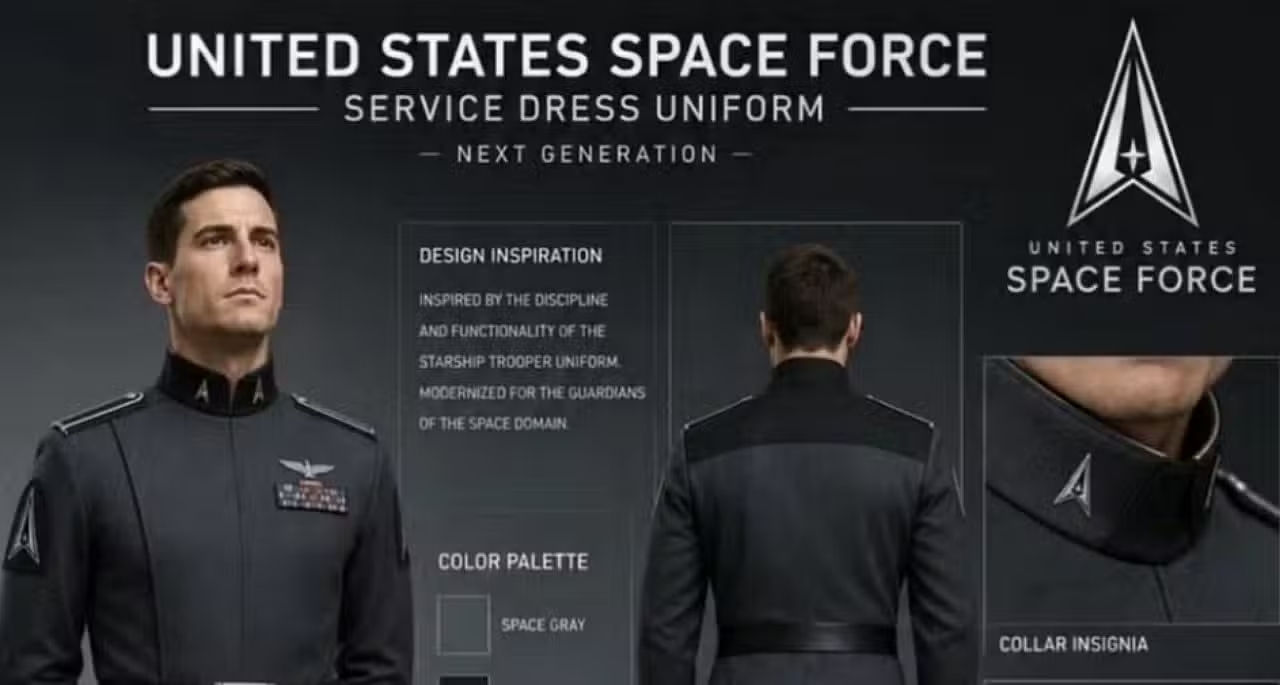
United States President Donald Trump published an artificial intelligence concept for future Space Force uniforms on his Truth Social account on September 6. The digital rendering displayed a dark service dress aimed at the next generation of American service members.
Online reactions link aesthetic to dark history and cinematic villainy
The computerized graphic published on Truth Social featured operational attire in dark gray and black tones, paired with knee-high boots, a fitted belt, and a traditional peaked cap for military officers. Artificial intelligence tools generated the entire demonstration. Online observers immediately circulated the illustration across digital networks.
Donald Trump posted digital artwork.
Social media users compared the dark fabric, boot alignment, and peaked cap to garments worn by the SS in Germany during the Nazi regime. Commentators on the web also linked the attire to the costumes of Star Wars villains. The presentation omitted technical data regarding production fabrics or designated manufacturing suppliers.

Trump referenced the fictional feature film Starship Troopers to explain the uniform layout. The post described the fictional costumes as functional models for guardians guarding space.
Hollywood director framed the referenced movie as satire
The cited science fiction movie debuted in theaters in 1997. Directed by Dutch filmmaker Paul Verhoeven, the story followed soldiers from the United Citizen Federation fighting massive alien bugs across distant solar systems. Verhoeven explained in public interviews that he created the film as an explicit satire targeting authoritarianism, fascism, and aggressive military propaganda.
Although the feature film suffered from poor initial box office returns and negative reviews upon release, audiences and film critics later reevaluated the production for its deliberate mockery of militaristic structures, an artistic nuance that heightened discussions surrounding the uniform proposal on Truth Social.
The United States Armed Forces have not officially verified or adopted the pictured clothing. The digital upload left unresolved whether the graphic serves as an informal concept from the president or marks the start of a formal military procurement review.
Social media posts claim American ownership of the Moon
Trump expanded his commentary on September 6 by publishing an image of the Moon alongside a statement claiming the natural satellite belongs to the United States. An American flag sat directly beside the lunar surface in the digital entry. This rhetoric aligned with earlier administration arguments asserting United States dominance beyond Earth’s atmosphere.
The White House introduced structural policies for the sector in late August by creating the United States Space Academy. The educational institution holds presidential authorization to establish specialized training programs.
The presidential directive for the United States Space Academy stipulates that the institution will train specialized personnel across several critical disciplines:
- Astronauts and military officers destined for defense operations
- Scientists and engineers focused on orbital technology
- Industrial operators, entrepreneurs, and civilian civil servants
Graduates completing these technical programs must fulfill mandatory service terms inside the United States Armed Forces or within research installations managed by Nasa. These service obligations conclude the training cycle outlined by the federal government.