
NASA releases Curiosity Mars view after 5,000 Martian days

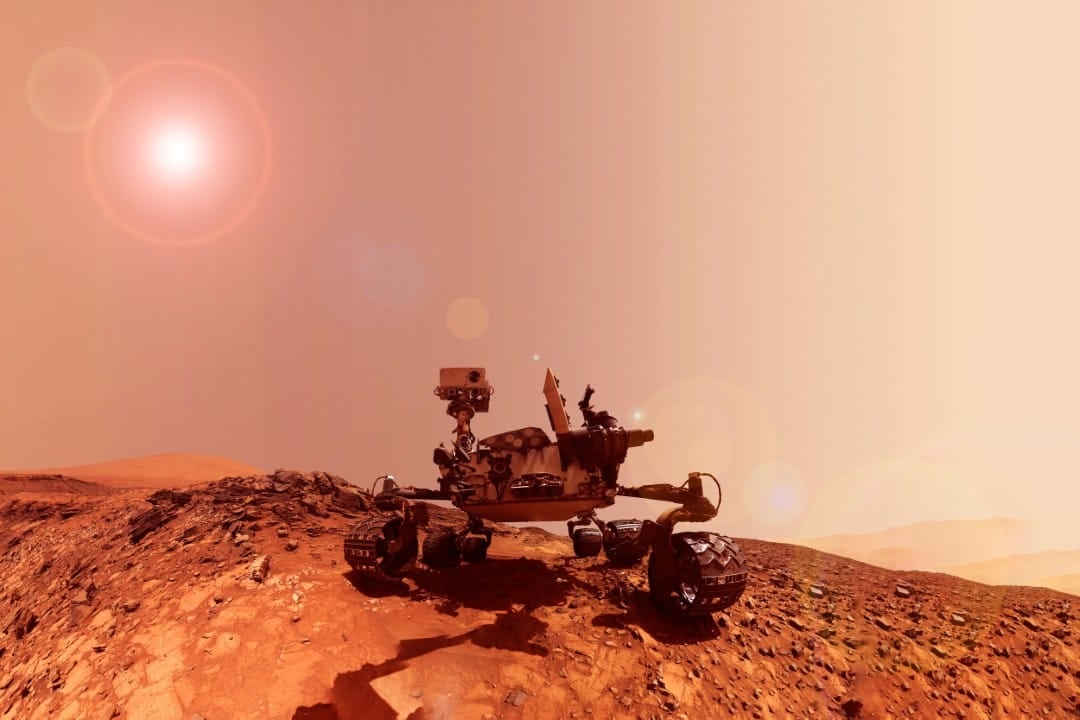
NASA released a new composite image of Mars to mark 5,000 Martian days of continuous surface exploration by the Curiosity robotic rover. The celebratory panorama showcases the persistent scientific trek across an alien world that has yielded crucial geological discoveries since touchdown.
Space agency engineers combined two separate exposures captured by black-and-white navigation cameras during distinct hours of the Martian day. Specialists then applied digital color to the transmitted files after receiving the raw telemetry on Earth. This processing highlighted subtle lighting shifts across rugged rock layers.
Engineers merged morning and afternoon views into a single Martian landscape
The first panoramic frame occurred on August 30 at 9:56 a.m. local Martian time on sol 5,000 of the expedition. The follow-up frame occurred on September 2 at 17:39 during sol 5,003. A single sol corresponds to one complete planetary rotation on Mars. The two images together showcase dramatic shadows.
Ground teams stitched both perspectives together once the downlink arrived at terrestrial control stations. Distinct blue hues represent the morning lighting conditions, whereas bright yellow tints illuminate the afternoon terrain.
NASA specialists emphasized that these added colors represent an artistic interpretation rather than true human visual perception. Such selective color balancing allows geologists to identify minute structural details in surface formations that standard monochrome views conceal. Science teams regularly utilize false color palettes to analyze Martian topography.
Hardware components and rover wheel tracks appear across the Chocolatal sand
Front-facing instruments mounted to Curiosity dominate the lower foreground of the newly published scene. Distinct tire tracks left behind by metallic wheels remain etched into the fine Martian soil.
Curiosity remained stationary on an informal sandy feature named Chocolatal while capturing both panoramic segments. Science operators chose this specific vantage point to ensure stable camera angles before moving forward. The stop provided a clear horizon.
The towering rim of Gale Crater stretches across the distant background behind the metallic robotic frame. Curiosity currently maneuvers around the lower foothills of Mount Sharp, an imposing sedimentary mountain rising roughly 5 kilometers into the thin atmosphere.
Mission operations directed from JPL started on the Red Planet during August 2012
Ever since touching down inside Gale Crater in August 2012, Curiosity has examined diverse rock layers, dried mudstones, and mineral deposits to determine whether ancient environmental conditions could have supported primitive microbial life on the Martian surface. That ongoing field research transformed our fundamental understanding of Martian environmental history. Teams continue to analyze soil chemistry to trace past moisture.
NASA Jet Propulsion Laboratory, managed by Caltech in Pasadena, oversees flight operations and daily navigation commands for Curiosity. The California facility built the machine as a central centerpiece of the Mars Exploration Program.





