NOAA projects 90% chance of historic El Niño across Pacific By Luís Henrique Costa
3 min read
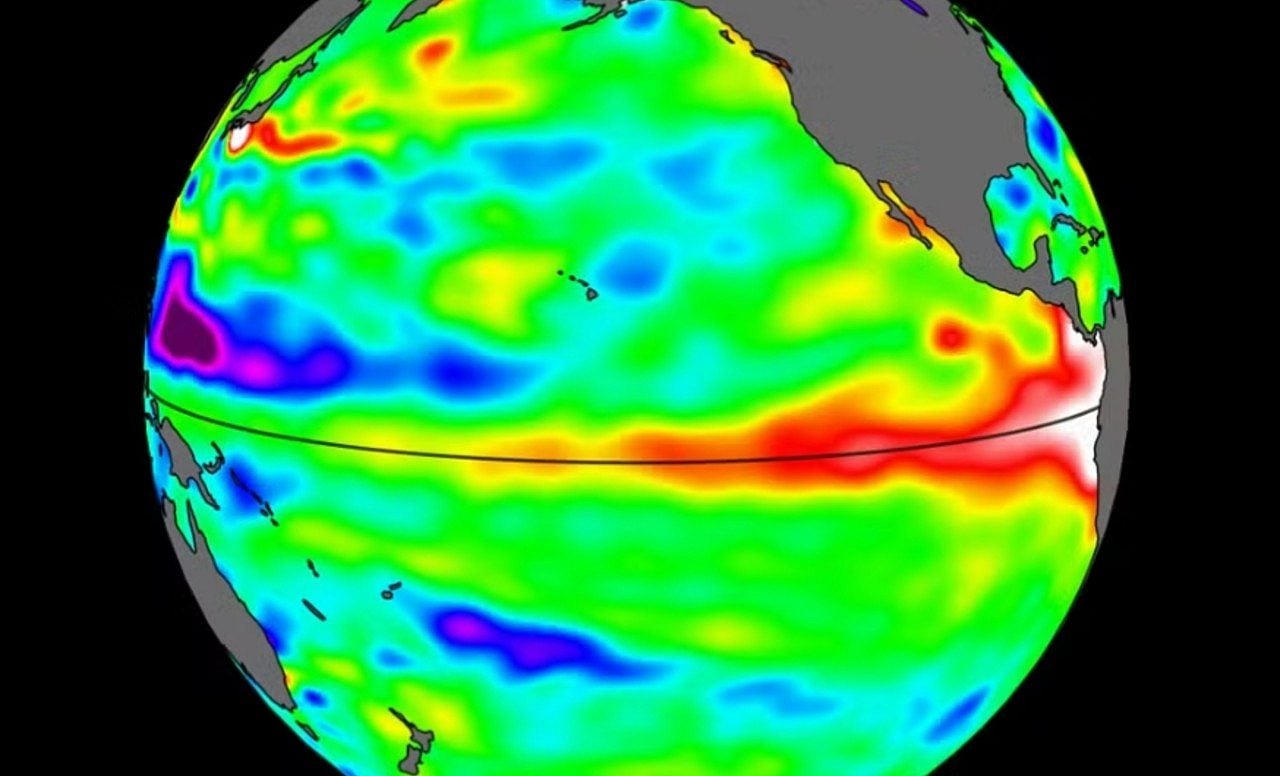 |
NOAA announced on September 15, 2026, that the expanding El Niño in the Pacific Ocean surpassed a 90% probability of reaching maximum category intensity between spring and early summer. The agency noted that this large-scale system will disrupt global weather patterns until at least the first half of 2027. Climate specialists identified continuous heat transfers that drive these elevated marine readings.
🌡️ El Niño is firmly established and will intensify into a very strong event in the coming months. WMO forecasts show ~100% likelihood that it will persist through February 2027.
A very strong El Niño ≠ same impacts everywhere.
🆕 WMO El Nino Update: https://t.co/cXDIhJGKwq pic.twitter.com/D1OrV3LjVm
— Global Goals (@GlobalGoalsUN) September 12, 2026
In the equatorial waters of the eastern Pacific near South America, surface temperatures recorded deviations between 2.8 and 3.7 degrees Celsius above standard seasonal averages. Marine monitoring stations confirmed that this specific sector registered the sharpest thermal surge across the entire ocean basin.
Tropical wind patterns shifted. Atmospheric scientists tracking the coupled weather system confirmed distinct anomalies across upper tropospheric winds, where altered convection zones above the equatorial Pacific coincided with three-month rolling thermal index readings averaging 1.4 degrees Celsius between June and August 2026. This metric, known as the Oceanic Niño Index variant RONI, remains on an uninterrupted upward path. Researchers reported consistent thermal accumulation throughout the lower atmospheric boundary.
Historical comparison and thermal index progression
Numerical forecast models indicate that the ongoing event could rival the strongest El Niño episodes recorded in modern history. Official statistical records kept since 1950 assign a 75% probability that measurements between October and December 2026 will exceed previous historical records. Atmospheric teams verified that deep oceanic heat storage supports these high-level projections.
Thermal metrics tracked by oceanic buoys remained at elevated levels.
During the severe 2015-2016 event, index measurements exceeded 2 degrees Celsius across multiple consecutive quarters, reaching a peak deviation of 2.3 degrees. Oceanographic centers will confirm any new global records following the conclusion of upcoming telemetry cycles. Previous data series establish benchmarks against which current Pacific observations are evaluated.
Atmospheric patterns across South American territories
Meteorological disruptions originating over the Pacific Ocean will persist through spring, summer, and parts of autumn across the Southern Hemisphere. As the system intensifies, broad regions across South America face significant departures from typical seasonal behavior.
Weather monitoring stations identified divergent conditions developing across individual geographic sectors.
- Rainfall volumes exceeding seasonal averages alongside severe storm activity across southern zones
- Substantial precipitation deficits leading to water shortages across northern territories
- Prolonged heatwaves generating elevated temperatures across central areas
Intense heatwaves settled over northern sectors where diminished rainfall kept ground moisture at record lows. Meanwhile, southern regions registered severe flooding risks from persistent storm systems fueled by anomalous Pacific moisture flows. Meteorologists determined that uneven energy distribution across equatorial waters drives these contradictory weather phenomena within identical national borders.
Projected stabilization phases for equatorial ocean waters
Atmospheric and oceanic activity tied to El Niño will continue across the Pacific basin through the March to May period of 2027. A potential transition toward neutral sea surface temperatures represents a viable trajectory only during the April to June quarter of 2027.
Oceanic probability calculations place the likelihood of returning to normal baseline conditions during that window at 55%.