
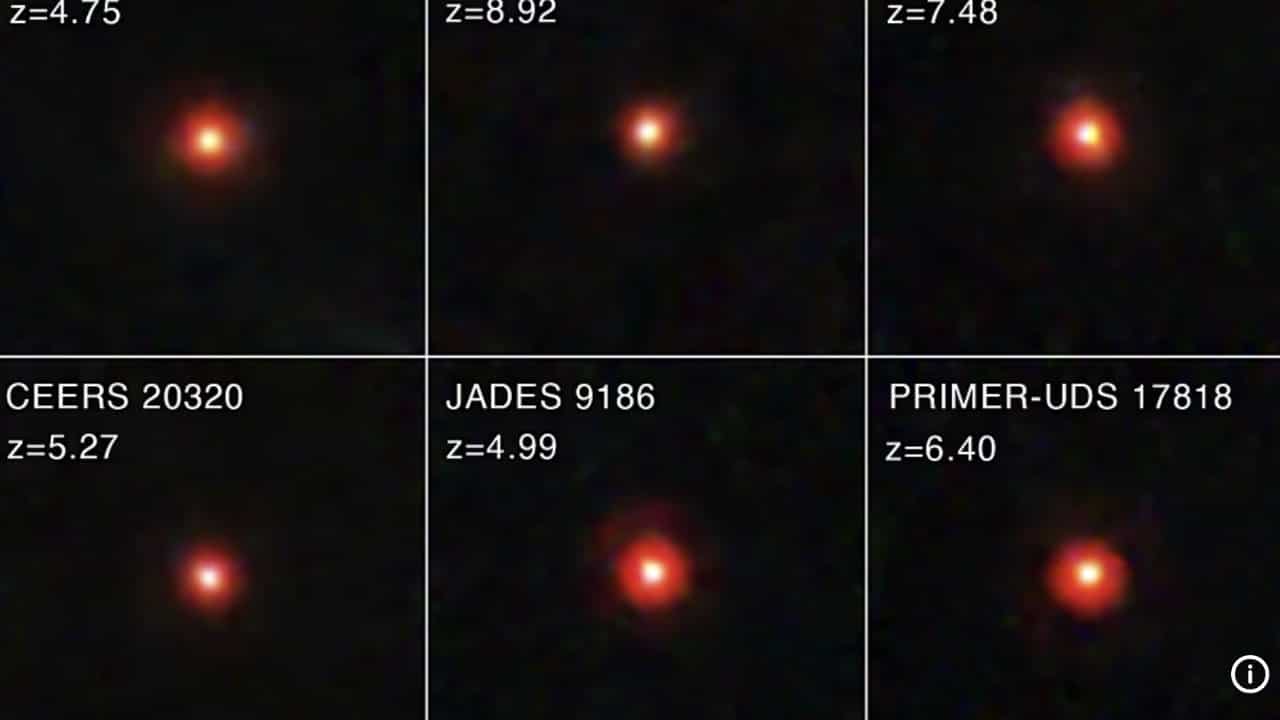
Cosmological simulations led by astrophysicists at the Max Planck Institute for Astrophysics show that the mysterious Little Red Dots detected by the James Webb Space Telescope are primordial supermassive black holes undergoing accelerated super-Eddington accretion. The numerical models demonstrate that massive cosmic structures in the early universe grow at rates dozens of times higher than standard feeding limits while wrapped inside a dense, optically thick gas envelope.
Published on September 16, 2026, in the journal Nature
, the research explains how these objects naturally produce both the distinctive red spectrum and the broad hydrogen emission lines observed across deep-field images. “The most exciting result is that objects resembling Little Red Dots emerge naturally in our cosmological simulations,” said Sunmyon Chon, lead researcher at the Max Planck Institute for Astrophysics in Garching bei München, Germany.James Webb observations reveal early cosmic anomalies
Since commencing scientific operations in 2022, the US$ 10 billion James Webb Space Telescope, built jointly by NASA, ESA, and CSA, has fundamentally challenged standard cosmic timelines. The space observatory discovered supermassive black holes harboring masses billions of times that of the sun less than 1 billion years after the Big Bang, defying traditional growth rates based on ordinary gas accretion or successive galactic mergers.
Arguably even more puzzling was the subsequent cataloging, beginning in 2023, of hundreds of compact Little Red Dots. These objects appear prominently between 600 million and 1 billion years after the Big Bang, yet they display no typical X-ray emissions commonly seen in active galactic nuclei. Furthermore, observations show that these specific targets vanish from the historical record once the universe reaches 1.5 billion years of age.
Simulations on the ATERUI III supercomputer reproduce quasi-star structures
To investigate the physics behind these early objects, Sunmyon Chon and coauthors Shingo Hirano of Kanagawa University, Tomoaki Ishiyama of Chiba University, and Volker Springel of the Max Planck Institute ran high-resolution radiation hydrodynamic models. On September 17, 2026, the National Astronomical Observatory of Japan outlined the execution of these extensive calculations, which were performed using its ATERUI III supercomputer in Tokyo, Japan.
See also: Webb reveals surprising lack of small worlds beyond Neptune
The resulting simulations demonstrated that intense far-ultraviolet radiation emitted by neighboring star-forming galaxies suppresses the fragmentation of nearby gas clouds into small stars. Instead, vast clouds undergo direct collapse into supermassive stars reaching several hundred thousand solar masses. After a lifespan of approximately 2 million years, these short-lived stars collapse directly into massive black hole seeds of approximately 10^6 solar masses, bypassing gradual accumulation steps.
“Massive black holes form and grow extremely rapidly, and during this growth they become surrounded by a very dense and optically thick gas envelope. This naturally produces several of the characteristic properties of observed Little Red Dots,” Chon explained. “When a black hole is supplied with gas at an extremely high rate, the gas cannot simply disappear into the black hole immediately. A large amount accumulates around it and forms a dense, optically thick structure due to the angular momentum.”
Chon noted the physical state that arises during this hyper-accretion phase: “In a sense, we are seeing an extremely overfed black hole wrapped in its own fuel.” Electromagnetic radiation generated near the event horizon must penetrate the dense surrounding gas, which shifts its wavelengths toward the red and broadens the H-alpha hydrogen lines. This dynamic also reproduces the properties of quasi-stars, which are theoretical objects composed of an infant black hole embedded within a massive gas shroud.

Chronology and core metrics of early black hole growth
- US$ 10 billion: construction and operating cost of the James Webb Space Telescope.
- 2 million years: lifespan of supermassive stars before collapsing into initial seed black holes.
- 10^6 solar masses: initial mass of primordial black hole seeds formed in the simulation.
- 3 x 10^7 solar masses: mass reached by the simulated black holes by redshift z ~ 8 through sustained feeding.
- 600 million to 1 billion years: cosmic epoch after the Big Bang when Little Red Dots are observed.
- 1.5 billion years: cosmic age after which Little Red Dots completely disappear from observations.
- September 16, 2026: official publication of the research paper in the journal Nature.
- September 17, 2026: technical release from the National Astronomical Observatory of Japan detailing the supercomputer models.
Unresolved evolutionary stages and upcoming cosmological tests
Despite resolving the rapid formation mechanism of supermassive seeds and explaining the spectral envelope of Little Red Dots, the numerical framework does not explain why these objects abruptly cease to exist in cosmic history. The exact physical driver behind their total disappearance after the universe reached 1.5 billion years of age remains unexplained by current simulations.
Check out: Webb and Hubble find 27 icy objects orbiting beyond Neptune
“Our simulations do not yet explain why Little Red Dots seem to disappear at later cosmic times. This is still a big mystery,” Chon stated. The research team plans to run subsequent simulations with varied environmental conditions to test whether Little Red Dots consistently form across different primordial settings, while generating refined spectral predictions to compare directly against forthcoming deep-space observations from the James Webb Space Telescope.