
Astronomers find first second-generation planet around white dwarf
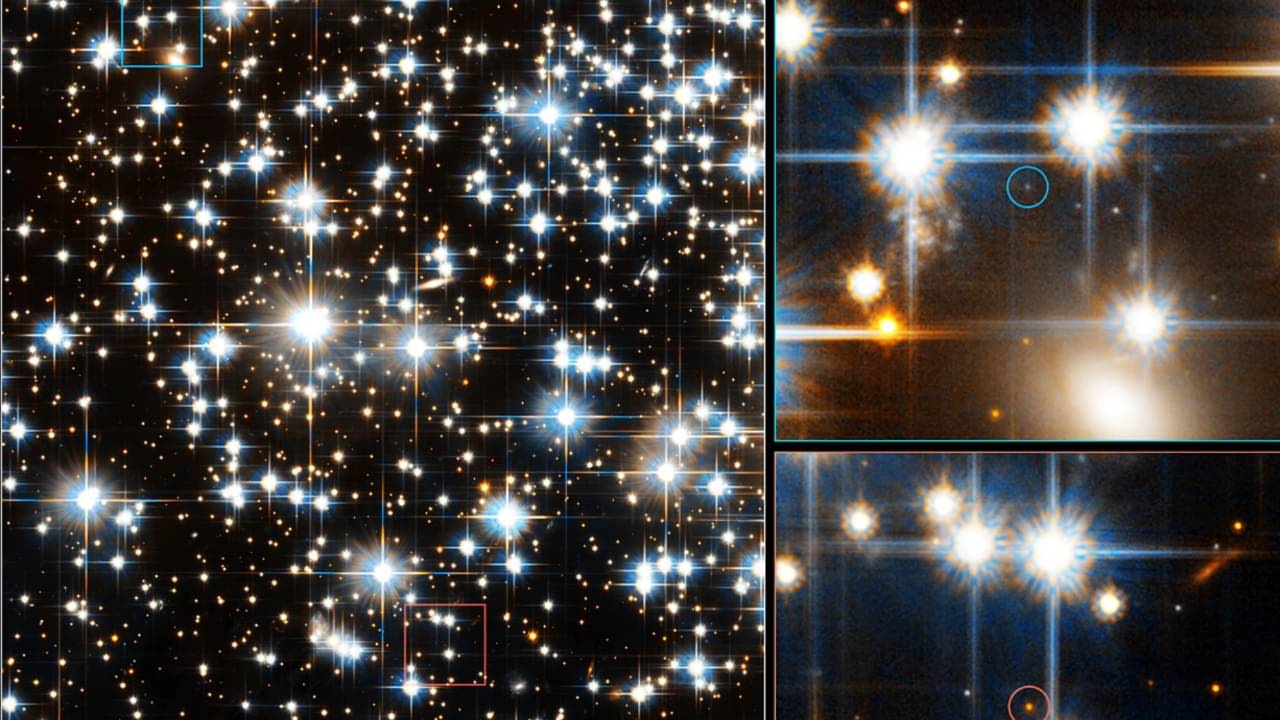
White dwarf HS 0209+0832 hosts what appears to be the first second-generation planet ever identified around a dead stellar core, researchers led by the University of Warwick announced this Monday (5). The celestial body condensed directly from the gas and dust ejected during the death throes of the original star, rather than surviving from the birth of the system.
The discovery, funded by the European Research Council and published in the journal Nature Astronomy on October 5, 2026, reveals a gas giant orbiting extremely close to the white dwarf. The proximity causes the planet to shed its outer atmosphere under heavy radiation, depositing heavy elements directly onto the surface of the dense remnant.
Learn more: Jupiter will vanish behind the crescent moon on Tuesday morning
Atmospheric pollution reveals rare s-process metals in HS 0209+0832
Spectroscopic evaluations of the white dwarf atmosphere detected unexpected concentrations of heavy elements, including zinc, copper, and niobium. The abundance of niobium reached levels over 1,000 times higher than those measured in the Sun, marking the first time that this metallic element has ever been detected in the atmosphere of a white dwarf.
These elements are synthesized via the s-process, a slow neutron-capture nuclear reaction that occurs inside dying stars during their swollen red giant phase. Typical planetary bodies that pollute dead stars deliver rocky material rich in iron and silicon, but the chemical envelope of HS 0209+0832 reflects the specialized nucleosynthesis of an aging star whose processed debris coalesced into a brand-new planet.
Check out: Miami Heat transforms into Vice City on November 18 before GTA VI launch
“This pattern of elements is a telltale sign of the ‘s-process,’ a nuclear reaction that builds heavy elements inside dying stars during their bloated red giant phase. It’s a chemical signature no ordinary, ‘first-generation’ planet should carry, which told us that this new planet was something different,” said Dr Nicholas Stone, researcher in the Department of Astronomy at the University of Wisconsin-Madison and co-author of the study.
TESS photometric measurements and metrics of HS 0209+0832
Photometric data gathered by NASA’s Transiting Exoplanet Survey Satellite recorded regular variations in brightness repeating every 4.4 days. The periodic signal matches the expected signature of a Jupiter-sized gas giant in synchronous tidal locking, revolving at an estimated orbital distance of 0.044 astronomical units from the white dwarf.
Read also: Ninja Theory begins staff cuts in the UK after Xbox divestment talks fail
- Host star: White dwarf HS 0209+0832
- Orbital period: 4.4 days detected through NASA TESS data
- Orbital separation: 0.044 astronomical units between star and planet
- Key chemical marker: Atmospheric niobium abundance exceeding solar levels by 1,000 times
- Discovery publication: Nature Astronomy on October 5, 2026
At such close quarters, intense stellar radiation boils away the planet’s outer gaseous layers. This escaping material continually cascades onto the stellar core, explaining why these short-lived heavy elements remain visible in the optical spectrum of the star instead of sinking beneath its outer atmosphere under gravity.
Companion star role in shaping the planet around HS 0209+0832
The formation of a planetary accretion disk out of ejected stellar material requires precise dynamical conditions that rarely occur during stellar evolution. In an isolated dying star, mass loss happens in a roughly spherical pattern, dispersing the gas outward into interstellar space before condensation can occur.
“Forming the protoplanetary disc in this situation is not easy and helps explain why these planets are so rare. A single, isolated star dies and sheds mass in a roughly symmetrical way. To form a disc of material necessary to birth a planet, HS 0209+0832 likely required a companion star that pulled the ejected material back into orbit, rather than letting it escape,” said Jamie Williams, doctoral researcher in the Department of Physics at the University of Warwick and lead author of the study.
Follow: Luxury watches of football stars top $2 million as Neymar and Messi buy rare models
Professor Boris Gänsicke, co-author from the Department of Physics at the University of Warwick, stated: “What’s remarkable about the planet around HS 0209+0832 is that this isn’t a planet from somewhere else, or a survivor from the system’s birth, it looks like it was built from the very material its own star cast off as it died. In a sense, this system has given birth to a new world using the foundations of the old one.”
Theoretical models and past searches for second-generation worlds
Theoretical astrophysicists first proposed the mathematical viability of second-generation planets more than 15 years ago, but observational evidence remained elusive. While astronomers previously suspected similar reborn worlds around rapidly rotating neutron stars known as pulsars, no confirmed cases existed around white dwarfs, which represent the final evolutionary stage for more than 95 percent of all stars in the universe.
Standard white dwarf accretion models consistently register accretion remnants that mirror the chemistry of terrestrial rocky planets formed during the primordial formation of the stellar nursery. The unambiguous signature of advanced red giant nucleosynthesis at HS 0209+0832 alters current understanding of planetary survival and regeneration following catastrophic stellar expansion.
James Webb Space Telescope observations planned for definitive confirmation
The object remains formally classified as a planet candidate in the research paper while the team awaits final confirmation through independent instrumentation. Additional high-resolution spectrographic measurements are needed to eliminate alternative orbital configurations and fully map the geometry of the evaporating gas stream.
See also: Nobel prize in medicine goes to trio for brain research
Astronomers plan to deploy the James Webb Space Telescope over the coming year to measure atmospheric spectra directly from the companion body and refine the mass limits of the system. The findings also offer clues about the ultimate destiny of the Solar System, where the Sun will exhaust its core fuel in roughly 5 billion years, presenting identical physical conditions that could eventually leave behind a second generation of planets forged from its own remnants.


