
Overseas investors triggered a sharp sell-off in Brazilian financial assets during Sunday night (25) trading sessions after President Luiz Inácio Lula da Silva of the Workers’ Party (PT) defeated Senator Flávio Bolsonaro of the Liberal Party (PL) in Brazil’s presidential runoff. The iShares MSCI Brazil (EWZ), the primary U.S.-listed exchange-traded fund tracking Brazilian equities, tumbled as much as 19.63% to $34.23 in the minutes immediately following the official confirmation of the election result. By 10:43 p.m. Brasília time, the fund was trading at $35.03, representing a 17.75% decline compared to its Friday (23) closing price of $42.59 on the NYSE Arca exchange.
Selling pressure quickly spilled over into currency derivatives in North America and equity markets opening for Monday (26) sessions in Asia. On the Chicago Mercantile Exchange (CME), the Brazilian real futures contract for November 2026 delivery fell 9.97% by 10:30 p.m. Brasília time, pushing the implied U.S. dollar exchange rate to an equivalent of R$ 5.56. Meanwhile, on the Tokyo Stock Exchange, the NEXT Funds Ibovespa Linked ETF—an investment fund tied to Brazil’s benchmark stock index—opened Monday’s local trading session in negative territory and widened its losses to 14.37%, falling to 280 yen at 10:40 p.m. Brasília time from Friday’s (23) close of 327 yen.
Heavy losses hit Petrobras, Itaú and Vale receipts in after-hours US trading
American Depositary Receipts (ADRs)—certificates traded on U.S. stock exchanges that represent shares of foreign companies—mirrored the steep downturn seen in the EWZ fund during Sunday’s overnight session. Around 9:15 p.m. Brasília time, common ADRs of state-controlled oil company Petrobras (PBR) dropped 11.96% to trade at $23.15, while the company’s preferred receipts (PBR-A) slid 10.33% to $21.10. At that same timestamp, receipts for Brazil’s largest private lender, Itaú Unibanco (ITUB), posted a 13.65% loss, and shares of mining giant Vale (VALE) retreated 4.19%.
Earlier in the evening on the Chicago derivatives market, prior to reaching the implied rate of R$ 5.56 per dollar, the November 2026 Brazilian real futures contract traded at $0.1814 per real at 9:04 p.m. Brasília time, marking a 9.14% depreciation for the South American currency. In inverse terms, that quote corresponded to R$ 5.5127 per U.S. dollar, a 10.06% jump above the previous settlement price of R$ 5.0088. Market data published by the CME carries a minimum delay of ten minutes and does not set the official spot exchange rate in Brazil, but institutional traders routinely use these contracts to hedge portfolios before the B3 stock exchange opens in São Paulo.
Market strategists noted that Sunday night trading sessions in New York and Chicago operate with thinner order books and fewer active participants, a structural condition that often magnifies price swings during major political events. “It is still too early to gauge the full extent of this move [the drop in the indices], because regular markets are closed and futures contracts have lower liquidity, but the signals point to a steep decline, reversing a large portion of the rally seen after the first round,” said William Castro, chief strategist at the investment platform Avenue.
Analysts weigh fiscal spending rules and currency forecasts for 2027
The abrupt repricing of Brazilian securities abroad reflects the rapid unwinding of market positions built around a potential victory by Flávio Bolsonaro, an outcome that many institutional investors had linked to stricter government spending caps and a more liberal economic agenda. Gustavo Sung, chief economist at the financial analysis firm Suno Research, noted that his team had modeled a different outcome heading into Sunday’s vote. “President Lula’s victory was not our base scenario. We were working with a slight favoritism for Flávio Bolsonaro, and the market saw the possibility of a change in government and a more liberal agenda,” Sung said.
According to Sung’s assessment, previous policy statements made by Vice President Geraldo Alckmin and Minister Dario Durigan indicate that the federal administration is likely to pursue more gradual spending restraint during Lula’s fourth term than financial markets had anticipated under a hypothetical Bolsonaro presidency. Suno Research projects that Brazil’s Gross Domestic Product (GDP, the total value of all goods and services produced in the country) will expand by roughly 1.3% in 2027. While that growth rate is higher than the firm’s estimate under a Liberal Party victory, the forecast comes paired with more persistent inflation, narrower room for reductions in the benchmark Selic interest rate, and upward pressure on government bond yields.
See also: Brazil 2026 presidential runoff places Flávio Bolsonaro at 50.02% and Lula at 49.98% in TSE count
Looking ahead to the resumption of domestic trading in São Paulo, the Suno Research chief economist anticipates widespread portfolio adjustments across equities, foreign exchange, and domestic interest rate futures. “Monday could be quite volatile, because there will be a correction in course and in market sentiment,” he stated. Regarding the longer-term trajectory for the Brazilian currency against the U.S. dollar, Sung added: “We see volatility in the exchange rate, which should remain around R$ 5.40 on a sustained basis in 2027.”
Sung also pointed out that the initial market sell-off following Lula’s previous presidential election victory in 2022 eventually gave way to improved investor expectations after Congress approved a new fiscal framework in 2023. In the upcoming term, the administration will negotiate budgetary measures with a more conservative legislature, as Flávio Bolsonaro’s Liberal Party won 28 of the 81 seats in the Federal Senate and 121 of the 513 seats in the Chamber of Deputies during the October 4 general elections. “We need to watch how the government will organize itself for 2027. That is the main point we are calling attention to,” the economist declared.
Historic runoff comeback reverses the post-first-round market rally
The downturn recorded across international trading desks on the night of October 25, 2026 stands in sharp contrast to the euphoria that swept Brazilian markets three weeks earlier. In the first-round vote held on October 4, 2026, Flávio Bolsonaro finished in first place with 47.03% of the valid votes—holding a lead of roughly 2.2 million ballots—against 45.16% for Lula. That unexpected first-round advantage propelled Brazil’s benchmark Ibovespa stock index past the historic 200,000-point threshold for the first time in the very next trading session. Days prior to that initial vote, in a research note dated September 29, 2026, U.S. investment bank JPMorgan had estimated that a scenario of gradual fiscal deterioration in Brazil could trigger a 21% drop in domestic equities and a 6% depreciation in the Brazilian real.
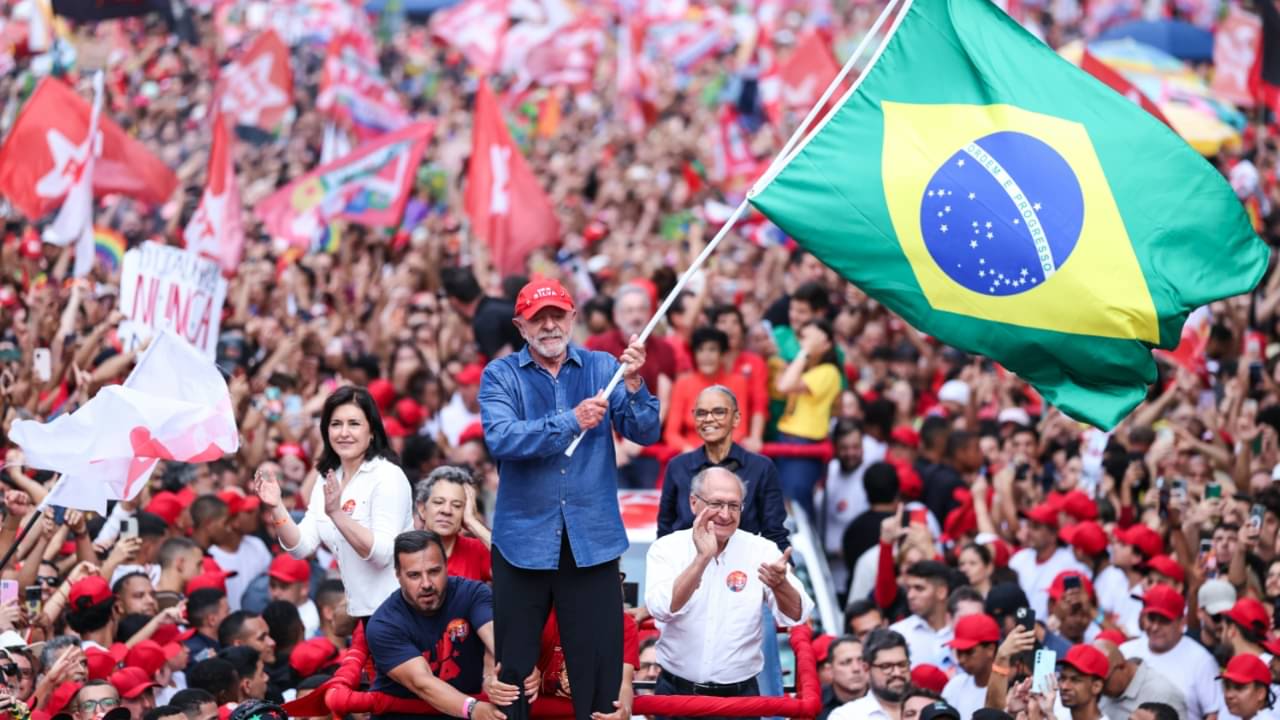
In Sunday’s runoff, however, Lula achieved a political reversal unseen since Brazil restored direct presidential elections in 1989, becoming the first candidate to lose the first round and go on to win the second round. Brazil’s Superior Electoral Court (TSE), the highest judicial authority overseeing elections in the country, mathematically confirmed Lula’s re-election at 9:10 p.m. Brasília time with 98.27% of polling stations counted, showing the incumbent with 51.75% of valid votes compared to 48.25% for Bolsonaro—a margin of 4.25 million votes. Later in the evening, with 99.88% of precincts tallied by the electoral court, Lula held 64,156,472 votes (51.76% of the valid total), while Flávio Bolsonaro had 59,781,887 votes (48.24%).
Key dates and market benchmarks from the October 2026 election cycle
- October 4, 2026 — Senator Flávio Bolsonaro finishes first in the opening round of the presidential race with 47.03% of valid votes, ahead of President Luiz Inácio Lula da Silva at 45.16%.
- October 5, 2026 — In the first trading session after the opening round, the Ibovespa index surges 7.70%, the U.S. dollar falls 4.12% to R$ 5.00, and the U.S.-listed EWZ ETF jumps 12.54%, climbing from $38.19 to $43.00.
- October 23, 2026 — On the final Friday session before the runoff vote, the Ibovespa closes up 0.47% at 205,082.56 points, while the EWZ ETF advances 1.77% in New York to finish at $42.59.
- October 25, 2026, at 8:26 p.m. Brasília time — Lula overtakes Bolsonaro in the official second-round vote count, and polling institute Datafolha projects the incumbent’s victory at 8:53 p.m.
- October 25, 2026, at 9:10 p.m. Brasília time — The Superior Electoral Court (TSE) mathematically confirms Lula’s fourth presidential term; within minutes, the EWZ ETF plunges as much as 19.63% to $34.23 in U.S. overnight trading.
- October 26, 2026, at 9:00 a.m. and 10:00 a.m. Brasília time — Scheduled opening times on São Paulo’s B3 exchange for currency futures trading (at 9:00 a.m.) and the spot Ibovespa stock market (at 10:00 a.m.).