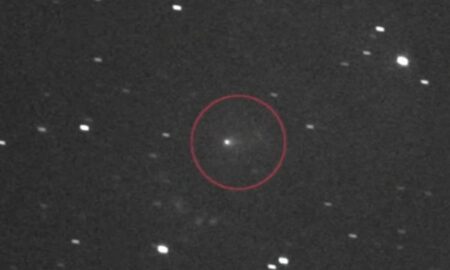
3I/ATLAS moves at 58 km/s, the highest speed of any interstellar object


The interstellar comet 3I/ATLAS is heading toward the inner Solar System at a speed of about 58 km/s, according to a 2026 measurement. Its path is hyperbolic, which means it passes the Sun without ever settling into an orbit around it. Astronomers have confirmed that it came from another star system.
The object was the third confirmed interstellar visitor, after ‘Oumuamua and Borisov. Its starting speed is above what is needed to escape the Sun’s gravity, so its course bends like a slingshot around the star before it leaves.
- 3I/ATLAS: about 58 km/s in the 2026 measurement, after an earlier estimate of 57 km/s
- 1I/’Oumuamua: 26 km/s, as compared in earlier reporting
- 2I/Borisov: 33 km/s, as compared in earlier reporting
How objects like 3I/ATLAS are thrown out of other star systems
Bodies like 3I/ATLAS once orbited distant stars before being ejected. Gravitational interactions or stellar explosions can send them into interstellar space.
Such objects can travel for millions of years before they cross systems like ours. Telescopes look for paths that are not tied to the Sun, which helps confirm where an object came from.
Why the hyperbolic path keeps 3I/ATLAS moving out of the Solar System
A hyperbolic path means the speed is higher than the local escape speed at every point along the way. 3I/ATLAS entered the Solar System, swung around the Sun and is now leaving, without ever forming an orbit.
The Sun’s gravity changes its direction but does not slow it enough to capture it. Observers continue to follow its path into deep space.
Check out: 3I/ATLAS interstellar comet: 57 km/s hyperbolic orbit confirms it came from another star
Calculations placed its closest approach to the Sun in late October 2025, and the interaction lasted several weeks. A 2026 study reported that 3I/ATLAS had the largest hyperbolic excess velocity among the interstellar objects detected so far.
How 3I/ATLAS compares with comets born in the Solar System
Comets born in the Solar System reach speeds of tens of km/s at perihelion, the point closest to the Sun. Interstellar objects keep the speeds they gained in the galactic environment.
That difference points to an external origin for 3I/ATLAS. Spectroscopy studies its composition and has found element proportions that are unusual for the Solar System. In a Nature Astronomy study, a Webb team measured methane with a deuterium ratio of about 3.33%, roughly 14 times higher than the ratio measured in comet 67P/Churyumov-Gerasimenko.
The 2017 acceleration of ‘Oumuamua and what researchers say explains it
‘Oumuamua showed an unexpected acceleration in 2017 while passing the Sun. Outgassing of trapped hydrogen is offered as the natural explanation for that motion.
Heat from the Sun releases gas from inside the object. Alternative hypotheses lack concrete evidence.
Gravity and the trajectory of 3I/ATLAS after its passage
The passage bends the trajectory of 3I/ATLAS by a calculated angle. A passage near Jupiter, just outside its Hill radius, took place on March 16, 2026.
Follow: 3I/ATLAS interstellar comet shows high carbon dioxide levels during solar system passage
Kinetic energy outweighs the Sun’s pull on the comet. Once it leaves, it keeps moving through space, and observatories continue to track it.
What Webb and other telescopes found about the comet’s ice and chemistry
A study led by Silvia Protopapa of the Southwest Research Institute reported that the comet’s ice is made of tiny grains mixed with a lot of dust. Its findings were published on October 26, 2026, in The Astrophysical Journal Letters, and they show a resemblance to some objects beyond Neptune.
A study led by Luis Salazar Manzano at the University of Michigan found that the comet’s water contains an unusually high level of deuterium. The team concluded that 3I/ATLAS most likely formed in a colder region with less radiation than the one that shaped the Solar System.
As it moves away from the Sun, the comet is getting fainter, and the Very Large Telescope observations are nearing their end.