

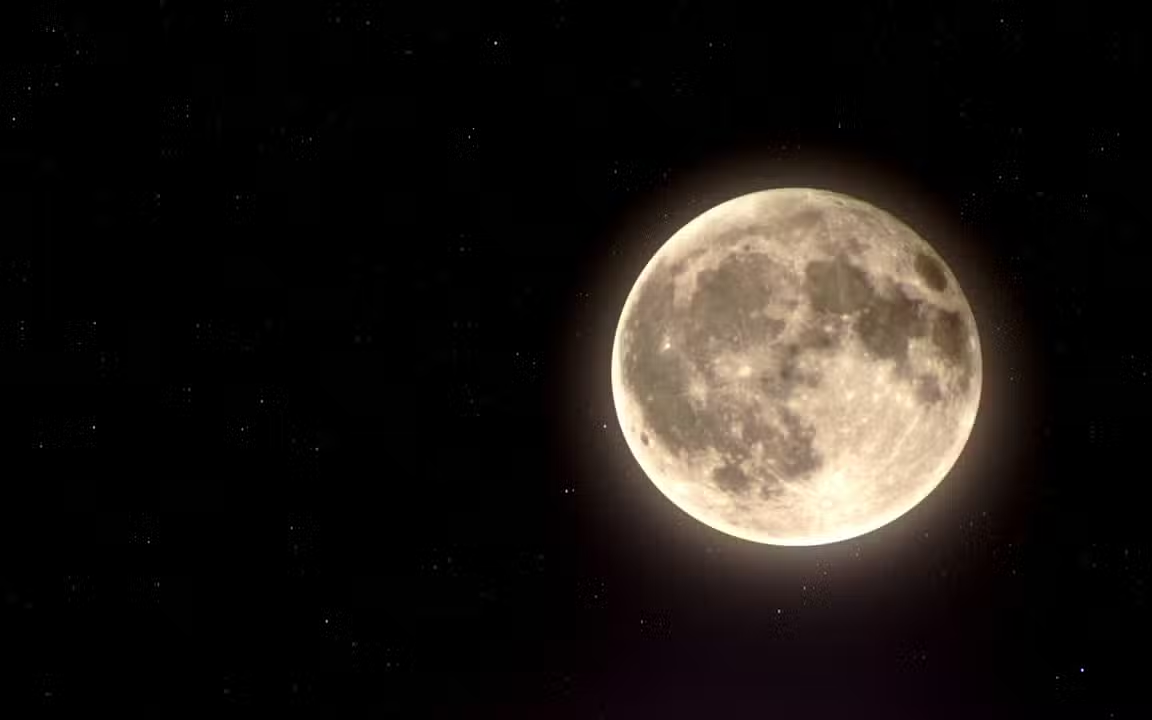
NASA announced on Friday, April 4, 2025, that the asteroid 2024 YR4, recently discovered, has seen its likelihood of colliding with the Moon increase from 1.7% to 3.8%, according to recalculated data. The potential impact is projected for December 22, 2032, based on refined observations from advanced telescopes, including the James Webb Space Telescope. First spotted in December 2024 by a telescope in Chile’s desert, the asteroid initially carried a negligible 0.004% chance of striking Earth, a risk now virtually eliminated. Despite the heightened odds of a lunar collision, NASA emphasizes that there remains a 96.2% probability the asteroid will miss the Moon entirely, though the scenario has sparked intrigue among scientists eager to witness a rare cosmic event.
The asteroid’s discovery quickly drew attention due to its proximity to the Earth-Moon system. Early estimates suggested a tiny chance of an Earth impact in 2032, but updated calculations shifted focus to the Moon. Measuring between 53 and 67 meters—roughly the height of a 10-story building—the 2024 YR4 is large enough to create a visible crater if it hits, though too small to disrupt the Moon’s orbit. In recent months, dozens of smaller objects have passed closer to Earth than the Moon’s distance, often disintegrating unnoticed in the atmosphere. The 2024 YR4 stands out, however, for its potential to interact with our natural satellite, prompting renewed interest in space monitoring and the study of celestial impacts.
Further observations are scheduled for next month, when the James Webb will again target the asteroid with its infrared capabilities. For now, the 2024 YR4 continues its journey through space, captivating astronomers and space enthusiasts alike. A lunar impact, while unlikely, could provide a unique opportunity to observe a real-time collision, offering insights into both the asteroid’s makeup and the Moon’s response to such events.
Revised trajectory: what shifted the odds
Advanced telescope data, particularly from the James Webb, enabled NASA to refine the 2024 YR4’s projected path. Initially pegged at a 1.7% chance of striking the Moon, the odds jumped to 3.8% after infrared observations clarified its orbit. This adjustment underscores the precision of modern instruments in tracking subtle changes in space objects’ trajectories. NASA notes that even with this uptick, the asteroid is still overwhelmingly likely to bypass the Moon without incident.
The asteroid’s size has also been narrowed down. Previously estimated more broadly, it’s now confirmed to span 53 to 67 meters in diameter, placing it in the mid-range category. By comparison, the Chelyabinsk asteroid, which exploded over Russia in 2013, was about 20 meters wide and caused significant damage upon atmospheric entry. A lunar strike, however, would pose no such risk to Earth, given the Moon’s lack of atmosphere, though it could leave a noticeable mark visible from our planet.
Astronomers highlight the Moon’s cratered surface as evidence of its long history of impacts. A 2024 YR4 collision, though rare in human timescales, would be a minor addition to this cosmic record. NASA plans ongoing monitoring to further refine the asteroid’s path and assess any changes in its risk profile.
A natural experiment: what a lunar hit could reveal
Should the 2024 YR4 strike the Moon in 2032, scientists would gain a front-row seat to a live cosmic collision. Experts suggest the event could be visible through ground-based telescopes and possibly binoculars, depending on atmospheric conditions and the impact’s location. The resulting crater, likely spanning a few hundred meters, would offer valuable data on the asteroid’s composition and the Moon’s surface dynamics under such forces.
The Moon has endured far larger impacts in its distant past, like the one that carved the 2,500-kilometer-wide Aitken crater near its south pole. In contrast, the 2024 YR4 is modest, incapable of altering the Moon’s orbit or gravity but sufficient to create a striking visual effect. Researchers anticipate that a hit could shed light on whether the asteroid is rocky, metallic, or a mix, based on its likely origin in the asteroid belt between Mars and Jupiter.
Asteroids by the numbers: key statistics
Tracking near-Earth objects is a critical task for space agencies like NASA. Here’s how the 2024 YR4 fits into the bigger picture:
- Over 34,000 near-Earth asteroids have been cataloged as of April 2025.
- Around 1,200 exceed 140 meters and follow potentially hazardous orbits.
- The Moon sits 384,400 kilometers from Earth, yet the 2024 YR4 may pass even closer to it.
- Lunar impact odds rose from 1.7% to 3.8%, still below a 5% threshold.
These figures highlight the importance of advanced tracking systems in managing space risks.

Timeline of 2024 YR4: what’s next
The asteroid’s journey follows a schedule keeping scientists on watch. Key milestones include:
- December 2024: Initial discovery by a Chilean telescope.
- April 2025: NASA updates orbit data, raising lunar risk to 3.8%.
- May 2025: Planned follow-up observations with the James Webb Space Telescope.
- December 22, 2032: Projected date for potential impact or near-miss with the Moon.
This timeline reflects ongoing efforts to monitor and predict the asteroid’s behavior over the coming years.
Why the Moon takes the hits
Covered in countless craters, the Moon’s surface tells a story of relentless bombardment over billions of years. Unlike Earth, which burns up most small asteroids in its thick atmosphere, the Moon lacks this shield, making it a frequent target. Daily micrometeorite strikes pepper its surface, but a visible event like a 2024 YR4 impact remains a rarity in human observation.
With no significant erosion, the Moon preserves these scars, offering a geological record of its past. A new crater from the 2024 YR4 would join this collection, potentially captured in high detail by orbiters like the Lunar Reconnaissance Orbiter, active since 2009.
Tech at work: James Webb’s role
Launched in 2021, the James Webb Space Telescope has proven vital in studying the 2024 YR4. Its infrared imaging pinpointed the asteroid’s size and orbit, refining earlier estimates. Positioned 1.5 million kilometers from Earth, the telescope excels at observing distant objects, providing unprecedented clarity on space phenomena.
Next month’s observations will delve deeper into the asteroid’s makeup. These findings could reveal whether it’s primarily rock, metal, or a composite, influencing predictions about its potential lunar effects.
Smaller asteroids: the unseen passersby
While the 2024 YR4 garners focus, smaller objects routinely zip past Earth. In recent months, at least 40 asteroids came closer than the Moon’s distance, most under 10 meters and disintegrating harmlessly as meteors. The 2024 YR4, at 53 to 67 meters, occupies a middle ground—trackable yet dwarfed by the giants that shaped the Moon eons ago.
The 2013 Chelyabinsk event showed smaller asteroids can still pack a punch. That 20-meter object released energy 30 times that of the Hiroshima bomb, injuring over 1,000 with debris. A lunar hit, however, would be a safe, scientific boon.
Science boost: a cosmic window
A 2024 YR4 lunar strike would be more than a visual treat. The ejected material could reveal the asteroid’s innards, offering clues about the solar system’s formation. NASA and global partners are poised to train telescopes on the event if it happens, capitalizing on a rare chance to study a live impact.
The scenario also fuels talks on planetary defense. Though the 2024 YR4 poses no Earth threat, it underscores the need for deflection tech, proven by the 2022 DART mission’s success in altering an asteroid’s path.
Asteroid and Moon facts
The 2024 YR4 brings out intriguing space trivia:
- The Moon boasts over 1 million craters wider than 1 meter.
- Asteroids 50 to 100 meters hit Earth every 100-200 years; the Moon sees more.
- Ceres, the largest asteroid, spans 940 kilometers—14 times the 2024 YR4’s size.
- Apollo 11 samples show lunar impacts dating back billions of years.
These tidbits frame the ongoing dance of celestial bodies.
Tracking ahead: the road to 2032
Over the next seven years, the 2024 YR4 will stay under close watch. May 2025’s observations could tweak current odds further. Should the risk rise, missions might be planned to study the impact up close, possibly with probes capturing the moment.
NASA’s near-Earth object catalog, updated regularly, lists the 2024 YR4 among those warranting attention. International collaboration ensures any future risks are flagged early.
2024 YR4 milestones
The asteroid’s journey has already made waves:
- Discovered in December 2024 in Chile.
- Earth impact risk cut to 0.004%.
- Lunar odds climbed from 1.7% to 3.8%.
- Size pegged at 53-67 meters by James Webb.
These steps show science advancing with each new datum.
A rare spectacle looms
The slim chance of the 2024 YR4 hitting the Moon in 2032 keeps eyes on the skies. If it happens, it’d mark a scientific milestone, illuminating processes that shaped our cosmic neighborhood. Until then, the asteroid drifts on, tracked by humanity’s keen gaze.