

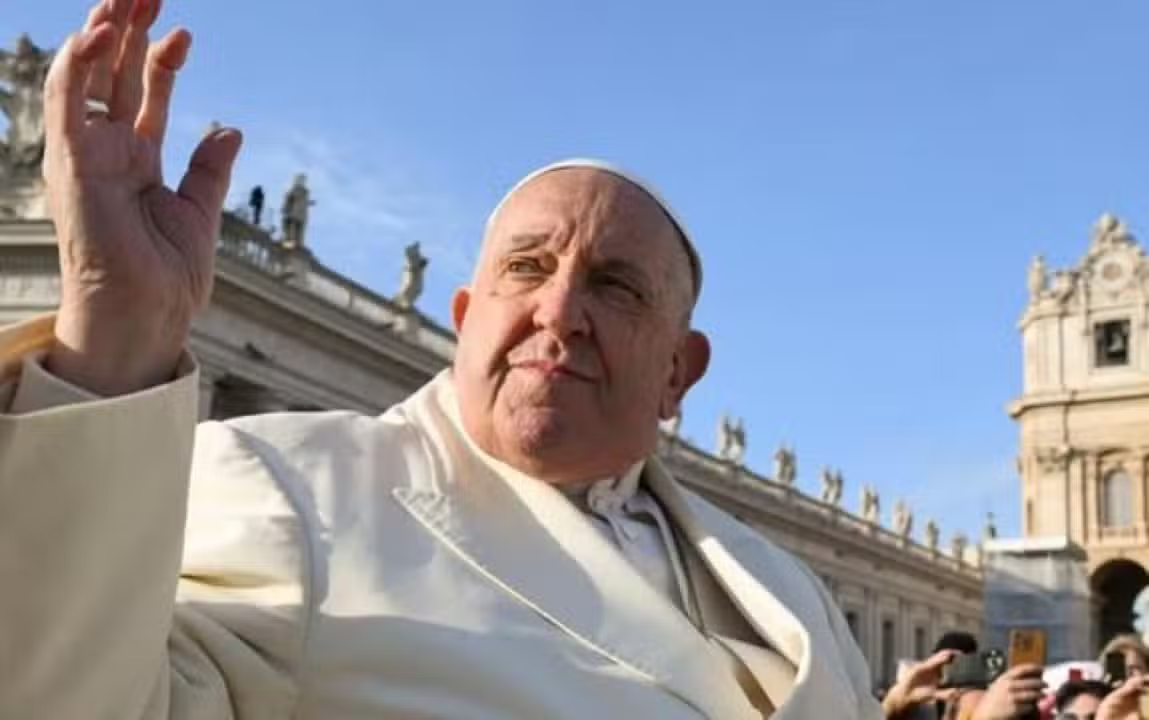
The death of Pope Francis at 88 on Monday, April 21, 2025, marked the end of a pontificate defined by reform, interfaith dialogue, and advocacy for social justice. Francis, the first Latin American pope, succumbed to a stroke and heart failure, as reported by the Vatican. The Catholic Church now enters a transitional phase, known as Sede Vacante, while the College of Cardinals prepares for the conclave, set to begin within 15 to 20 days. During this period, urgent decisions fall to the cardinals, and the world watches to see who will lead 1.4 billion Catholics. Among the 135 cardinals eligible to vote, seven are Brazilian, though none are among the top contenders.
The conclave, held in the Sistine Chapel, is a secretive and ritualistic process where cardinals elect the new pope by a two-thirds majority. The decision reflects not only theological priorities but also global challenges, such as the rising influence of Catholicism in the Global South, secularization in Europe, and contemporary ethical issues. Francis left a legacy of openness but also internal divisions, particularly between progressive and conservative factions. The next pope will face the challenge of unifying the Church while addressing issues like climate change, inclusion of minorities, and sexual abuse scandals.
Names from various continents are among the frontrunners, reflecting the Church’s diversity. Cardinals from Europe, Asia, Africa, and North America are considered favorites, each with distinct backgrounds and visions. The choice could signal continuity with Francis’ reforms or a return to more traditional stances. Below, we outline the leading candidates for the papacy, their profiles, and what they represent for the Church’s future.
- Jean-Marc Aveline: Archbishop of Marseille, French, 66, known for simplicity and alignment with Francis’ ideas.
- Peter Erdo: Hungarian cardinal, 72, a conservative with evangelization expertise.
- Mario Grech: Maltese, 68, a proponent of Francis’ synodal reforms.
- Juan Jose Omella: Archbishop of Barcelona, Spanish, 79, focused on social justice.
- Pietro Parolin: Italian, 70, Vatican Secretary of State.
- Luis Antonio Tagle: Filipino, dubbed the “Asian Francis,” with strong pastoral appeal.
- Joseph Tobin: American, 72, open to LGBTQIA+ inclusion.
- Peter Turkson: Ghanaian, 76, a candidate for the first African pope.
- Matteo Zuppi: Italian, 69, called the “Italian Bergoglio” for his focus on the poor.
Profile of Jean-Marc Aveline: a progressive Frenchman
Jean-Marc Aveline, the 66-year-old archbishop of Marseille, is closely tied to Pope Francis’ legacy. Known for his simplicity, humor, and commitment to interfaith dialogue, particularly with Islam, Aveline was born in Algeria to a family of Spanish immigrants. Raised in multicultural Marseille, he developed an inclusive worldview. His rise in the Church was propelled by Francis, who named him bishop in 2013, archbishop in 2019, and cardinal in 2022.
Aveline stands out for his advocacy for immigration, a cornerstone of Francis’ papacy, and his ability to organize high-profile events, such as the 2023 Mediterranean conference, which brought together religious leaders with Francis as the keynote guest. Holding a doctorate in theology and a degree in philosophy, he is a respected intellectual yet maintains an approachable demeanor. If elected, he would be the first French pope since the 14th century, offering a European perspective aligned with progressive reforms.
His relative youth compared to other cardinals is an advantage, as the Church may seek a leader with the energy for a long pontificate. However, his lack of experience in senior Vatican roles could be a drawback, as some cardinals prefer a candidate well-versed in the Roman Curia. Nevertheless, Aveline embodies the reformist spirit of Francis, emphasizing inclusion and global dialogue.
Peter Erdo: Hungary’s pragmatic conservative
Peter Erdo, a 72-year-old Hungarian cardinal, has been a familiar name in the College of Cardinals since the 2013 conclave, where he was already considered a papal contender. A canon law expert, Erdo became a bishop at 40 and a cardinal at 51 in 2003, making him the youngest member of the College at the time. His expertise in evangelization, particularly in secularized Europe, makes him appealing to cardinals aiming to revive faith on the continent.
Though conservative in theology, Erdo is seen as pragmatic, avoiding direct clashes with Francis. His stance during the 2015 migrant crisis, however, sparked controversy. While Francis urged churches to welcome refugees, Erdo suggested this could be seen as human trafficking, aligning partly with Hungary’s nationalist government. This position may polarize cardinals, especially those from the Global South, where immigration is a sensitive issue.
Erdo’s extensive connections in Africa and Europe bolster his candidacy. His emphasis on Europe’s Christian roots resonates with traditionalist factions, but his ability to engage with diverse groups could attract votes from cardinals seeking a balance between conservatism and modernity.
Mario Grech: Malta’s reformist voice
Mario Grech, 68, has risen to prominence under Francis’ pontificate. Hailing from Gozo, a small island in Malta, he serves as the secretary-general of the Synod of Bishops, a key role in advancing Francis’ synodal reforms. Initially perceived as conservative, Grech has evolved into a vocal advocate for inclusion, particularly for LGBTQIA+ Catholics.
In a 2014 Vatican speech, Grech called for the Church to be more welcoming to its LGBT members, earning praise from Francis. His journey from a conservative background to a reformist stance reflects adaptability, a valued trait in a conclave navigating internal divisions. As a Maltese, Grech brings a peripheral perspective, but his Vatican experience equips him to handle the Church’s administrative challenges.
- Humble origins: Grech comes from an island of fewer than 40,000 people, reinforcing his image of simplicity.
- Synodal reforms: As synod secretary, he has driven Francis’ model of broad consultation.
- Francis’ support: His closeness to the pope may sway progressive cardinals.

Juan Jose Omella: Spain’s champion of social justice
Juan Jose Omella, the 79-year-old archbishop of Barcelona, embodies the simplicity and commitment to the poor championed by Francis. Born in a village in northeastern Spain, Omella has dedicated his career to pastoral care and social justice. His time as a missionary in Zaire (now the Democratic Republic of Congo) and his work with the Spanish charity Manos Unidas, which fights poverty, highlight his humanitarian focus.
Named a cardinal in 2016, Omella is seen as a progressive in a country where the Spanish Church has historically leaned conservative. His advanced age may be a hurdle, as cardinals often favor a younger pope for a longer pontificate. Still, his humility and alignment with Francis’ priorities make him a respected contender.
Omella has stated that the Church must view the world through the eyes of the poor, a perspective that mirrors Francis’ vision. His ability to engage with Spain’s increasingly secular society could be an asset in a conclave seeking a leader to address global secularization.
Pietro Parolin: the favored diplomat
Pietro Parolin, 70, is the Vatican’s Secretary of State, a role akin to a “vice-pope” in the Church’s hierarchy. An Italian with a long diplomatic career, Parolin has served as Vatican ambassador to Venezuela and architect of agreements with China and Vietnam. His skill in navigating complex geopolitical issues positions him as a leading candidate.
Parolin has faced criticism from conservatives for his China deal on bishop appointments, but he defended it as a way to avoid a schism. His low-profile approach to the Church’s “culture wars,” such as debates on abortion and LGBT rights, makes him a potential consensus candidate, bridging progressive and conservative factions.
- Diplomatic expertise: Parolin has served in countries like Mexico and Nigeria.
- Closeness to Francis: As Secretary of State, he has implemented many of the pope’s policies.
- Ideal age: At 70, he balances experience with vitality for a pontificate.

Luis Antonio Tagle: the “Asian Francis”
Luis Antonio Tagle, known as “Chito,” is a Filipino cardinal representing Asia’s growing influence in the Church. The Philippines, with over 80 million Catholics, is a major Catholic hub, and Tagle’s energy and charisma make him a potential first Asian pope. Ordained in 1982, he served as bishop of Imus and archbishop of Manila before becoming a cardinal in 2012.
Often compared to Francis for his focus on social justice and accessibility, Tagle was moved to the Vatican in 2019 to lead the Dicastery for Evangelization, boosting his global profile. His Filipino-Chinese heritage symbolizes the Church’s cultural diversity.
However, some cardinals may hesitate due to his limited Vatican administrative experience. Still, his popularity among the faithful and ability to connect with grassroots Catholics make him a strong contender.
Joseph Tobin: an unlikely American
Joseph Tobin, the 72-year-old archbishop of Newark, USA, is a less likely but notable candidate. Known for his openness to LGBTQIA+ Catholics and transparent handling of the Theodore McCarrick abuse scandal, Tobin held Vatican roles before becoming a cardinal in 2016.
A recovering alcoholic, Tobin’s pastoral approach aligns with Francis’ style. His experience managing crises in the U.S. Church makes him a tested leader, but the prospect of an American pope is seen as unlikely due to the U.S.’s global political influence.
Peter Turkson: Africa’s hope
Peter Turkson, a 76-year-old Ghanaian cardinal, represents the possibility of a historic first African pope. Born to a humble family, Turkson served as archbishop of Cape Coast and led the Pontifical Council for Justice and Peace, advocating for climate action and human rights. His pastoral and administrative experience makes him a versatile candidate.
Africa is a region of rapid Catholic growth, and Turkson’s election could reflect this shift. His participation in global forums like Davos showcases his ability to engage world leaders. However, his age may be a limiting factor.
Matteo Zuppi: the “Italian Bergoglio”
Matteo Zuppi, the 69-year-old archbishop of Bologna, is an Italian known for his focus on the poor and migrants. Nicknamed “Father Matteo,” he shuns formalities, often riding a bicycle instead of an official car. His 2022 appointment as president of the Italian Bishops’ Conference strengthened his influence.
Seen as a continuator of Francis’ legacy, Zuppi faces criticism from abuse victims for the Italian Church’s slow response to the issue. His election would mark the first Italian pope since 1978, appealing to cardinals seeking a leader familiar with Vatican dynamics.
The conclave process: how it works
The conclave is one of the Catholic Church’s oldest and most secretive events. After a pope’s death, cardinals under 80 gather in the Sistine Chapel to elect the new pontiff. The process, governed by the Code of Canon Law and the apostolic constitution Universi Dominici Gregis, requires a two-thirds majority.
Each voting round is followed by the burning of ballots, with white smoke signaling a new pope and black smoke indicating the process continues. The conclave can last days or weeks, though recent ones, like the 2013 conclave that elected Francis, were swift, concluding in two days.
- Preparation: The camerlengo, currently Cardinal Kevin Farrell, oversees the Sede Vacante.
- Secrecy: Cardinals swear an oath of silence, and the Sistine Chapel is sealed.
- Announcement: The new pope is introduced with the phrase “Habemus Papam.”
Challenges for the next pope
The next pope will inherit a Church in transformation. Secularization in Europe, the growth of Catholicism in Africa and Asia, and internal tensions between progressives and conservatives are key challenges. Francis opened discussions on women deacons, clerical celibacy, and LGBTQIA+ inclusion, but many issues remain unresolved.
Sexual abuse scandals continue to erode the Church’s credibility, demanding a leader capable of structural reforms. Climate change, a priority for Francis, will likely remain central, alongside interfaith dialogue in a world marked by conflict.
Conclave timeline
The selection of the new pope follows a well-defined schedule, rooted in tradition and canon law.
- April 21, 2025: Death of Pope Francis, start of Sede Vacante.
- May 6–11, 2025: Likely start of the conclave, 15 to 20 days after the death.
- Date TBD: Announcement of the new pope, depending on the conclave’s duration.
Francis’ legacy and expectations
Francis reshaped the Church with his emphasis on simplicity, inclusion, and social justice. His death leaves a void but also a more diverse, global Church. The next pope will need to consolidate his reforms or steer the Church toward a more conservative path.
Choosing a pope from the Global South, like Tagle or Turkson, could reflect Catholicism’s demographic shift, while a European, like Parolin or Zuppi, might reinforce the continent’s traditional influence. Regardless of the outcome, the 2025 conclave will be a defining moment for the Catholic Church’s future.