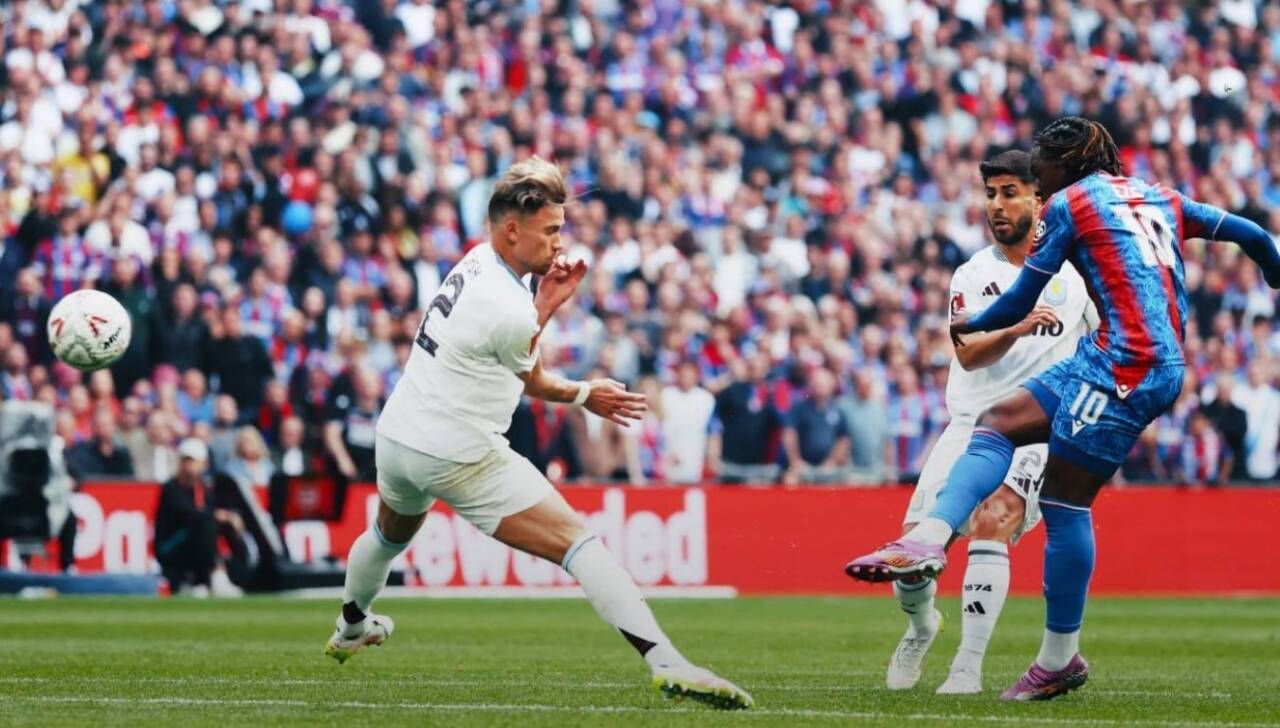
Wembley, the stage for English football’s grandest moments, hosts an electrifying semifinal clash of the 2024/25 FA Cup this Saturday, April 26. Crystal Palace and Aston Villa are locked in a thrilling battle, with the Eagles leading 1-0 at halftime, courtesy of a brilliant goal by Eberechi Eze at the 30th minute. The number 10, set up by Ismaila Sarr, struck a precise shot into the bottom right corner past goalkeeper Emiliano Martínez, igniting the London-based supporters in the stands. The match, still ongoing, promises more drama in the second half, as Villa chase an equalizer and Palace aim to extend their lead to secure a spot in the final. This single-leg tie reflects both clubs’ ambitions to end long title droughts in the world’s oldest football competition.
Crystal Palace arrived at the match buoyed by a strong FA Cup campaign, having dispatched teams like Fulham, Millwall, and Doncaster Rovers with convincing performances. Under Oliver Glasner’s guidance, the team relies on Eze’s creativity and Jean-Philippe Mateta’s efficiency to pull off an upset. Meanwhile, Aston Villa, led by Unai Emery, navigates a season of highs and lows, highlighted by a thrashing of Newcastle in the Premier League but marred by a recent Champions League exit. The semifinal offers redemption for the Villans, who lean on the experience of players like Martínez and Youri Tielemans. So far, the game has been evenly matched, with both sides creating chances and solid defending thwarting attacks.
The atmosphere at Wembley is electric, with Palace and Villa fans creating a spectacle in the stands. Eze’s goal, one of the first half’s defining moments, gave Crystal Palace the edge, but Aston Villa showed resilience, pressing for an equalizer. Fouls, yellow cards, and blocked shots characterized the opening 45 minutes, signaling an open contest. Attention now turns to the second half, where Glasner and Emery’s tactical adjustments will be put to the test in a match that could shape the season for either club.
Key moments of the first half
The first half of the semifinal between Crystal Palace and Aston Villa was packed with action that kept fans on edge. Below are the main events that shaped the opening 45 minutes:
- Minute 8: Cash, Villa’s right-back, commits a foul on the right flank, halting a Palace advance.
- Minute 16: Kamara, Villa’s midfielder, receives a yellow card for a robust challenge in midfield.
- Minute 19: Mitchell, Palace’s left-back, is booked with a yellow card for a tactical foul.
- Minute 30: Goal for Crystal Palace! Sarr steals the ball, surges down the right, and finds Eze, who finishes with precision to open the scoring.
- Minute 38: Konsa, Villa’s defender, has a shot saved by Henderson, preserving Palace’s lead.
Rising tension at Wembley
The match kicked off with both teams asserting their styles. Crystal Palace, lined up in a 3-4-3, prioritized defensive solidity with Lacroix, Guéhi, and Richards, while Eze and Sarr exploited pace on counterattacks. Aston Villa, in a 4-2-3-1, focused on possession and movement from Asensio and Watkins to breach the opposition’s defense. Early on, the game was balanced, with neither side finding accuracy in their shots. At the 11th minute, Kamara tried from distance, but the ball sailed wide of Henderson’s goal.
Intensity surged midway through the first half, with hard fouls and yellow cards for Kamara and Mitchell. Crystal Palace hit their stride at the 30th minute when Sarr dispossessed a Villa player and set up Eze. The midfielder, composed, picked his spot and scored, sending the Eagles’ fans into a frenzy. Villa responded swiftly, with McGinn and Konsa creating chances, but Palace’s defense, anchored by Guéhi, held firm. By halftime, the match remained fiercely contested, with Lacroix nearly doubling the lead with a shot that went wide at the 44th minute.
Recent history favors Palace
Crystal Palace took to the pitch boosted by a favorable recent record against Aston Villa. In their last four meetings, the Eagles have remained unbeaten, including a 4-1 Premier League rout and a League Cup elimination of Villa this season. These results gave Glasner’s side a psychological edge, particularly in such a high-stakes encounter. The London club, yet to win the FA Cup, sees the tournament as a chance to make history, having reached the final in 1990 and 2016 but falling short of the trophy.
Conversely, Aston Villa, with seven FA Cup titles, the last in 1957, aims to reclaim domestic glory. Emery’s team has shown offensive prowess this season, with Watkins and Asensio delivering goals and assists. However, a midweek loss to Manchester City, decided in stoppage time, dented their confidence, making this semifinal a test of resilience. The match is a chance for Villa to prove they can compete at the highest level, even against an opponent that has consistently troubled them.
Individual standouts in the first half
Eberechi Eze was undoubtedly the star of the first half. The 26-year-old midfielder, renowned for his flair and vision, scored the goal that put Crystal Palace ahead and was central to their attacking moves. His partnership with Sarr on the right was a highlight, exploiting gaps in Villa’s defense. Mateta, though without a clear shot, contributed with movement that created space for teammates. Defensively, Guéhi and Lacroix were pivotal in neutralizing Watkins and Asensio.
For Aston Villa, Emiliano Martínez, despite conceding, made crucial interventions to keep his team in the game. Konsa and McGinn also shone, with the defender nearly equalizing at the 38th minute and the midfielder driving Villa’s pressure in midfield. Asensio, a surprise starter, had flashes of brilliance but struggled against Palace’s tight marking. Substitutions like Bailey or Ramsey in the second half could be Emery’s trump card to turn the tide.
- Standout players:
- Eberechi Eze: scored the goal and spearheaded Palace’s attack.
- Ismaila Sarr: stole the ball and provided the assist for the goal.
- Emiliano Martínez: prevented a wider scoreline with key saves.
- Konsa: reliable in defense and dangerous going forward.
The technique, yet again, special. pic.twitter.com/jB0pEZFMxY
— Crystal Palace F.C. (@CPFC) April 26, 2025
Tactical strategies at play
Oliver Glasner fielded Crystal Palace in a formation balancing defense and attack. The 3-4-3 setup allows Lacroix, Guéhi, and Richards to form a robust backline, while Muñoz and Mitchell push up the flanks. In midfield, Wharton and Kamada ensure swift transitions, feeding the front three of Sarr, Eze, and Mateta. The approach paid off in the first half, with the goal stemming from a high-pressing move that led to Eze’s strike. Palace’s tactical discipline has been a strength, but they must stay focused to withstand Villa’s second-half pressure.
Unai Emery opted for a 4-2-3-1, with Kamara and McGinn shielding the defense and Tielemans, Rogers, and Asensio creating for Watkins. Starting Asensio over Ramsey or Bailey was unexpected, but the Spaniard added mobility to the attack. Villa aimed to dominate possession but struggled to break through Palace’s defense. Introducing faster players like Bailey or swapping Watkins for Malen could be Emery’s adjustments for the second half, targeting counterattacks.
Midfield battle intensifies
The midfield was the most contested area in the first half, marked by frequent fouls and physical duels. Kamada, for Palace, committed three fouls, while Kamara, for Villa, was also cautioned for tough tackles. The intensity in this sector underscored the match’s significance, with both teams vying for control to dictate the tempo. Wharton, for Palace, impressed with his game-reading, while Tielemans, for Villa, tried to orchestrate attacks but was stifled by marking.
The midfield skirmish also led to yellow cards, with Mitchell and Kamara booked. These moments highlighted a game fought on grit as much as skill. Crystal Palace gained the upper hand by winning key balls, like in Eze’s goal, while Villa relied on long balls to Watkins, who was caught offside once. The second half promises even fiercer battles in this critical area.
Wembley’s weight in the semifinal
Playing at Wembley is always special, but for Crystal Palace and Aston Villa, this FA Cup semifinal carries extra significance. Palace, yet to win the competition, came close in 1990 and 2016, only to finish as runners-up. The Eagles’ fans dream of a maiden title, and the halftime lead fuels that hope. With players like Eze, Mateta, and Sarr, the team has the confidence to aim for a historic qualification.
Aston Villa, with seven FA Cup titles, the last in 1957, seeks to revive its storied past. Emery’s side, which shone in moments like their rout of Preston in the quarterfinals, wants to reclaim domestic prestige. The recent loss to Manchester City serves as both a warning and motivation for Villa to stage a comeback. The stadium, split between the fanbases, creates a mix of pressure and support that could sway the teams’ performances in the second half.
- Wembley history:
- Crystal Palace: FA Cup runners-up in 1990 and 2016.
- Aston Villa: seven titles, the last in 1957.
- Last Wembley clash: Villa beat Palace in the 2010 FA Cup semifinal.
Match timeline
Below is a timeline of the first half’s key moments, highlighting the plays that shaped the scoreline at the break:
- Minute 0: The ball rolls at Wembley, with Crystal Palace kicking off.
- Minute 16: Kamara is shown a yellow card for a midfield foul.
- Minute 19: Mitchell receives a yellow card for a tactical foul.
- Minute 30: Eze scores a stunning goal, set up by Sarr, giving Palace the lead.
- Minute 38: Konsa’s shot is saved by Henderson, keeping Palace ahead.
- Minute 44: Lacroix shoots from distance, but the ball goes wide, closing the first half’s chances.
Second-half expectations
With a 1-0 lead, Crystal Palace heads into the second half with the advantage but aware that Aston Villa won’t go down easily. Oliver Glasner is likely to stick with his high-pressing, quick-transition strategy, relying on Sarr’s speed and Eze’s flair. Substitutions like Nketiah or Chilwell could bolster the attack or defense, depending on the game’s flow. Henderson’s solidity in goal will be vital to repelling Villa’s advances.
Unai Emery, meanwhile, must tweak Aston Villa to chase the equalizer. The starting lineup, with Asensio in attack, underperformed, and bringing on Bailey or Ramsey could add dynamism. Watkins, denied by an offside call, remains the main goal threat, while Martínez needs to stay sharp to prevent a bigger deficit. Villa may focus on crosses and wing play, using Cash and Digne, to break Palace’s defense.
Impact of Eze’s goal
Eberechi Eze’s goal was not just a moment of individual brilliance but a testament to Crystal Palace’s strategy. The move, sparked by Sarr’s high press, showcased the value of intensity in the Eagles’ approach. Eze, who scored against Fulham in the quarterfinals, reaffirmed his clutch form in big games. The stunning strike, curled into Martínez’s bottom right corner, was among the match’s most memorable moments so far.
For Aston Villa, the goal exposed a defensive lapse, with Sarr finding space on the right. The backline, led by Konsa and Pau Torres, must regroup to prevent further counterattacks. The goal’s psychological toll is notable, as Villa now faces an uphill battle in a knockout tie. Palace’s fans, ecstatic, keep roaring, while Villa’s supporters urge their team to fight back.
The power of the fans
Wembley’s stands are evenly split, with Crystal Palace and Aston Villa fans delivering a sonic spectacle. The Eagles, hailing from south London, wave flags and chant loudly, celebrating Eze’s goal. Villa’s supporters, undeterred by the score, continue backing their team to spark a comeback. Though not a historic rivalry, the semifinal’s stakes amplify the contest, making every cheer count.
The massive turnout reflects the FA Cup’s importance to both clubs. For Palace, it’s a shot at a title that slipped away in 1990 and 2016. For Villa, it’s a chance to end a near seven-decade drought in the competition and cement Emery’s project. The festive yet tense atmosphere makes this semifinal unforgettable for those at Wembley.
What’s at stake
The FA Cup semifinal is more than a ticket to the final. For Crystal Palace, it’s an opportunity to achieve a historic triumph, securing a title that could elevate the club’s status in English football. For Aston Villa, it’s a chance to end a 68-year wait for the trophy and solidify Emery’s tenure. The winner will face either Nottingham Forest or Manchester City in the final, set for May 17, also at Wembley.
With the match still in progress, emotions run high. Crystal Palace, holding the lead, aims to stay focused to protect their advantage, while Aston Villa gears up to overturn the scoreline. The FA Cup, renowned for its upsets and epic moments, continues to deliver a spectacle worthy of its legacy, with Eze and company penning another chapter in its story.