Shanghai Auto Show 2025: global brands launch 100 electric models to reconquer China


The Shanghai Auto Show 2025, held from April 23 to May 2, solidified its position as the world’s largest and most influential automotive event, bringing together around 1,000 exhibitors and showcasing over 100 new models, mostly electric and hybrid, across a 360,000-square-meter area. Marked by technological innovations such as autonomous driving systems and ultra-fast charging batteries, the event highlighted the dominance of Chinese brands like BYD, Geely, and GWM, which drew crowds with high-impact launches, while foreign manufacturers, including Volkswagen, Toyota, Audi, and Buick, bet on models developed exclusively for the Chinese market to regain lost ground. China, the world’s largest automotive market with 22 million vehicles sold in 2024, has become a battleground where electrification and connectivity set the rules, forcing global brands to adapt to the “China speed.” The show also reflected trade tensions, with tariffs imposed by the United States and the European Union challenging the global ambitions of Chinese automakers, who are responding with localized production in foreign markets.
The rise of Chinese brands is undeniable. Companies like BYD, which unveiled five new models from the Ocean series and the luxurious Yangwang U8L, dominated public attention, while Xpeng impressed with batteries offering 420 km of range after a 10-minute charge. Traditional brands, such as Volkswagen, which revealed the ID. Aura, ID. Era, and ID. Evo electric concepts, and Audi, with the innovative E5 Sportback, showed a clear strategic shift, designing vehicles tailored to Chinese consumers’ preferences for technology, futuristic design, and competitive pricing. The absence of giants like Tesla, Hyundai, and Kia reinforced the perception that the Chinese market demands a local approach, with strategic partnerships and joint ventures, such as Nissan’s with Dongfeng and Toyota’s with GAC.
The event was also a stage for advances in artificial intelligence and vehicle safety, with China reinforcing regulations for batteries and driver assistance systems after incidents like the fatal accident involving a Xiaomi vehicle. The Chinese government’s crackdown on terms like “autonomous driving” in marketing campaigns forced automakers to prioritize safety messages, such as Xpeng’s “training camp.” With a domestic market accounting for 40% of global electric vehicle sales, China not only sets trends but redefines the future of the automotive industry, challenging foreign brands to innovate or lose relevance. Below, we explore the highlights of the Shanghai Auto Show, the most curious models, and the strategies of automakers to win over Chinese consumers.
- Exhibitors: Around 1,000 companies, including BYD, Volkswagen, Toyota, and GWM.
- Launches: Over 100 new models, with 70% being electric or hybrid.
- Visitors: Approximately 1 million attendees by May 2.
- Economic impact: Chinese market moved 22 million vehicles in 2024.
Chinese dominance in the automotive market
Chinese brands stole the spotlight at the Shanghai Auto Show 2025, consolidating their leadership in the world’s largest automotive market. BYD, the country’s top electric vehicle manufacturer, showcased five new models from the Ocean series, plus the Yangwang U8L, a luxury SUV with a 3,250 mm wheelbase and 24K gold accents, designed to compete with global premium brands. Geely, through its Zeekr brand, launched the 9X SUV, equipped with level 3 driver assistance technology, enabling hands-free driving on highways and urban streets while requiring driver attention. Xpeng highlighted its AI-powered batteries, offering 420 km of range with a 10-minute charge, while Leapmotor unveiled the B01 electric sedan, focused on cost-effectiveness, with plans for a Brazil debut in the second half of 2025.
This supremacy reflects years of government incentives and intense domestic competition. In 2024, electric and hybrid vehicles accounted for 26% and 19% of sales in China, respectively, a 40% increase from 2023. Brands like Li Auto, NIO, and Xiaomi, which drew queues with the SU7 despite incidents with its autonomous system, showed how technological innovation and affordable prices win over Chinese consumers. Huawei, through its HIMA brand, launched the AITO M8, a SUV with over 44,000 confirmed orders, while GWM announced global expansion plans, including opening 20 dealerships in Brazil by May 2025. These companies not only dominate the domestic market but also export 300,000 units annually, challenging global giants like Tesla, which saw its market share in China drop from 15% in 2020 to 9% in the first quarter of 2025.
Local competition has forced Chinese brands to innovate rapidly, offering vehicles with driver assistance systems, interactive screens, and futuristic designs at competitive prices. An example is BYD’s Tang L, a SUV that recharges 400 km of range in five minutes, directly challenging the Tesla Model Y. This dynamic has pressured foreign manufacturers, who, to remain relevant, have had to adapt their products to local preferences, often in collaboration with Chinese partners. Below, we detail the strategies of global brands to reconquer the Chinese market.
Strategies of foreign brands
Foreign brands, once dominant in China, face a transformed market where local companies lead in innovation and volume. Volkswagen, previously the top foreign automaker in the country, saw sales drop 6% in the first quarter of 2025. At the Shanghai Auto Show, the company unveiled three electric concepts — ID. Aura, ID. Era, and ID. Evo — developed with local partners like FAW-Volkswagen, SAIC Volkswagen, and Volkswagen Anhui. These models, set for launch in 2026, integrate AI and level 4 autonomous driving technologies, plus designs tailored to Chinese tastes, such as spacious interiors and interactive screens. Volkswagen plans to launch 30 new models in China by 2027, 20 of which will be electrified, to recover its market share.
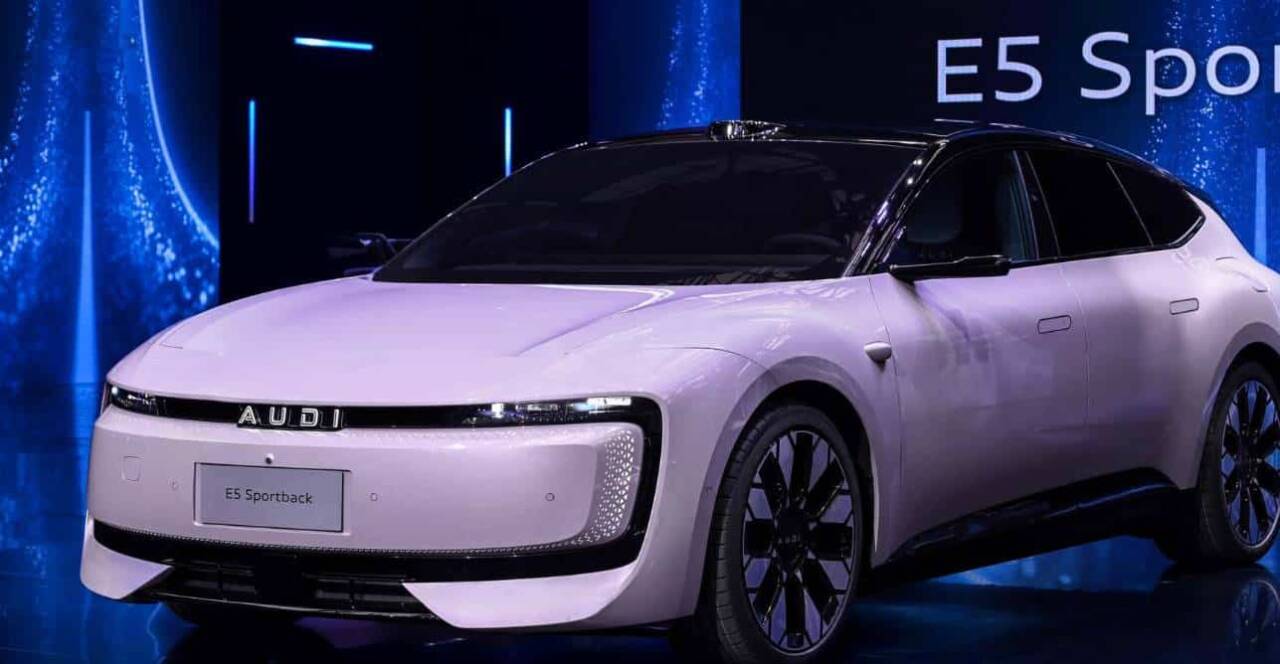
Audi, another Volkswagen Group brand, revealed the E5 Sportback, a China-exclusive model produced with SAIC. Unlike traditional Audi models, the E5 ditches the iconic four rings for an “AUDI” logo in uppercase, signaling a new approach to attract younger consumers. The vehicle, a hybrid between a hatchback and a station wagon, blends sleek design with connectivity technologies, aiming to reverse the brand’s sales decline, once a status symbol in the country. Nissan, meanwhile, showcased the Frontier Pro Plug-in Hybrid, a midsize pickup designed by its Chinese partner Dongfeng Motors, with an attractive design and plans for export to markets like Australia, South Africa, and Latin America, including Brazil.
Toyota also adopted a local approach, launching the bZ3X, an electric SUV based on GAC’s AION V, and the bZ7, an electric sedan developed exclusively in China. The Lexus ES 2026, though designed in Japan, had its global debut in Shanghai, underscoring the Chinese market’s importance for the brand. Buick, from General Motors, presented the Electra GS Concept, an electric vehicle with bold design, developed by GM China’s Advanced Design Center, reinforcing the brand’s relevance in the country. These strategies show that global brands are abandoning the practice of adapting Western models, opting for designs and technologies created in China, often in partnership with local manufacturers.
- Volkswagen: Three electric concepts (ID. Aura, ID. Era, ID. Evo) with a 2026 launch.
- Audi: E5 Sportback, first model without the four rings, aimed at younger buyers.
- Nissan: Frontier Pro Plug-in Hybrid, with exports to global markets.
- Toyota: bZ3X and bZ7, developed with GAC, and debut of the Lexus ES 2026.
Most curious models of the Shanghai Auto Show
The Shanghai Auto Show 2025 was marked by launches that combined innovation, design, and adaptation to the Chinese market, with some models standing out for their originality. The Audi E5 Sportback, for instance, surprised by abandoning the brand’s traditional logo, betting on a design that blends hatchback and station wagon, with a focus on connectivity and comfort. Developed by SAIC, the model is a direct response to competition from brands like AITO and Li Auto, which offer high-tech vehicles at affordable prices. Its debut reflects the need for reinvention among premium German brands, which face declining popularity among Chinese consumers.
The Nissan Frontier Pro Plug-in Hybrid, designed by Dongfeng Motors, is another highlight. With a modern design and plug-in hybrid technology, the midsize pickup aims to restore Nissan’s competitiveness in global markets, including Brazil, where the brand faces challenges against rivals like Toyota and Ford. The model combines the ruggedness expected of a pickup with energy efficiency, meeting the growing demand for hybrids in regions like Southeast Asia and Latin America. Toyota, meanwhile, presented the bZ3X, an electric SUV based on GAC’s AION V, and the bZ7, an electric sedan rivaling the Tesla Model 3, both produced exclusively in China to cater to local preferences for spacious, connected vehicles.
Mazda brought the EZ-60, a compact electric SUV based on Changan’s Deepal SL07, its Chinese partner. With plans for export to Europe, the model follows the footsteps of the EZ-6, already sold outside China. Buick, from General Motors, unveiled the Electra GS Concept, an electric vehicle with futuristic design, developed by GM China’s Advanced Design Center. The concept reinforces Buick’s importance in the Chinese market, where the brand is more relevant than in other countries. These models, designed with strong Chinese influence, show how global brands are adapting to compete with local innovation, which combines affordable prices with cutting-edge technology.
Impact of trade tariffs
Trade tariffs imposed by the United States and the European Union on Chinese electric vehicles were a recurring theme at the Shanghai Auto Show 2025. U.S. President Donald Trump announced 145% tariffs on Chinese products, including a 25% tax on imported cars and parts, while the EU applies tariffs ranging from 17% to 38% on Chinese electric vehicles. These trade barriers challenge the global ambitions of Chinese automakers, who exported 300,000 units in 2024, but also encourage localized production strategies. Companies like BYD, which opened a factory in Hungary, and GWM, planning production in Brazil, are investing in plants outside China to bypass tariffs and access markets like Europe and South America.
Foreign brands also face challenges. Volkswagen, which relies on China for 40% of its global sales, is impacted by Beijing’s retaliatory tariffs, including up to 25% taxes on imported parts, increasing production costs. Toyota, which announced a fully foreign-owned electric car factory in Shanghai, aims to reduce reliance on imports, while Nissan plans to export the Frontier Pro to markets outside China, leveraging the competitiveness of its partner Dongfeng. These strategies reflect the need to balance costs and market access in a trade war scenario, which raises vehicle prices and pressures global supply chains.
The Chinese government’s crackdown on terms like “autonomous driving” in marketing campaigns, following incidents like the fatal accident with a Xiaomi vehicle, also impacted the event. Automakers like Xpeng and BYD adjusted their messaging, emphasizing the safety of their driver assistance systems. Xpeng announced a “training camp” to educate drivers on the limits of its technologies, while BYD integrated the “God’s Eye” system as standard across its range, reinforcing safety as a differentiator. These measures show how trade and regulatory tensions are shaping automakers’ strategies in the world’s largest automotive market.
- U.S. tariffs: 145% on Chinese products, with 25% on cars and parts.
- EU tariffs: 17% to 38% on Chinese electric vehicles.
- Chinese response: Factories in Hungary, Brazil, and Mexico to bypass barriers.
- Safety: Crackdown on terms like “autonomous driving” after accidents.
Highlighted technologies
The Shanghai Auto Show 2025 was a showcase of advanced technologies, focusing on artificial intelligence, autonomous driving, and fast-charging batteries. BYD impressed with the Tang L, a SUV that recharges 400 km of range in five minutes, while Xpeng unveiled AI-powered batteries offering 420 km with a 10-minute charge. Zeekr, from Geely, launched the 9X, equipped with level 3 driver assistance technology, enabling hands-free driving under specific conditions. Volkswagen integrated AI-powered virtual assistants in its ID. Aura, ID. Era, and ID. Evo concepts, while the Audi E5 Sportback offers a digital experience with interactive screens and 5G connectivity.
Safety was also a central theme, driven by new Chinese regulations. After a fatal accident with a Xiaomi vehicle, the government banned terms like “intelligent” and “autonomous” in marketing, requiring automakers to highlight the limits of their systems. Xpeng responded with a driver training program, while BYD reinforced the safety of its “God’s Eye” system, which uses two proprietary chips for real-time monitoring. Leapmotor, Stellantis’ partner, presented the B01, an electric sedan with REEV (Range Extended Electric Vehicle) technology, combining an electric motor with a gasoline generator for extended range, similar to Nissan’s approach in Japan.
Multi-energy platforms, enabling different powertrains (electric, hybrid, and combustion), also stood out. GWM, planning to launch flex models in Brazil in 2025, showcased its Hi4 hybrid technology, while GAC Motor announced four launches in Brazil, including three electrics and one HEV hybrid. These innovations show how China is leading the transition to electric mobility while adapting its technologies to the needs of global markets, where infrastructure for purely electric vehicles remains limited.
Shanghai Auto Show 2025 schedule
The Shanghai Auto Show 2025 followed a structured schedule, with specific events for press, exhibitors, and the general public. Below are the key milestones:
- April 21-22: Press-only days, with automaker press conferences.
- April 23: Official opening, with the unveiling of 100 new models.
- April 24-30: Public visitation, with around 1 million visitors.
- May 1-2: Final days, with networking events and vehicle test drives.
The event occupied 360,000 square meters at the National Exhibition and Convention Center in Shanghai, with interactive booths attracting consumers and industry analysts alike. Volkswagen, for instance, used the slogan “A new dawn” to highlight its electric concepts, while BYD organized live demonstrations of its fast-charging systems. The schedule underscores the event’s importance as a global showcase, influencing automotive trends in markets like Brazil, Europe, and the United States.
Global impact of the launches
The launches at the Shanghai Auto Show 2025 have implications beyond China, influencing global markets, including Brazil. The Nissan Frontier Pro Plug-in Hybrid, for example, is expected in Brazil, where the brand aims to strengthen its presence in the midsize pickup segment, competing with the Toyota Hilux and Ford Ranger. Leapmotor, Stellantis’ partner, confirmed the debut of the B10 and C10 SUVs in Brazil in the second half of 2025, bringing technologies like the REEV system, which combines electric efficiency with extended range. GWM, already operating in Brazil, plans to launch flex models and expand its dealership network, while GAC Motor begins operations in May with three electrics and one hybrid.
Europe will also be impacted, with Mazda exporting the EZ-60, based on the Deepal SL07, and BYD expanding its presence with models like the Tang L. In the United States, the Buick Electra GS Concept may inspire future electric models, though 145% tariffs limit direct imports of Chinese vehicles. Volkswagen, with its ID. Aura, ID. Era, and ID. Evo concepts, plans to adapt China-developed technologies for other markets, while Audi considers exporting the E5 Sportback to Asian regions. These launches show how China is shaping the future of the automotive industry, exporting not only vehicles but also innovations that redefine global mobility.
The internationalization of Chinese brands is another critical factor. BYD, which exported 300,000 units in 2024, plans factories in Hungary and Brazil, while GWM invests in local production in South America. These strategies aim to bypass tariffs and meet the growing demand for electric and hybrid vehicles, especially in emerging markets. In Brazil, where electrified vehicle sales grew 65% in 2024, Shanghai’s launches strengthen the competitiveness of Chinese brands against giants like Toyota and Volkswagen, which are also expanding their electric model offerings in the country.
Challenges for foreign brands
Foreign brands face significant challenges to regain ground in the Chinese market. Volkswagen, which lost leadership to BYD, is betting on its “In China, for China” strategy, with a new development center in Hefei that cuts model creation time to 34 months. Audi, pressured by declining sales, seeks to attract younger consumers with the E5 Sportback, while Nissan, which lost market share globally, sees the Frontier Pro as a recovery opportunity. Toyota, though less affected, adapts its bZ line to compete with more affordable Chinese models like those from Leapmotor and Xpeng.
Competition with Chinese brands is intensified by their ability to offer advanced technology at low prices. A Buick executive highlighted the difficulty of competing with Chinese entry-level vehicles that include driver assistance systems at reduced costs, while Volkswagen faces pressure from brands like BYD, which integrated the “God’s Eye” system as standard across its range. Additionally, trade tariffs and China’s economic slowdown, which reduced market growth in 2023, require foreign brands to optimize costs and innovate quickly to remain competitive.
The absence of brands like Tesla, Hyundai, Kia, and Citroën at the Shanghai Auto Show reflects the difficulty of competing without a local strategy. Tesla, operating a mega-factory in Shanghai, has skipped the event since 2021 after a protest against vehicle failures. Hyundai and Kia, facing sales drops, prioritize other markets, while Citroën, which showcased a hybrid sedan in 2023, presented no novelties in 2025. These absences reinforce the need for partnerships with Chinese manufacturers like SAIC, Dongfeng, and GAC to access the market and meet consumer expectations.
Tips for interested consumers
The launches at the Shanghai Auto Show 2025 offer valuable insights for consumers interested in electric and hybrid vehicles, especially in Brazil, where the electrified market is expanding. Below are some tips to follow the novelties:
- Research Chinese brands: BYD, GWM, and Leapmotor offer competitive models in Brazil at affordable prices.
- Consider plug-in hybrids: The Nissan Frontier Pro and GAC models combine efficiency and range for long trips.
- Assess infrastructure: Check charger availability before buying an electric, especially outside major cities.
- Track launches: Models like the Leapmotor B01 and Mazda EZ-60 will arrive in Brazil in 2025.
- Prioritize safety: Choose vehicles with tested assistance systems, like BYD’s “God’s Eye.”
These tips help consumers prepare for the arrival of new models, leveraging Shanghai’s innovations while considering Brazil’s market limitations, such as charging infrastructure.