
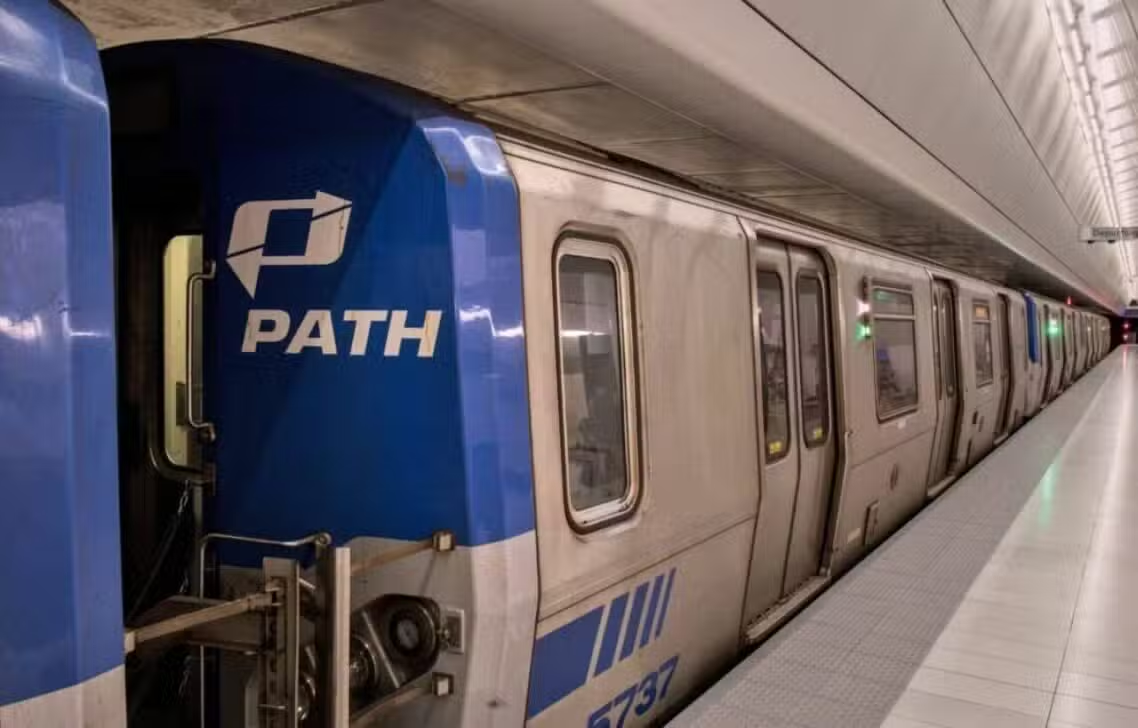
Commuters faced significant disruptions on May 8, 2025, as PATH trains were suspended systemwide and NJ Transit reported delays of up to 30 minutes for trains heading into New York City’s Penn Station. The chaos stemmed from an Amtrak switch issue and track maintenance near Elizabeth, New Jersey, compounded by a separate track condition at Grove Street affecting PATH services. NJ Transit announced the delays shortly after 7 a.m., with PATH suspensions following by 8 a.m., leaving thousands of riders scrambling for alternatives during the morning rush. The disruptions marked the second consecutive day of Amtrak-related issues, following similar problems that affected Long Island Rail Road commuters on May 7.
The Amtrak switch failure near Elizabeth disrupted NJ Transit’s Northeast Corridor and North Jersey Coast Line services, critical routes for commuters traveling between New Jersey and Manhattan. PATH’s suspension, triggered by a track issue at Grove Street, further complicated travel, as the system serves as a vital link between New Jersey and New York City. NJ Transit responded by cross-honoring rail tickets on PATH trains at Newark Penn Station, Hoboken, and 33rd Street in New York, while also coordinating with private bus carriers to accommodate stranded passengers. The Port Authority of New York and New Jersey, which operates PATH, reported ongoing efforts to resolve the track condition but provided no immediate timeline for service restoration.
Key impacts of the disruptions include:
- NJ Transit delays of up to 30 minutes on trains to Penn Station.
- Systemwide PATH suspension affecting Newark, Hoboken, and World Trade Center routes.
- Cross-honoring of NJ Transit tickets on PATH and bus services.
- Thousands of commuters forced to seek alternative transportation options.
These incidents highlight ongoing challenges with Amtrak’s aging infrastructure, which supports both NJ Transit and PATH operations along the Northeast Corridor. As commuters voiced frustration on social media, transit agencies worked to mitigate the disruptions, but the lack of clear resolution timelines added to the morning’s chaos.
Amtrak’s role in commuter disruptions
Amtrak’s infrastructure issues were at the heart of the May 8 disruptions, with a switch failure near Elizabeth disrupting NJ Transit services. The agency, which owns and maintains much of the Northeast Corridor’s tracks, reported that track maintenance work extended beyond its scheduled timeframe, impacting train movements. This incident followed a similar issue on May 7, when Amtrak’s overnight repairs on a line outside the East River Tunnel ran over schedule, causing delays for Long Island Rail Road commuters. That event saw 43 LIRR trains delayed, five canceled, and six diverted, prompting sharp criticism from transit officials.
LIRR President Rob Free labeled the May 7 disruptions “unacceptable,” attributing them to Amtrak’s poor maintenance practices. Amtrak acknowledged the issue, stating that repair work exceeded the allotted outage period, and issued an apology to affected passengers. The recurrence of such problems underscores the challenges of maintaining a century-old rail network, including the 114-year-old Portal Bridge and the East River Tunnel, both notorious for causing delays when repairs are needed.
- Amtrak-related disruptions on May 7 and 8:
- May 7: LIRR faced 43 delayed trains due to unfinished Amtrak repairs.
- May 8: NJ Transit delays caused by switch issue near Elizabeth.
- Ongoing maintenance challenges with aging infrastructure.
The Elizabeth switch issue reflects broader systemic issues with Amtrak’s infrastructure, which NJ Transit and other regional operators rely on heavily. With over 400 daily trains on the Northeast Corridor, the majority operated by NJ Transit, any maintenance delay can ripple across multiple transit systems.
PATH’s systemwide suspension
PATH trains, operated by the Port Authority, faced a separate but equally disruptive issue on May 8, with a track condition at Grove Street prompting a systemwide suspension by 8:44 a.m. The Port Authority reported that crews were working to resolve the issue, but updates posted on social media offered little clarity on when service would resume. The suspension affected all PATH lines, including Newark-World Trade Center, Hoboken-World Trade Center, and Journal Square-33rd Street, stranding commuters at key stations like Hoboken, Newark, and Journal Square.
To mitigate the impact, NJ Transit rail and bus services, along with Hudson-Bergen Light Rail and specific bus routes like Hoboken Bus #126, began cross-honoring PATH tickets. The Port Authority also coordinated with New York Waterway to provide ferry services for PATH passengers at Hoboken, Brookfield Place, and Paulus Hook. Despite these measures, commuters reported significant delays and overcrowding at alternate transit hubs, with many turning to rideshare services or private buses to reach Manhattan.
The Grove Street track issue added to PATH’s recent history of disruptions. In January 2025, a broken rail between Exchange Place and World Trade Center suspended Hoboken-World Trade Center service during rush hour, highlighting the system’s vulnerability to infrastructure failures. The Port Authority’s ongoing maintenance efforts, including planned station closures in Hoboken for February 2025, aim to address such issues but have yet to prevent recurring service interruptions.
Commuter experiences and frustrations
Commuters bore the brunt of the May 8 disruptions, with many taking to social media to express frustration over delayed trains and suspended PATH services. Reports described packed platforms at Newark Penn Station and Hoboken, where passengers waited for updates or sought alternative routes. Some commuters, anticipating delays, opted for early departures but still faced extended travel times due to the cascading effects of the disruptions.
At Penn Station in New York, NJ Transit passengers encountered delays of up to 30 minutes, with some trains held at stations along the Northeast Corridor as Amtrak crews addressed the switch issue. PATH’s suspension forced many to reroute through Hoboken or Newark, where cross-honored tickets led to overcrowding on buses and ferries. Commuters like Devon Rolon, a Hoboken resident, noted frequent delays in recent months, with some expressing resignation to the Northeast Corridor’s reliability issues.
- Commuter challenges during the disruptions:
- Overcrowded platforms at Newark Penn and Hoboken stations.
- Extended travel times due to 30-minute NJ Transit delays.
- Limited access to PATH services, forcing reliance on buses and ferries.
- Increased use of rideshare services as a costly alternative.
The disruptions underscored the interconnected nature of the region’s transit systems, where a single issue on Amtrak’s tracks can disrupt multiple operators, leaving commuters with few reliable options during peak hours.
Infrastructure challenges in the Northeast Corridor
The Northeast Corridor, stretching from Washington, D.C., to Boston, is one of the busiest rail networks in the United States, handling over 400 daily trains. Amtrak owns much of the corridor’s infrastructure, including tracks, signals, and tunnels, which NJ Transit and other regional operators lease for their services. However, aging components, such as the 114-year-old Portal Bridge and the East River Tunnel, pose ongoing challenges, with frequent maintenance needs leading to delays and cancellations.
Amtrak’s overhead wire systems, or catenaries, are particularly vulnerable, often sagging in extreme heat or becoming tangled with train pantographs. In April 2025, Amtrak began a $40 million project to upgrade wires between New York Penn Station and Trenton, aiming to reduce disruptions. Despite these efforts, incidents like the May 8 switch failure highlight the difficulty of maintaining a century-old network under heavy daily use. The Portal Bridge, a notorious chokepoint, has been under replacement since groundbreaking ceremonies began, but completion remains years away.
NJ Transit’s reliance on Amtrak’s infrastructure amplifies the impact of such issues. In 2024, Amtrak-related disruptions accounted for thousands of hours of NJ Transit delays, prompting New Jersey Governor Phil Murphy to convene a summit with both agencies to address service reliability. Improvements, including faster response times to outages and a new NJ Transit staff member at Penn Station’s dispatch room, were implemented, but the May 8 disruptions suggest that significant challenges persist.
Amtrak’s ongoing repair efforts
Amtrak’s repair efforts have been a focal point for transit agencies and commuters alike, particularly following a “summer of hell” in 2024 marked by widespread electrical failures. The agency invested $12 million in infrastructure improvements last year and plans to spend $40 million in 2025 to address issues like outdated wires and signals. A key project involves replacing fixed-tension catenary wires with constant-tension systems, which adjust automatically to temperature changes, reducing the risk of sagging or tangling.
The East River Tunnel, damaged by Superstorm Sandy in 2012, is another priority, with Amtrak planning to close two of its four tubes for 13 months each to complete repairs. This proposal has drawn opposition from New York Governor Kathy Hochul and the Metropolitan Transportation Authority, who argue that full closures would severely disrupt LIRR and NJ Transit services. Amtrak has defended the plan, citing the need to prevent further deterioration, but negotiations continue to find a less disruptive approach.
- Amtrak’s 2025 infrastructure projects:
- $40 million investment in wire and signal upgrades.
- Replacement of fixed-tension catenary wires.
- East River Tunnel repairs, with proposed tube closures.
- Ongoing Portal Bridge replacement to reduce delays.
These projects aim to improve reliability, but their scale and complexity mean that disruptions like those on May 8 are likely to persist in the near term, testing commuter patience.
NJ Transit’s response to delays
NJ Transit acted swiftly to mitigate the May 8 delays, leveraging cross-honoring agreements to provide commuters with alternative options. By 7:30 a.m., the agency announced that rail tickets and passes would be accepted on PATH trains at Newark Penn, Hoboken, and 33rd Street, as well as on private carrier buses. Hudson-Bergen Light Rail and specific NJ Transit bus routes, such as JSQ Bus #1, also cross-honored tickets to ease the burden on affected passengers.
The agency’s social media updates kept commuters informed, though some criticized the lack of precise timelines for service restoration. NJ Transit’s deployment of customer-service teams at major hubs like Penn Station and Newark, launched in March 2025, aimed to improve communication during disruptions. These teams provided real-time assistance, directing passengers to alternate routes and addressing concerns about delays.
Despite these efforts, NJ Transit’s dependence on Amtrak’s infrastructure limits its ability to prevent such incidents. The agency has pushed for greater coordination with Amtrak, including joint maintenance planning to minimize outages. Governor Murphy’s 2025 budget address emphasized infrastructure upgrades, with NJ Transit advocating for federal funding to support regional rail improvements.
PATH’s operational challenges
PATH’s systemwide suspension on May 8 was a significant blow to commuters, given its role as a critical link for New Jersey residents working in Manhattan. The Grove Street track issue, while not detailed by the Port Authority, follows a pattern of infrastructure-related disruptions. In February 2025, PATH’s Hoboken station was set to close for nearly a month for renovations, including track and platform upgrades, indicating a broader effort to address aging infrastructure.
The Port Authority has faced criticism for PATH’s reliability, with incidents like the January 2025 broken rail highlighting vulnerabilities. To address these issues, the agency has increased ferry services during peak hours and introduced free shuttle buses to nearby PATH stations during planned outages. On May 8, these measures were extended to accommodate the unexpected suspension, with ferries operating from Hoboken and Paulus Hook to Manhattan.
PATH’s daily ridership, which exceeds 250,000 passengers, underscores its importance to the region’s transit network. The system’s 13 stations and four lines connect key employment centers, making disruptions particularly disruptive. The Port Authority’s ongoing investments, including signal upgrades and station renovations, aim to enhance reliability, but the May 8 incident suggests that more work is needed to prevent unplanned outages.
Regional transit coordination
The May 8 disruptions highlighted the need for better coordination among the region’s transit agencies, including Amtrak, NJ Transit, PATH, and the MTA. The interconnected nature of their operations means that a single issue, like the Elizabeth switch failure, can affect multiple systems. Cross-honoring agreements, while helpful, often lead to overcrowding on alternate modes of transport, as seen with buses and ferries on May 8.
New Jersey Governor Phil Murphy and New York Governor Kathy Hochul have both called for improved collaboration with Amtrak, particularly on maintenance scheduling. In April 2025, Murphy met with NJ Transit and Amtrak officials to discuss strategies for avoiding another “summer of hell,” with a focus on preventive maintenance and faster outage responses. Hochul’s push to revise Amtrak’s East River Tunnel repair plan reflects similar concerns about minimizing commuter disruptions.
The MTA, which operates LIRR and Metro-North, has also faced Amtrak-related delays, with the May 7 LIRR disruptions serving as a recent example. Joint efforts to modernize the Northeast Corridor, including federal funding for the Gateway Program to replace the Portal Bridge and expand tunnel capacity, are underway but face long timelines. Until these projects are complete, regional transit agencies must navigate the challenges of an aging network.
Economic and social effects
The disruptions on May 8 had tangible effects on commuters and the regional economy, particularly in New York City, where Penn Station serves as a major hub for workers. Delays and suspensions forced some employees to arrive late, risking productivity losses for businesses in Manhattan’s financial and corporate sectors. Others incurred additional costs for rideshare services or parking, adding to the financial burden of commuting.
Social media posts captured the frustration of commuters, with some describing the disruptions as “ruining” their daily routines. The recurring nature of Amtrak-related issues, including a February 2025 signal failure that delayed NJ Transit and LIRR trains for hours, has fueled public discontent. Riders like Forrest McCloud, an East Orange resident, noted that reverse commuters face fewer delays, but the majority of peak-hour travelers continue to experience unreliable service.
- Economic and social impacts:
- Productivity losses due to late arrivals in Manhattan.
- Increased commuting costs for rideshares and parking.
- Public frustration with recurring transit disruptions.
- Strain on businesses reliant on timely employee arrivals.
The disruptions also highlighted disparities in transit access, as commuters with flexible work schedules or access to private transport were better able to adapt than those reliant on public transit.
Historical issues with Amtrak infrastructure
Amtrak’s infrastructure challenges are not new, with incidents dating back decades. The Portal Bridge, a swing bridge that frequently gets stuck open, has been a persistent source of delays since its construction in 1910. Efforts to replace it began with groundbreakings in 2009, 2013, and 2017, but funding and logistical challenges delayed progress until recent federal support under the Gateway Program.
The Hudson River Tunnels, over 100 years old, are another weak link, with Superstorm Sandy causing significant damage that continues to require repairs. Icicle formation in winter, addressed by Amtrak’s Ice Patrol, and sagging catenary wires in summer further complicate operations. In 2024, Amtrak reported 4,000 hours of delays across the Northeast Corridor, with NJ Transit bearing a disproportionate share due to its high volume of trains.
Past incidents, such as a December 2024 downed wire near Philadelphia that suspended Amtrak and NJ Transit services, mirror the May 8 disruptions. These recurring issues have prompted calls for greater federal investment in rail infrastructure, with Amtrak estimating a $4.6 billion backlog for power system upgrades alone. The May 8 switch failure near Elizabeth adds to this history, reinforcing the urgency of modernization.
- Notable Amtrak infrastructure issues:
- 1910: Portal Bridge opens, becoming a chokepoint.
- 2012: Superstorm Sandy damages East River and Hudson River Tunnels.
- 2024: 4,000 hours of delays reported across Northeast Corridor.
- 2025: Ongoing wire and signal upgrades to address backlog.
Future infrastructure investments
Amtrak and regional transit agencies are pursuing several projects to address the Northeast Corridor’s infrastructure challenges. The Gateway Program, which includes a new Portal Bridge and additional Hudson River Tunnels, is a cornerstone of these efforts, with construction underway and completion targeted for the early 2030s. Federal funding from the Bipartisan Infrastructure Law has accelerated progress, but the program’s $16 billion price tag remains a point of contention.
NJ Transit is also investing in customer-facing improvements, such as new trains and station upgrades at Trenton and Newark. The agency’s March 2025 deployment of customer-service teams at Penn Station and other hubs aims to enhance communication during disruptions. PATH’s planned renovations, including track work at Hoboken and signal upgrades systemwide, are expected to improve reliability, though short-term outages will continue during construction.
Amtrak’s $40 million investment in 2025 focuses on wire and signal upgrades, with a long-term goal of replacing all fixed-tension catenaries with constant-tension systems. These efforts, combined with joint planning with NJ Transit and the MTA, aim to reduce the frequency and severity of disruptions like those on May 8. However, the scale of the Northeast Corridor’s needs suggests that commuters will face ongoing challenges until major projects are complete.