Now: Israel and Iran intensify attacks on 3rd day of conflict with dozens killed this Sunday


The conflict between Israel and Iran reached its third day on Sunday (15), with intense bombings reported in Tel Aviv, Jerusalem, and Tehran, leaving at least 78 dead in Iran and 13 in Israel. The Israel Defense Forces (IDF) conducted airstrikes on Iranian military and nuclear targets, while Iran responded with ballistic missiles hitting Israeli urban areas. The violence, which began on Friday (13), has killed Iranian military leaders and civilians, raising international alerts and fears of a regional war. Rescue teams are searching for survivors amid the rubble, and the UN calls for restraint.
The conflict escalated dramatically with the deaths of key Iranian figures, including Hossein Salami, head of the Islamic Revolutionary Guard Corps, and Mohammad Bagheri, chief of staff of the Armed Forces. Israel’s actions, justified as a response to Iran’s nuclear threat, destroyed part of the Natanz complex, according to Prime Minister Benjamin Netanyahu. Iran’s Supreme Leader, Ayatollah Ali Khamenei, vowed retaliation, while Iran warned Israelis to avoid “vital areas.”
- Main targets hit: Natanz nuclear facilities and missile bases in Iran; residential areas in Tel Aviv and Jerusalem.
- International response: UN and Gulf countries call for de-escalation; Trump signals possible U.S. involvement.
- Humanitarian impact: rescue teams report difficulties accessing victims in conflict zones.
The exchange of attacks comes at a time of diplomatic fragility, with nuclear talks between Iran and the U.S. stalled. Regional tensions, already high due to conflicts involving Hamas and Hezbollah, could lead to unpredictable consequences.

Origin of the new escalation
The wave of hostilities began on Thursday night (12), Brasília time, when Israel launched Operation Rising Lion, targeting strategic sites in Iran. According to the IDF, the action was prompted by the “ongoing aggression” of the Iranian regime, focusing on its nuclear program. The attack killed military leaders and nuclear scientists, such as Fereydoon Abbasi, former head of Iran’s nuclear agency. Iranian state media reported 78 deaths in Tehran alone, with over 320 injured, including civilians.
Iran retaliated with Operation True Promise 3, firing ballistic missiles at Israel. Nighttime footage showed the Iron Dome system intercepting projectiles over Tel Aviv, but some areas were hit, resulting in 13 confirmed deaths so far. The intensity of the attacks, which struck residential areas, marks a shift from previous confrontations that avoided urban centers.
Attacks on critical infrastructure
Israel focused its efforts on nuclear and military facilities in Iran. Netanyahu stated that the main structure of the Natanz complex, 225 km from Tehran, was destroyed, compromising Iran’s uranium enrichment program. The International Atomic Energy Agency (IAEA) confirmed no increase in radiation levels but warned that Iran is violating non-proliferation obligations.
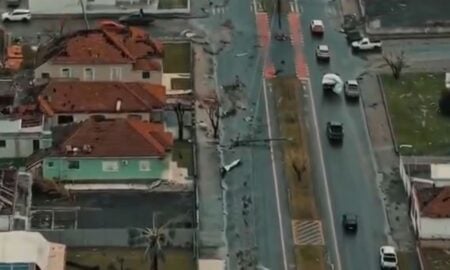
In Iran, air defense systems were activated in the west of the country but failed to prevent damage to missile bases and residential buildings. The state-run IRNA agency reported that densely populated Tehran neighborhoods suffered structural collapses, with women and children among the injured. The governor of East Azerbaijan province, Bahram Sarmast, reported 31 deaths in the region, including 30 military personnel.
Iranian response and threats
Iran, through its Foreign Minister Abbas Araqchi, labeled the Israeli attacks a “declaration of war.” In a statement to the Organization of Islamic Cooperation (OIC), Araqchi called for collective action against Israel, accusing it of violating international law. Iranian military spokesperson Abolfazl Shekarchi vowed that Israel and its allies, including the U.S., “will pay a high price.”
- Potential targets: U.S., French, and British military bases in the region.
- Iranian strategy: use of ballistic missiles and drones to strike urban areas in Israel.
- Threats to civilians: Iran warned Israelis to avoid areas near critical infrastructure.
- Military mobilization: Iranian Armed Forces on maximum alert.
Supreme Leader Ali Khamenei reiterated that Israel “miscalculated” and promised a response demonstrating the “capability and will” of the Iranian people. The belligerent rhetoric heightens fears of an uncontrollable escalation.
International involvement
The international community reacted with concern. UN Secretary-General António Guterres called for an immediate end to hostilities, warning of the risk of a “devastating large-scale conflict.” Gulf countries, such as Saudi Arabia and the United Arab Emirates, condemned the attacks and urged restraint. Russia, an ally of Iran, expressed “deep concern” and is monitoring the situation through its intelligence services.
The United States, which assisted Israel in intercepting Iranian missiles, evacuated non-essential personnel from its embassy in Baghdad. President Donald Trump suggested that the U.S. might become directly involved in the conflict and mentioned Russian President Vladimir Putin as a possible mediator, a proposal analysts consider unlikely due to geopolitical tensions.
Hamas actions and additional fronts
As Israel and Iran exchange attacks, Hamas, an Iran-backed Palestinian group, launched projectiles at southern Israel, triggering sirens in the region. The IDF emphasized that the country faces a “war on multiple fronts,” with simultaneous fighting against Hamas in Gaza and Hezbollah in Lebanon. An Israeli strike in Gaza on Saturday (14) killed dozens in a school used as a shelter, according to the local Health Ministry, further escalating tensions in the Strip.
Israel’s operation against Hamas, launched after the October 7, 2023 attack, has killed over 55,000 in Gaza, according to UN data. The death of Hamas leader Yahya Sinwar in October 2024 weakened the group but did not halt its actions. The simultaneity of conflicts complicates Israel’s military strategy.
Rescue efforts and humanitarian impact
In both countries, emergency teams face challenges accessing affected areas. In Israel, the Magen David Adom service reported difficulties locating victims in rubble in the Tel Aviv metropolitan area. Among the injured, two patients are in critical condition due to shrapnel and smoke inhalation.
In Iran, the Red Crescent reported 55 injured in East Azerbaijan province, including 20 children hit in an attack on a Tehran building. Power outages in parts of the Iranian capital are hindering rescue efforts, and hospitals are overwhelmed.
Risks of a nuclear race
Israel’s attacks on the Natanz complex have reignited fears of a nuclear race in the Middle East. Iran possesses uranium enriched to 60%, close to the level needed for a nuclear bomb, according to the IAEA. The partial destruction of Natanz may delay Iran’s program, but analysts warn that public humiliation could prompt Tehran to accelerate its nuclear efforts.
- Global concerns: nuclear proliferation and regional instability.
- Program history: 2015 nuclear deal undone by Trump in 2018.
- IAEA response: threat to bring the issue to the UN Security Council.
The prospect of a nuclear Iran is seen as an existential threat by Israel, which has conducted covert operations against Iran’s program for years, including the use of the Stuxnet virus in the 2000s.
Regional reactions and diplomacy
The Organization of Islamic Cooperation (OIC) announced it will work with the UN to mobilize support against Israel. OIC Secretary-General Hissein Brahim Taha stressed the need to protect regional stability. Arab countries, such as Jordan and Saudi Arabia, maintain a cautious stance, coexisting with Iran but concerned about escalation.
Iraq, Iran’s neighbor, is trying to avoid being drawn into the conflict. Advisers to Iraqi Prime Minister Mohammed Shia al-Sudani said the government is negotiating with pro-Iran groups to prevent retaliation against U.S. bases in the country. The region’s fragility increases the risk of a broader conflict.
Current military situation
Israel remains on high alert, with tens of thousands of soldiers mobilized. The Israeli Air Force conducted strikes with 200 fighter jets, dropping over 330 munitions on Iranian targets. The Mossad, Israel’s intelligence service, reportedly assisted in identifying targets, including drones launched from Iranian territory.
Iran, meanwhile, intensified its use of drones and ballistic missiles, firing over 100 projectiles at Israel on Sunday (15). Iranian air defenses, though active, sustained significant damage in Israel’s initial attacks, limiting their response capacity.