

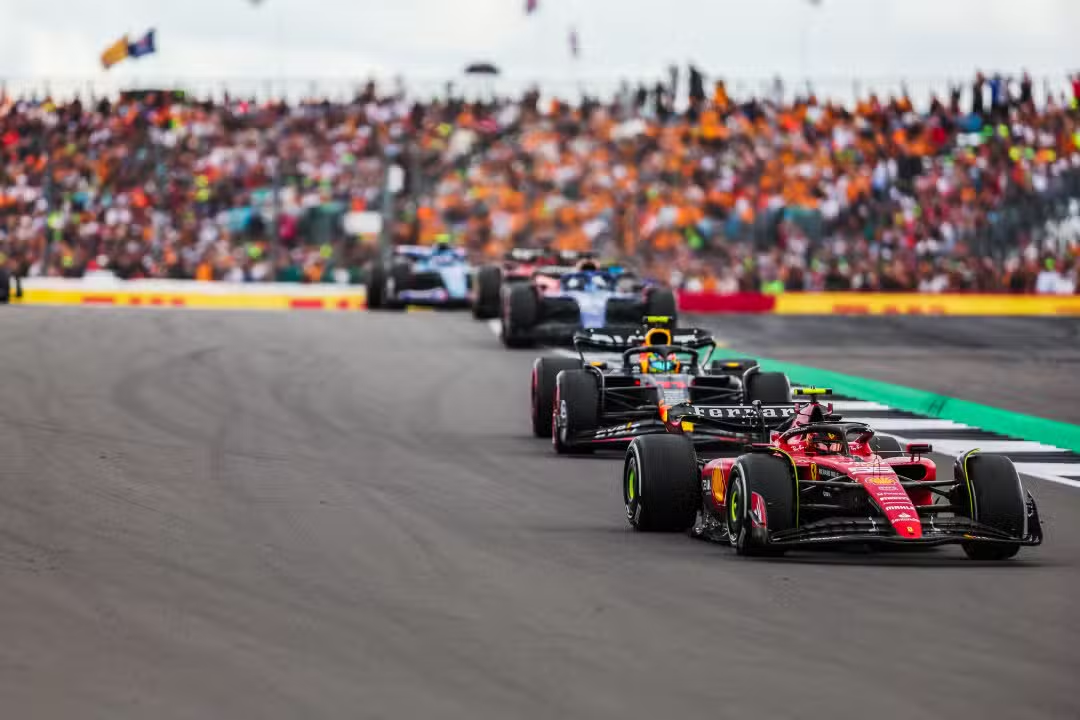
On May 13, 1950, the Silverstone circuit in England made history by hosting the first Formula 1 race, won by Italian Giuseppe Farina of Alfa Romeo. Since then, the British Grand Prix has remained one of the most iconic events in motorsport, present in every season alongside the Italian GP. A stage for unforgettable moments, the race blends tradition, technology, and the passion of millions of fans. The 2025 edition, scheduled for July, promises to uphold the circuit’s relevance, home to legendary drivers like Lewis Hamilton, Ayrton Senna, and Jim Clark. The competition, held on one of the world’s most challenging tracks, embodies the essence of F1.
The Silverstone circuit is not just a historical landmark but also a British motorsport icon. Even before Formula 1’s creation, the track, built on a former World War II airfield, hosted races. Its significance grew over time, becoming synonymous with speed and innovation.
- Key highlights of the British GP:
- First F1 race in history, in 1950.
- Uninterrupted presence in all seasons of the category.
- Nine victories by Lewis Hamilton, the race’s record holder.
- Technical track with legendary corners like Copse and Maggotts.
The British GP’s history is rich in detail, and its evolution mirrors the development of Formula 1 itself. The event continues to draw thousands of spectators who fill Silverstone’s grandstands to celebrate speed.
Origins of a historic milestone
The British GP was born in a post-war rebuilding context, as motorsport sought to establish itself globally. Silverstone, with its unique infrastructure, was chosen as the ideal venue. Giuseppe Farina, driving an Alfa Romeo, crossed the finish line in 1950, marking the start of a new era. The circuit, with its long straights and fast corners, challenged drivers of the time, who raced with rudimentary equipment compared to today’s cars. The track became a symbol of resilience and innovation, adapting over decades to meet F1’s safety and performance demands. In the following years, Silverstone solidified its reputation as one of the world’s most respected circuits.
Silverstone’s selection was no accident. Its central location in England and vast available space allowed for a versatile track layout. The circuit underwent several upgrades but retains features that make it unique, like the Maggotts-Becketts corner sequence, which tests drivers’ skills.
Other circuits in the GP’s history
Silverstone hasn’t always been the sole home of the British GP. Between 1955 and 1962, the Aintree circuit hosted five editions of the race. Also known for horse racing, Aintree brought a unique charm but lacked the infrastructure to continue. Brands Hatch, another British circuit, hosted 14 grands prix between 1964 and 1986. With a more winding layout, Brands Hatch alternated with Silverstone, creating a healthy rivalry. Since 1987, however, Silverstone has reclaimed the spotlight, becoming the event’s exclusive venue.
Aintree and Brands Hatch left significant legacies. Aintree saw Stirling Moss’s victory in 1955, while Brands Hatch hosted wins by drivers like Niki Lauda. Still, Silverstone has always been the heart of the British GP, with its ability to draw large crowds and modern facilities.
Record holders and track legends
Lewis Hamilton dominates the British GP statistics with nine victories, an impressive record that underscores his connection to the circuit. The British heptacampeon won in 2008, 2014, 2015, 2016, 2017, 2019, 2020, 2021, and 2024, showing consistency and adaptability to F1’s changes. Jim Clark and Alain Prost, with five wins each, are the runners-up but lag far behind Hamilton’s feat. Clark, a 1960s icon, shone at Silverstone with his aggressive style, while Prost, dubbed “The Professor,” relied on strategy to triumph.
Brazilian drivers also left their mark. Emerson Fittipaldi won in 1972 and 1975, Ayrton Senna in 1988, and Rubens Barrichello in 2003. Senna and Barrichello’s wins, in particular, are remembered for their performances in the rain, conditions that highlight drivers’ skills at Silverstone.
Memorable moments at Silverstone
Silverstone has hosted races that became F1 history. In 1987, Nigel Mansell pulled off an epic overtake on Nelson Piquet, winning the race and sending the crowd into a frenzy. In 2008, Lewis Hamilton, then in his second season, put on a masterclass in the rain, winning by over a minute. Another standout moment was Rubens Barrichello’s 2003 victory in a chaotic race marked by a track invasion by a spectator.
- Iconic British GP races:
- 1987: Mansell’s overtake on Piquet.
- 2003: Barrichello’s win in a tumultuous race.
- 2008: Hamilton’s dominance in the rain.
- 2020: Race decided by punctured tires on the final lap.
These episodes highlight Silverstone’s unpredictability, where British weather and the technical track often shape the outcome.
Circuit evolution
Silverstone’s layout has undergone numerous changes since 1950. Initially, the track was simpler, with fewer corners and basic barriers. As F1 advanced, the circuit was modernized to enhance safety and spectacle. In 2010, a new section called Arena was added, lengthening the track and creating more overtaking opportunities. Upgrades also included fan areas, such as larger grandstands and entertainment zones.
Silverstone’s infrastructure today is among the most advanced in the calendar. The circuit hosts not only F1 but also other categories like MotoGP and endurance racing. Its ability to reinvent itself ensures its relevance in a sport that demands constant evolution.
Brazilian presence at the British GP
Brazilian drivers have played a special role at Silverstone. Emerson Fittipaldi, a two-time world champion, won in 1972 with Lotus and in 1975 with McLaren, showcasing versatility. Ayrton Senna, in 1988, dominated the rain-soaked race, cementing his reputation as a master in adverse conditions. Rubens Barrichello, in 2003, capitalized on a chaotic race to secure his first Ferrari victory.
- Brazilian winners at Silverstone:
- Emerson Fittipaldi: 1972 and 1975.
- Ayrton Senna: 1988.
- Rubens Barrichello: 2003.
These victories are cherished by Brazilian fans, who see Silverstone as a stage where their idols shone.
The British GP in 2025
The 2025 British GP is scheduled for July 6, as part of Formula 1’s 24-race calendar. Silverstone will be the 12th round of the season, which includes the São Paulo GP in November. The race is expected to draw thousands of spectators, with sold-out crowds anticipated. New technologies, such as more sustainable cars and improved tires, will likely shape the competition, which also celebrates the event’s 75th anniversary.
The GP’s organizers have announced enhancements to the fan experience, including interactive areas and music performances. The race will be broadcast globally, reinforcing Silverstone’s importance in the sporting world.
British GP curiosities
The British GP boasts facts that go beyond racing. Silverstone was built on a former military airfield, and some corners, like Stowe and Club, are named after nearby landmarks. The race is also known for its unpredictable weather, with rain often altering race outcomes.
- Interesting facts about Silverstone:
- Origin: Former World War II airfield.
- Capacity: Up to 150,000 spectators per day.
- Weather: Rain has affected over 30% of editions.
- Most famous corner: Maggotts-Becketts, challenging and technical.
These tidbits help explain why the British GP is so beloved by fans.
Silverstone’s legacy in motorsport
Silverstone is not just the British GP’s home but also a hub for motorsport development. The circuit hosts F1 teams like Mercedes, with nearby bases. It’s also used for testing and promotional events, underscoring its importance to the category. Britain’s motorsport tradition, with drivers like Hamilton and Clark, is deeply tied to Silverstone.
The circuit continues to inspire new generations of drivers and engineers. Its history, combined with its capacity for innovation, ensures the British GP remains one of the sport’s most prestigious events.