Downdetector: Vivo outage affects thousands of DNS problems in São Paulo and other regions; 10,000 complaints in 30 minutes Por Luís Henrique Costa
7 min de leitura
 |
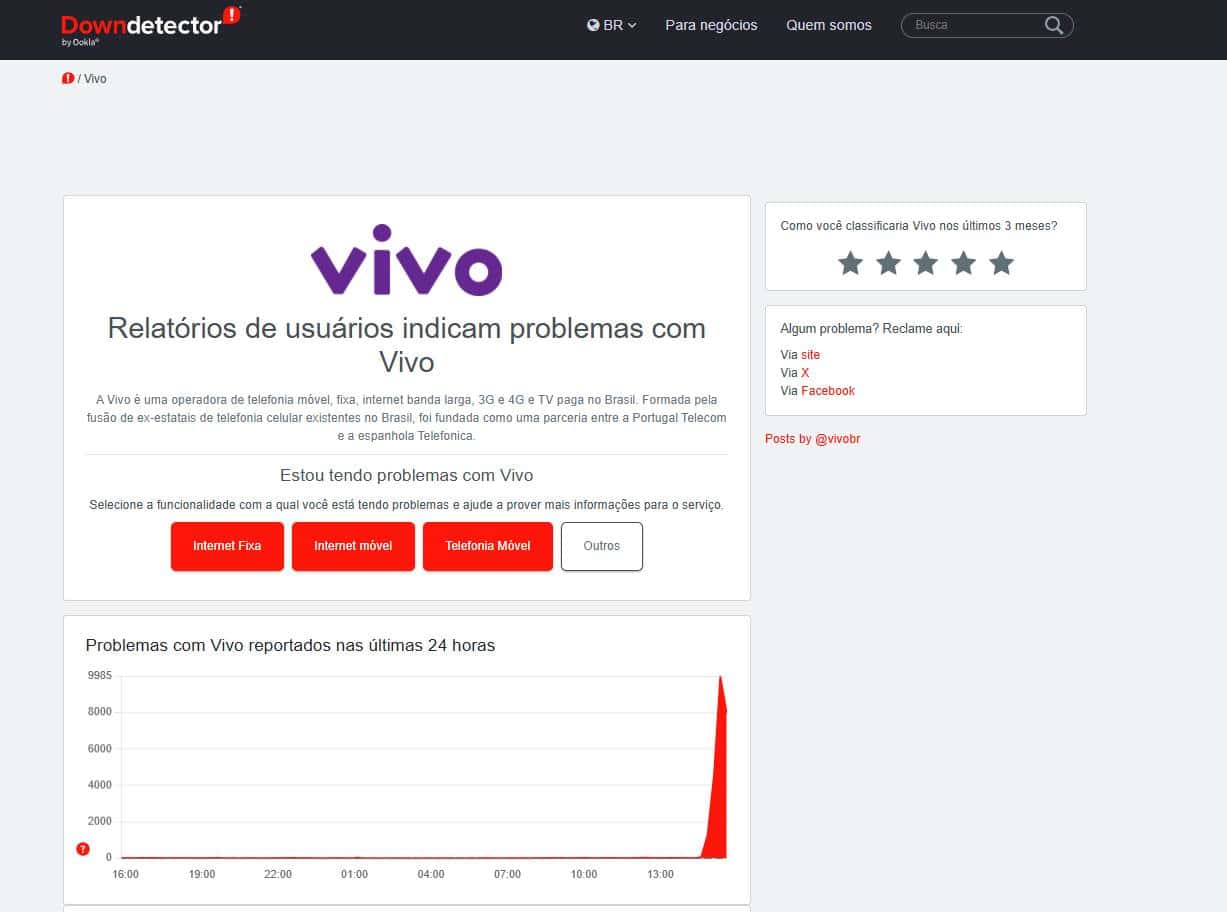
Thousands of Vivo users in various Brazilian cities, including São Paulo, Curitiba, Florianópolis, and Recife, faced connectivity issues on the afternoon of August 6, 2025, with over 10,000 reports of failures logged in less than 30 minutes on Downdetector. The instability primarily affected fixed internet (78% of complaints), followed by mobile internet (17%) and mobile telephony (6%). Reports highlighted difficulties accessing websites and apps, with DNS errors being the main cited cause. The operator’s support, both via phone and app, was also inaccessible, causing frustration among customers. The outage impacted everyone from remote workers to essential services, underscoring the reliance on stable connections. Vivo, controlled by Telefônica Brasil, has not yet issued an official statement on the cause or expected resolution, while users turn to alternatives like switching to Google or Cloudflare DNS.
The outage, which began around 2 p.m., spread quickly across regions, with the highest concentration of complaints in densely populated urban areas. Users reported that the instability disrupted access to critical platforms like Google, Slack, and social media, affecting productivity in remote work settings.
- Key affected cities: São Paulo, Curitiba, Campinas, Rio de Janeiro, Brasília, Porto Alegre, Belo Horizonte, Fortaleza, Florianópolis, and Recife.
- Type of issue: Predominantly fixed internet failures, with DNS errors and unstable access to sites and apps.
- User reactions: Frustration with the lack of technical support and issues accessing Vivo’s official app.
Technical cause behind the instability
The instability reported by Vivo users appears linked to failures in DNS (Domain Name System) servers, which translate website addresses into accessible IPs. Several reports indicate that switching from Vivo’s default DNS to alternatives like Google DNS (8.8.8.8) or Cloudflare (1.1.1.1) temporarily resolved the issue for some users. However, this solution requires technical knowledge, limiting its accessibility.
The failure may stem from an overload on the operator’s servers, particularly in high-demand areas like São Paulo, Brazil’s largest economic hub. Another possibility is unannounced maintenance on fiber optic cables, as suggested by a user in São José dos Campos who observed Vivo technicians working in the area. Similar issues occurred in 2025, with prolonged outages in cities like Fortaleza and São Luís in July, raising concerns about the operator’s infrastructure reliability.
- Possible causes: DNS server errors, traffic overload, or unannounced maintenance.
- Temporary solution: Manually switching DNS settings on routers or devices.
- Recent history: Outages in Fortaleza, São Luís, and Caruaru in July 2025, lasting up to 48 hours.
User backlash
The disruption in Vivo’s services triggered a wave of complaints on social media, with users expressing dissatisfaction over the operator’s lack of communication. In São Paulo, reports noted that the issue affected access to streaming apps and remote work tools like Google Meet and Slack. In Curitiba, fixed internet was completely offline, while in Florianópolis, users reported issues with both fixed internet and 5G, except for WhatsApp, which remained functional for some.
The lack of effective support worsened the situation. Many customers attempted to contact Vivo via phone or app but faced unanswered calls or system errors. Vivo, which holds a significant share of Brazil’s fixed and mobile internet market with 95% national coverage, faces criticism for recurring failures in 2025.
- Main complaints: Lack of support access, prolonged instability, and impact on professional activities.
- Critical regions: Urban areas with high population density, such as São Paulo and Rio de Janeiro.
- User workarounds: Using VPNs or switching DNS to bypass the issue.
Operator’s history of issues
Vivo has faced similar episodes throughout 2025, raising questions about its infrastructure’s ability to handle growing data demands. In July, cities like Fortaleza, São Luís, and Caruaru experienced prolonged outages, with some areas offline for up to 48 hours. These incidents exposed network vulnerabilities, especially during peak traffic hours, such as business hours.
The operator, which operates 2G, 3G, 4G, and 5G technologies, is a market leader in Brazil but risks reputational damage due to repeated failures. In São Paulo, where Vivo dominates the fixed internet market, the instability has a significant impact due to businesses and remote workers’ reliance on connectivity.
- Previous incidents: Outages in Fortaleza (July, 48 hours), São Luís (July, 48 hours), and Niterói (July).
- High-impact areas: Urban regions with heavy data demand, like capitals and industrial cities.
- User expectations: Official statement from Vivo with clarifications and resolution timelines.
Adopted solutions and workarounds
Users with technical expertise mitigated issues by changing DNS settings on their routers or devices. Using services like Google DNS or Cloudflare was widely shared on forums and social media as a temporary fix. However, most customers, lacking such knowledge, remained disconnected, relying on the operator for updates.
In some regions, like Atibaia (SP), users switched to other providers, such as Claro, seeking greater stability. Vivo has not disclosed details about the cause of the failure or its efforts to restore service, fueling dissatisfaction.
- Technical solution: Switching default DNS to alternatives like 8.8.8.8 (Google) or 1.1.1.1 (Cloudflare).
- Impact on competitors: Reports of users migrating to Claro in some cities.
- Demand for transparency: Customers call for an official statement and clear timelines.
Scenario in major urban centers
In São Paulo, the outage heavily impacted densely populated neighborhoods like Brooklin and Cursino, where Vivo Fibra experienced total instability. The capital, Vivo’s largest market, recorded the highest volume of complaints, with 78% related to fixed internet. In cities like Recife and Florianópolis, the instability also disrupted access to essential services, with reports of issues accessing remote work platforms. The lack of immediate support from Vivo heightened frustration, with users turning to social media for tips and complaints.
- Hardest-hit areas in São Paulo: Brooklin, Cursino, São Bernardo do Campo.
- Impact in Recife: Instability starting at 3 p.m., affecting access to sites and apps.
- Florianópolis: Failures in fixed and 5G mobile internet, with some apps spared.
Potential economic and social impacts
The disruption in Vivo’s services caused significant inconvenience at a time when connectivity is critical for remote work, online education, and digital services. In São Paulo, companies relying on tools like Google Meet and Slack faced operational challenges, while students reported issues attending virtual classes. The outage also highlighted vulnerabilities in essential services like telemedicine and app-based deliveries, which depend on stable internet.
The absence of an official statement from Vivo keeps users in the dark, increasing pressure for swift solutions. The operator, already criticized for prior outages, must act to prevent damage to its image in a competitive market.
- Affected sectors: Remote work, online education, telemedicine, app-based deliveries.
- Pressure on Vivo: Need for a rapid response to avoid customer loss.
- Temporary fixes: Use of VPNs and DNS changes as stopgap measures.